
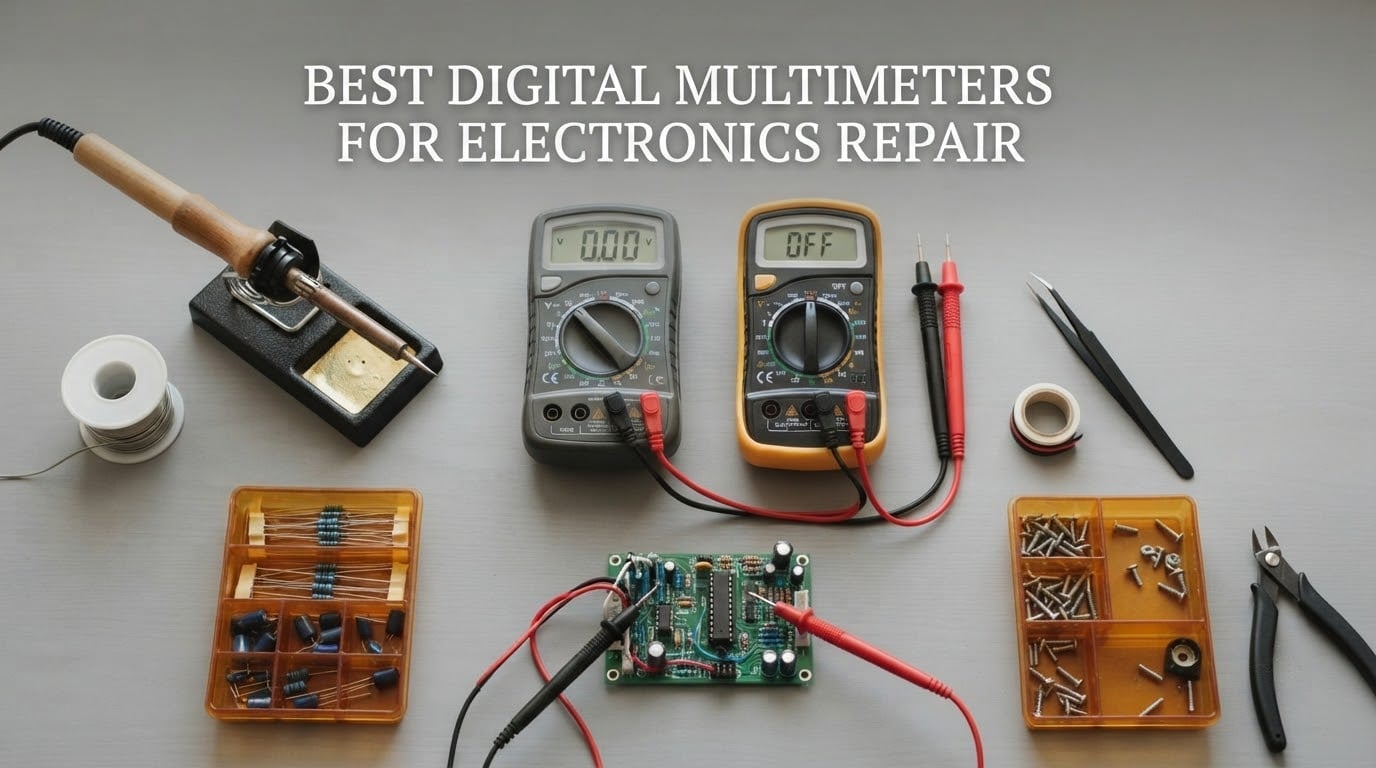
A dead board rarely tells you what is wrong with it. You get a symptom instead: a handheld console that will not charge, a laptop whose fan spins but whose screen stays black, an amplifier with a hum that will not go away. The meter is what turns that symptom into a number, and a number is the only thing that separates a ten-minute fix from a weekend.
That is the filter we used for this roundup of the best digital multimeters for electronics repair. Not the flattest specification sheet, not the biggest brand name, but the meters that do the specific jobs a circuit board throws at you: chasing a shorted trace, reading a diode forward drop across a dense SMD pad, confirming a 3.3V rail that looks fine and is not, and telling a good capacitor from a leaky one without an oscilloscope on the bench.
Our three headline picks are the AstroAI 6000-count True RMS meter, which carries the strongest combination of feature coverage and owner history in the group, the Fluke 17B+, which is the accuracy reference other meters get checked against, and the Klein Tools MM420, whose lead-alert jacks and accessible fuses remove two of the most common ways to get a bad reading. Everything else falls into a clear slot further down, and the buying guide explains how to match a meter to your actual work.
Last tested September 2026. We weighted the accuracy spec quoted as a percentage plus counts, disclosed true RMS behaviour on non-sinusoidal signals, fused versus unfused current inputs, the CAT rating and the environment it is valid for, probe quality as part of the package, and durability reported over years rather than weeks. Prices change constantly, so we have left them out entirely and pointed you at the check buttons instead.
Table of Contents
Top 3 Picks for Electronics Repair in 2026

AstroAI 6000-Count True RMS
- True RMS AC and current
- Capacitance for board checks
- Fast continuity beep
- Magnetic back mount

Fluke 17B+ Multimeter
- Most complete function set
- Temperature to 400C
- Frequency and capacitance
- CAT III 600V

Klein Tools MM420
- Lead-alert jack LEDs
- True RMS auto-ranging
- 2 metre drop rating
- Accessible ceramic fuses
The AstroAI 6000-count sits at number one because it does the widest spread of board-level work in a single body: true RMS on AC voltage and current, a capacitance range that reviewers have verified well beyond the manufacturer claim, a continuity beep fast enough to make trace chasing bearable, and a magnetic back mount that frees up both hands inside a chassis. The Fluke 17B+ is the one to buy when you want a number you can trust to the last digit, and it is the meter other people in this list get compared against. The Klein MM420 is the one that keeps beginners out of trouble.
Best Digital Multimeters for Electronics Repair in October
| Product | Specifications | Action |
|---|---|---|
| AstroAI 6000-Count True RMS |
|
Check Latest Price |
| Fluke 17B+ |
|
Check Latest Price |
| Klein Tools MM420 |
|
Check Latest Price |
 FNIRSI DMT-99 FNIRSI DMT-99 |
|
Check Latest Price |
 KAIWEETS HT118A KAIWEETS HT118A |
|
Check Latest Price |
 Crenova MS8233D Crenova MS8233D |
|
Check Latest Price |
 Thsinde 43180-66526 Thsinde 43180-66526 |
|
Check Latest Price |
 AstroAI DM130B AstroAI DM130B |
|
Check Latest Price |
 Hioki 3244-60 Hioki 3244-60 |
|
Check Latest Price |
 AstroAI AM33D AstroAI AM33D |
|
Check Latest Price |
 TESTSMEN TM-510 TESTSMEN TM-510 |
|
Check Latest Price |
 Fluke 15B+ Fluke 15B+ |
|
Check Latest Price |
1. AstroAI 6000-Count True RMS – Best Overall for Board-Level Repair
AstroAI Digital Multimeter, True RMS 6000 Counts Auto-Ranging Volt Meter for Automotive & Home Electrical Troubleshooting, AC/DC Voltage Current Resistance Continuity Capacitance Temperature Tester
True RMS AC/DC
6000 counts
Capacitance to tens of thousands of uF
1000V DC maximum
Pros
- True RMS on AC voltage and AC current
- Capacitance range verified accurate well beyond the manufacturer claim
- Fast continuity beep for trace chasing
- Magnetic back mount for hands-free work
- Large backlit display with kickstand and data hold
Cons
- Frequency counter tops out far below the advertised figure and needs a near 5V signal
- Transistor hFE socket reads low and is awkward on TO-220 parts
- Backlight shuts off quickly with no way to keep it on
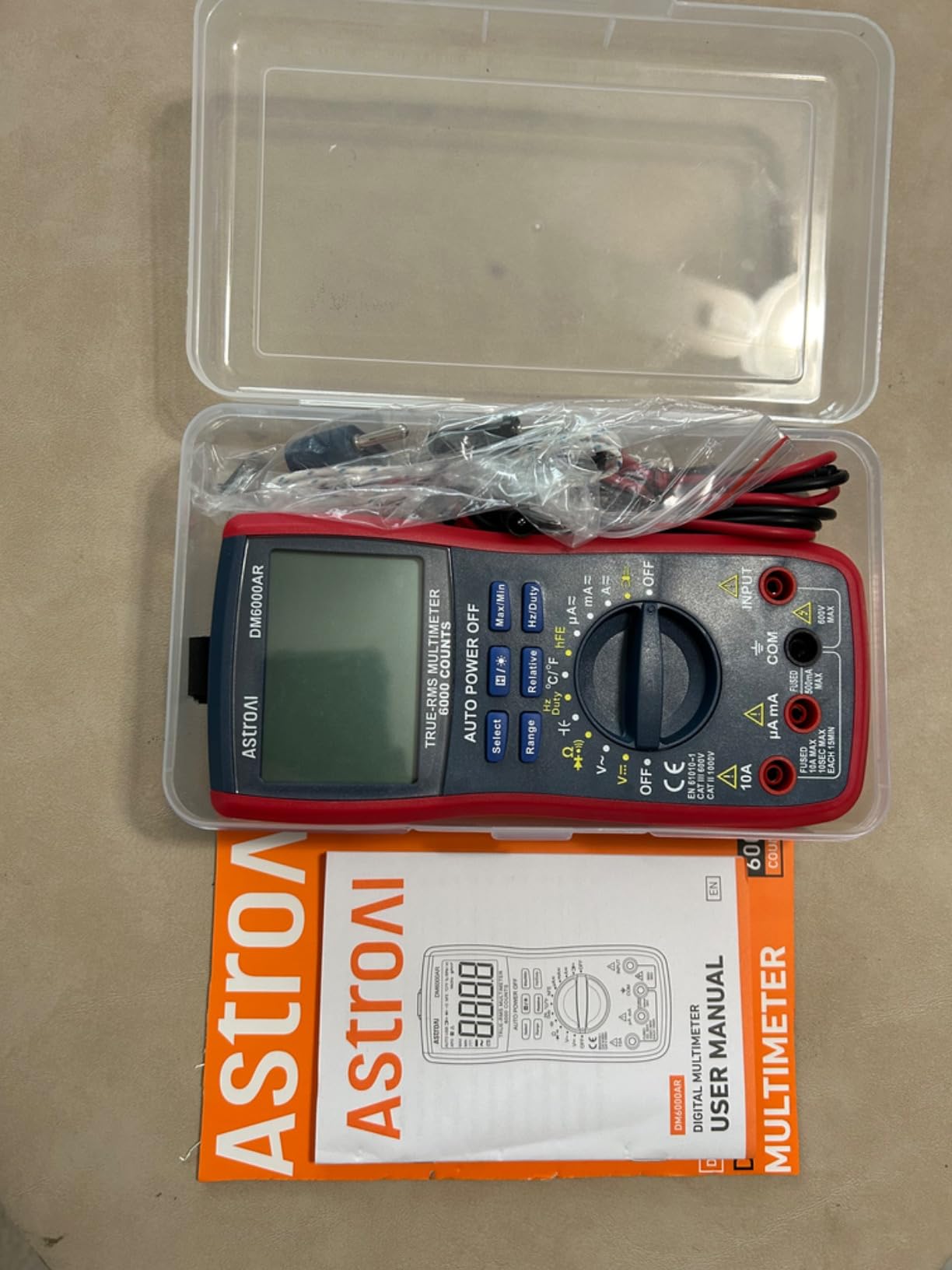
This is the meter we keep reaching for first. It is a blue 6000-count autoranging body measuring 7.48 by 3.54 by 1.38 inches and weighing 492 g, and everything on the dial is something a repair bench actually uses. AC and DC voltage, AC and DC current, resistance, capacitance, frequency, duty cycle, diode, continuity and temperature all live in one unit.
True RMS on both AC voltage and AC current is the headline for anyone chasing switch-mode power supplies, because an average-responding meter will read low on a chopped waveform and send you looking for a fault that is not there. Reviewers running power supply, console and tube amplifier work rate it for exactly that, and one detailed laboratory check confirmed DC and AC RMS, resistance, current and diode accuracy against an Amprobe AM-570 that costs several times more.
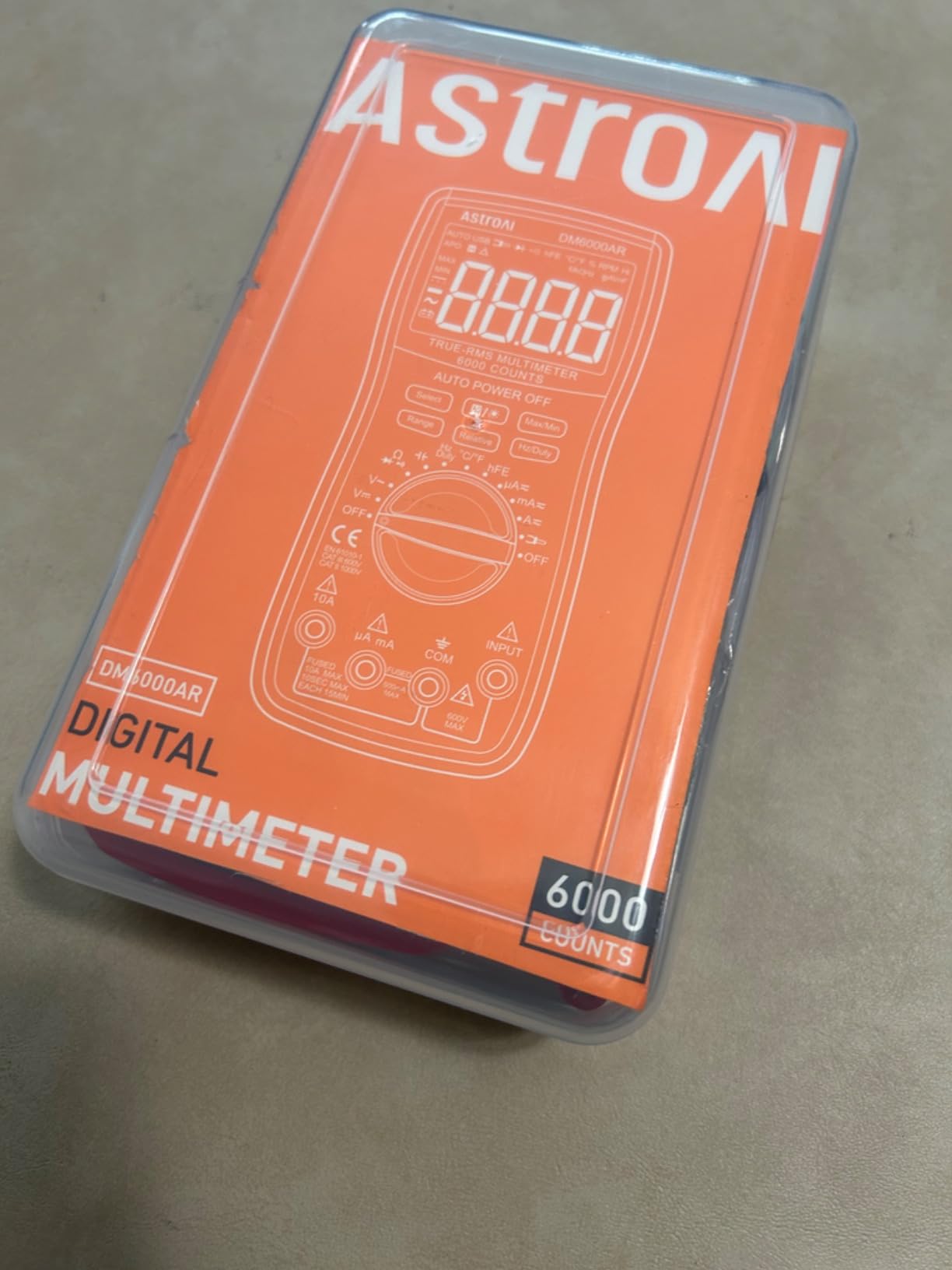
The capacitance range is the second reason it wins. Owners report measuring well past the manufacturer claim into the tens of thousands of microfarads, with results that matched the dearer reference closely. That matters when you are deciding whether a swollen electrolytic on a board rail is the problem or a bystander, and in-circuit capacitance readings are always approximate, so having a generous range limits how much of your circuit you have to desolder to get a trustworthy number.
The fast continuity beep is unglamorous and it is the third reason. Three samples per second across a dense board turns a two-hour trace chase into a coffee break, and the magnetic back mount lets you hang the meter inside a chassis while both hands stay on the probe tips.
Two caveats are worth knowing before you commit. The frequency counter is honest but modest: it tops out near 16MHz rather than the 60MHz the packaging implies, and it wants a signal close to 5V to lock on, so it is a bench confirmation tool rather than a scope substitute. And the included multi-function transistor adapter is wired C-B-E, which means the hFE reading comes out around half the real gain and sits awkwardly on TO-220 packages. Treat the socket as rough screening, not a device test.
When this meter earns its place on your bench
It is the right default for board-level work: verifying power rails, confirming a diode or LED forward drop, checking a suspect capacitor, and mapping a short to ground by watching the resistance reading fall as you move the probe. If you repair consoles, laptops, amplifiers or LED drivers, this is the one we would hand you first.
Its 1000V DC ceiling and ceramic fuse protection also mean it can handle the mains side of a power supply when you are comfortable working there, and the temperature function covers heatsink and thermal fault checks without a separate probe purchase.
When to pick a different meter instead
Do not rely on it for accurate transistor gain testing, and do not expect the frequency counter to tell you anything about a fast switching waveform. If your work is mostly microamp sleep-current measurement, insulation testing or true reference-grade voltage accuracy, the Hioki, an external current shunt setup or a Fluke will serve you better.
2. Fluke 17B+ – Best for Reference-Grade Accuracy
Fluke 17B+ Digital Multimeter, for Electrical Applications, Measures AC/DC Voltage 1000V, Current Measurements to 10A, Resistance, Continuity, Diode, Capacitance, Frequency, and Temperature Testing
Full professional function set
Temperature to 400C
AC/DC voltage to 1000V
CAT III 600V
Pros
- Most complete measurement set in the group
- Frequency and temperature included with type-K thermocouple
- Large backlit display with fast response
- Solid build that suits fine board repair
- Serial registration activates the manufacturer warranty
Cons
- Highest price in the roundup
- Battery compartment can require a screwdriver to open
- Frequency and temperature are wasted spend if you only work on low-voltage DC
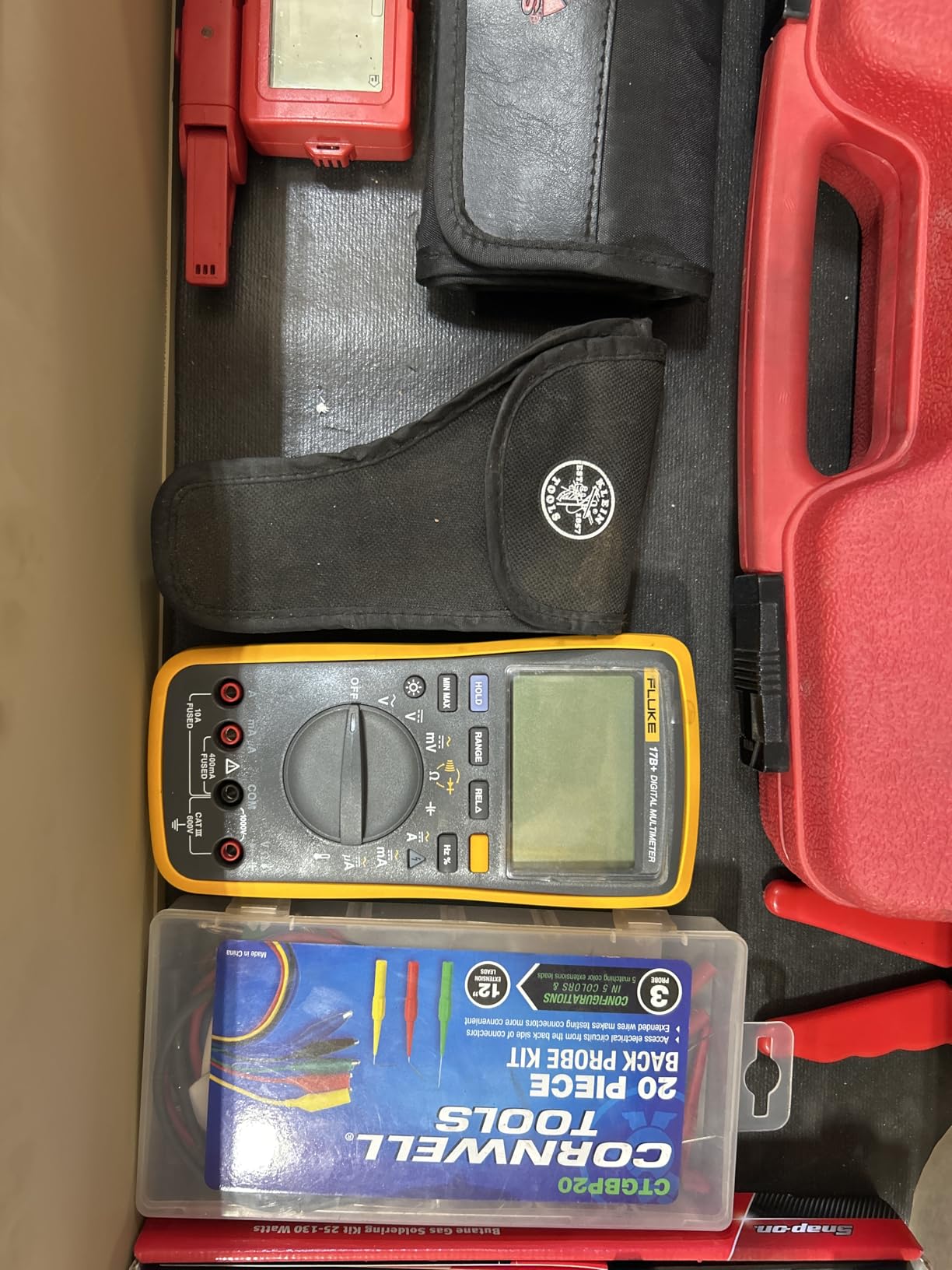
The 17B+ is the meter people buy to check their other meters. It carries a 4.8 rating from 1,030 reviews with 90 percent five-star, the highest five-star share of anything we analysed, and electronics-bench owners document cross-checks against a Fluke-adjacent lab standard that returned identical resistance readings and within 0.005V on a 10.000V laboratory supply reference.
Function-wise it is the most complete meter here. AC and DC voltage to 1000V, AC and DC current to 10A, resistance, continuity, diode, capacitance, frequency, and temperature to 400C with the type-K thermocouple included in the box. There is no hunting through menus to find the mode you need; the dial is where you expect it to be.
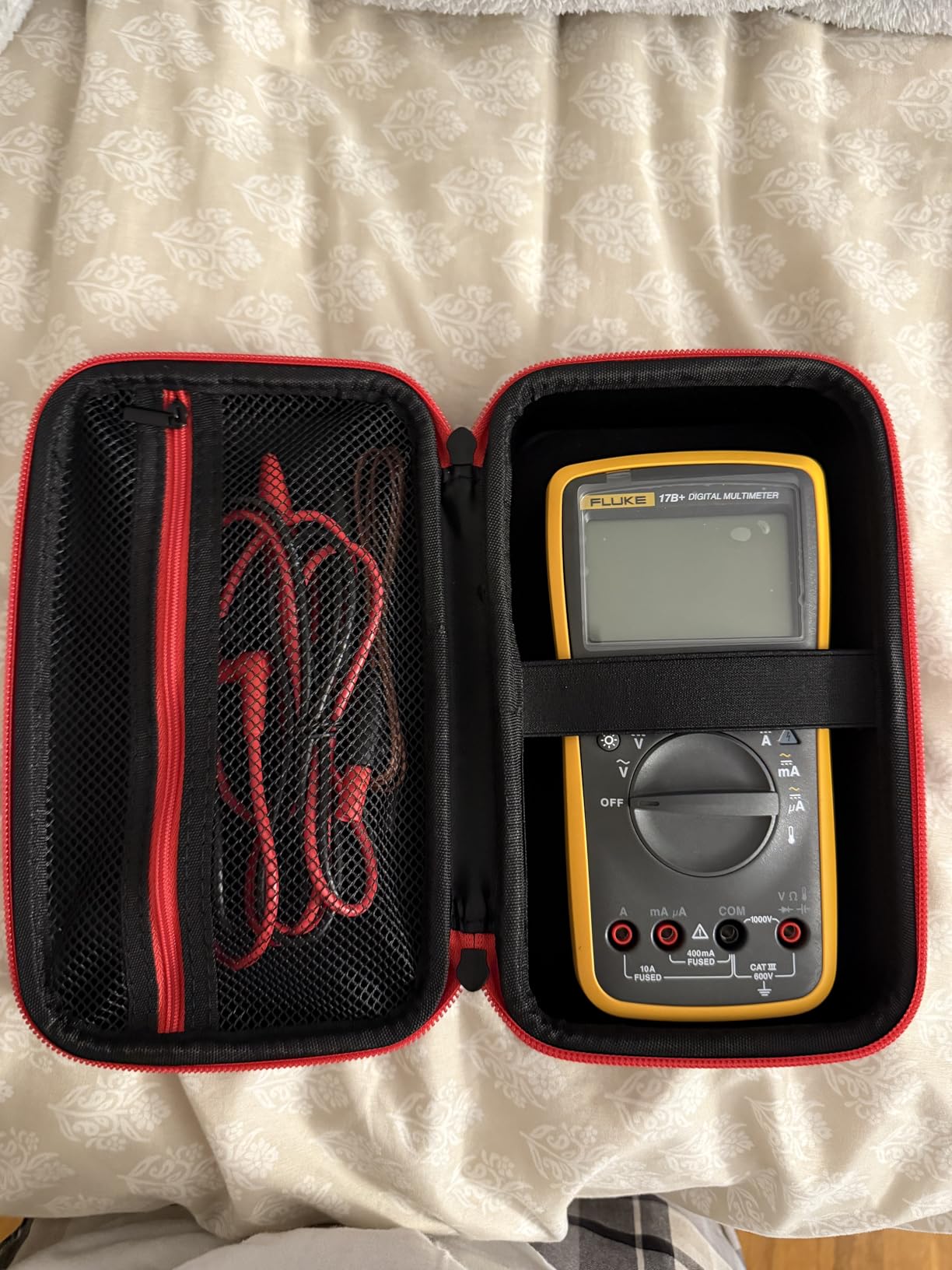
For electronics work specifically, the large backlit display with quick response is more useful than it first appears. When you are nose-down over a board with a probe in each hand and a solder joint barely visible, big high-contrast digits and a fast refresh beat a clever interface every time. Owners doing microsoldering and boardview-guided debugging call this out directly.
It is also a common second purchase. Once a bench has a primary meter that lives in a drawer, a second one that stays out on the mat is a genuine productivity gain, and the 17B+ is frequently bought in exactly that role.
The honest objection is cost, and it is the single most common reservation in the reviews. The second is that you are paying for temperature and frequency whether you use them or not. If your work is purely low-voltage DC board repair, the Fluke 15B+ below covers the core set for noticeably less money, and one reviewer made exactly that trade deliberately.
When this meter earns its place on your bench
Buy it when the number has to be right the first time, when you are chasing a rail that reads 4.98V instead of 5.00V and the difference matters, or when you want one instrument you can use to validate a whole bench. Temperature opens up thermal debugging that a cheaper meter cannot do at all.
It is also the safe pick for anyone who works across both electronics and electrical installations, because the CAT III 600V certification and the certification marks on the body are the reason nobody argues with the reading.
When to pick a different meter instead
Skip it if you only ever probe low-voltage DC boards and would never use the thermocouple or the frequency function. Skip it if your real gap is capacitance range, microamp resolution or leakage measurement, because no amount of brand reputation fills in a missing function.
3. Klein Tools MM420 – Best for Lead Safety and Job-Site Durability
Klein Tools MM420 Digital Multimeter, Auto-Ranging TRMS Multimeter, 600V AC/DC Voltage, 10A AC/DC Current, 50 MOhms Resistance
True RMS auto-ranging
600V AC/DC
10A current
50 MOhms resistance
Pros
- Lead-alert LEDs illuminate to confirm correct jack placement
- Drop-tested to 6.6 feet with accessible ceramic fuses
- No jack swap needed for mA measurements
- Temperature
- capacitance and duty cycle included
- Backlit display with lead holders and kickstand
Cons
- 600V ceiling is below the 1000V-rated meters
- One voltage position serves AC and DC and defaults to AC
- Backlight auto-off cannot be disabled
- AAA cells and a screw-secured battery door are poor for field work
The MM420 has the highest average rating in the group at 4.7 from 750 reviews, with 84 percent five-star, and the reason is a single design decision that the rest of the industry copied: LEDs at the input jacks that light up to show you have put the leads in the right place. A wrong-jack measurement is the number one self-inflicted error in electronics repair, and this meter makes it nearly impossible.
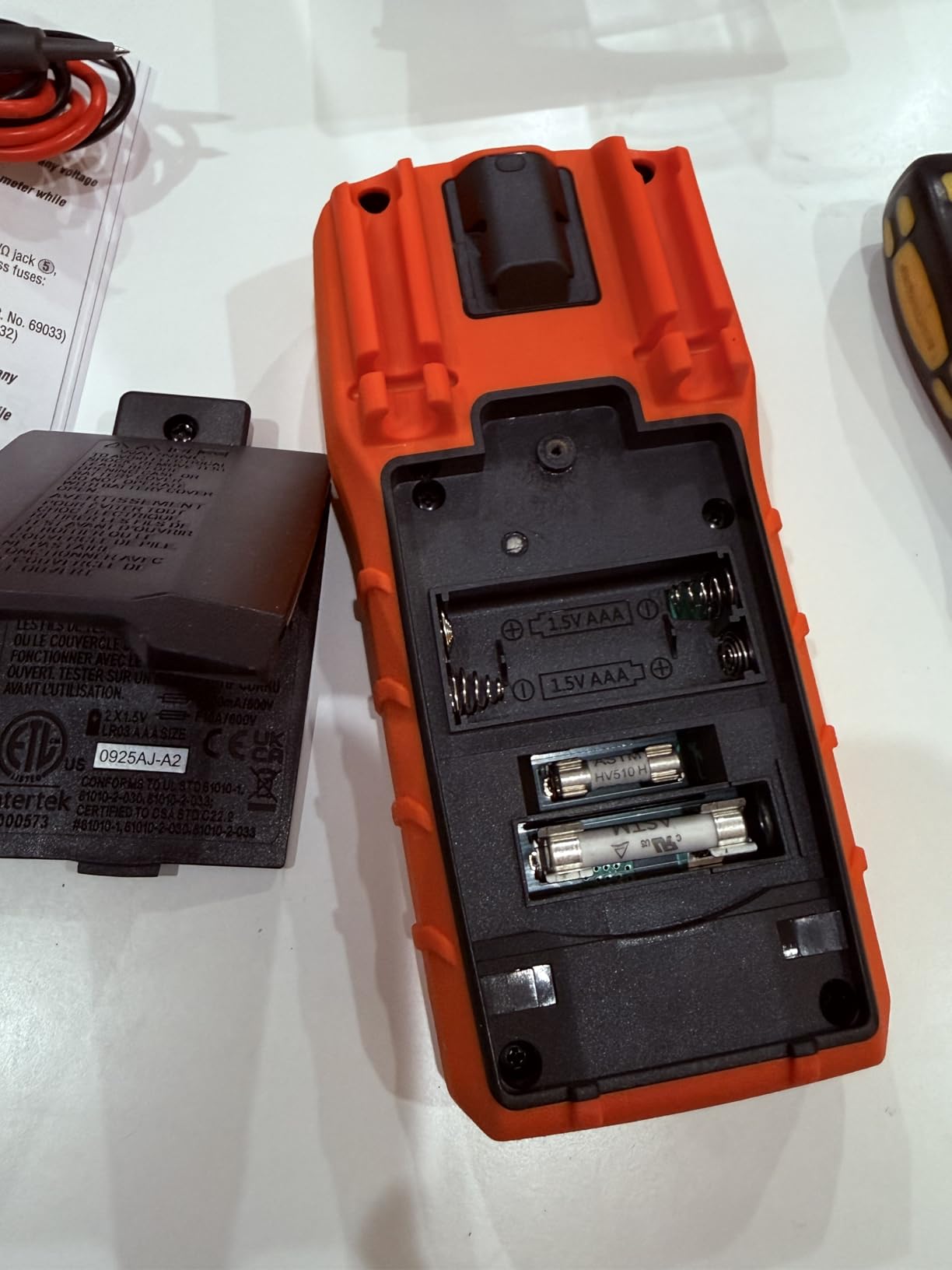
Everything else follows the same logic of removing mistakes rather than adding features. The mA input does not require a lead swap, so you are not juggling probes mid-diagnosis. The fuses are ceramic types and they live in the battery compartment rather than behind a separate panel, so a blown fuse is a five-minute fix instead of a trip to the shop. The body is drop-tested to 6.6 feet, which is the difference between a meter that survives a bench drop and one that does not.
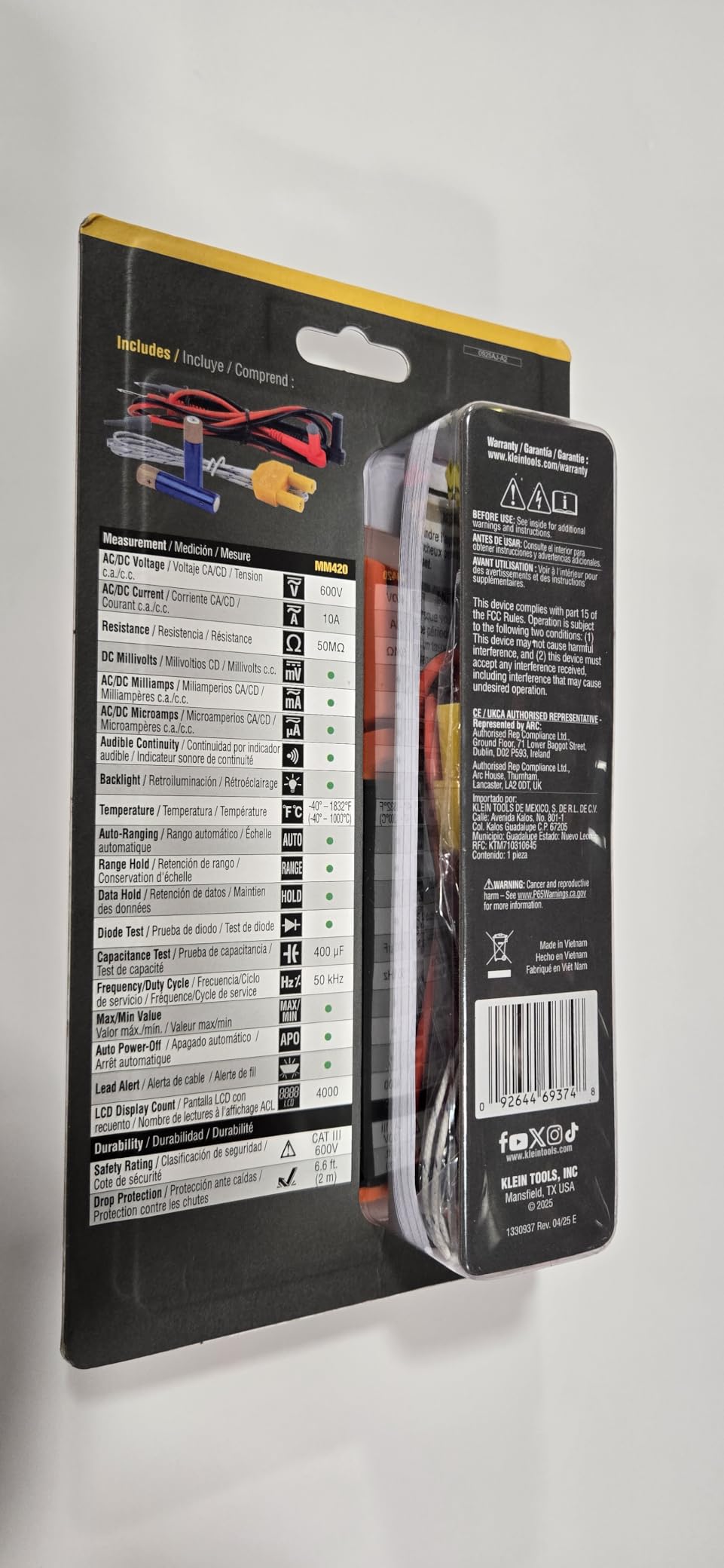
On the measurement side it is a genuine True RMS auto-ranger covering 600V AC and DC voltage, 10A AC and DC current and 50 MOhms resistance, plus continuity, temperature, capacitance, frequency, duty cycle and diode test. Several owners who already own a professional meter describe it as their everyday go-to precisely because it carries more functions than anything else in their kit.
There are design compromises to know about. The 600V ceiling sits below the 1000V-rated meters here, which matters if you work on switch-mode supplies with higher primary rails. A single voltage position serves both AC and DC and starts in AC, so you press the function key every time. And the backlight times out and cannot be switched off, which is annoying on a dim board.
Two smaller gripes appear repeatedly: the AAA cells and the screw-secured battery door are a poor combination for a meter that is meant to be carried around, and an occasional delivery has arrived without the described case. None of these are deal breakers, but they are worth knowing.
When this meter earns its place on your bench
It is the first meter we would hand a beginner, because the mistakes that waste beginners’ time are exactly the ones the hardware prevents. It is also the meter to carry between a van and a bench, given the drop rating and the accessible fuses.
Technicians who work across electrical and electronics repair will find the temperature, capacitance and duty cycle functions unusually useful for the money, and the lead-alert LEDs stay valuable even after you have measured ten thousand readings.
When to pick a different meter instead
Choose something else if you routinely work above 600V, if you need a thin body to probe inside crowded connectors, or if you want capacitance range beyond the basic board-check level. It is also not the meter for a high-contrast display-heavy workflow, since the backlight cannot be pinned on.
4. FNIRSI DMT-99 – Best for Ripple, Waveform and Intermittent Faults
FNIRSI DMT-99 Digital Multimeter 9999 Counts TRMS, Rechargeable Volt Meter
9999-count true RMS
2.4 inch colour TFT
1500mAh rechargeable cell
Graphic waveform view
Pros
- Highest display count among mid-priced meters
- Graphic waveform view plots ripple and transient spikes
- Threshold monitoring alarms for intermittent faults
- Rechargeable lithium cell with Type-C charging
- Fine-point leads sized for SMD and dense boards
Cons
- Colour screen drains the battery faster than a plain LCD
- Menus and monitoring modes add a learning curve
- Bulkier than a card meter for cramped enclosures
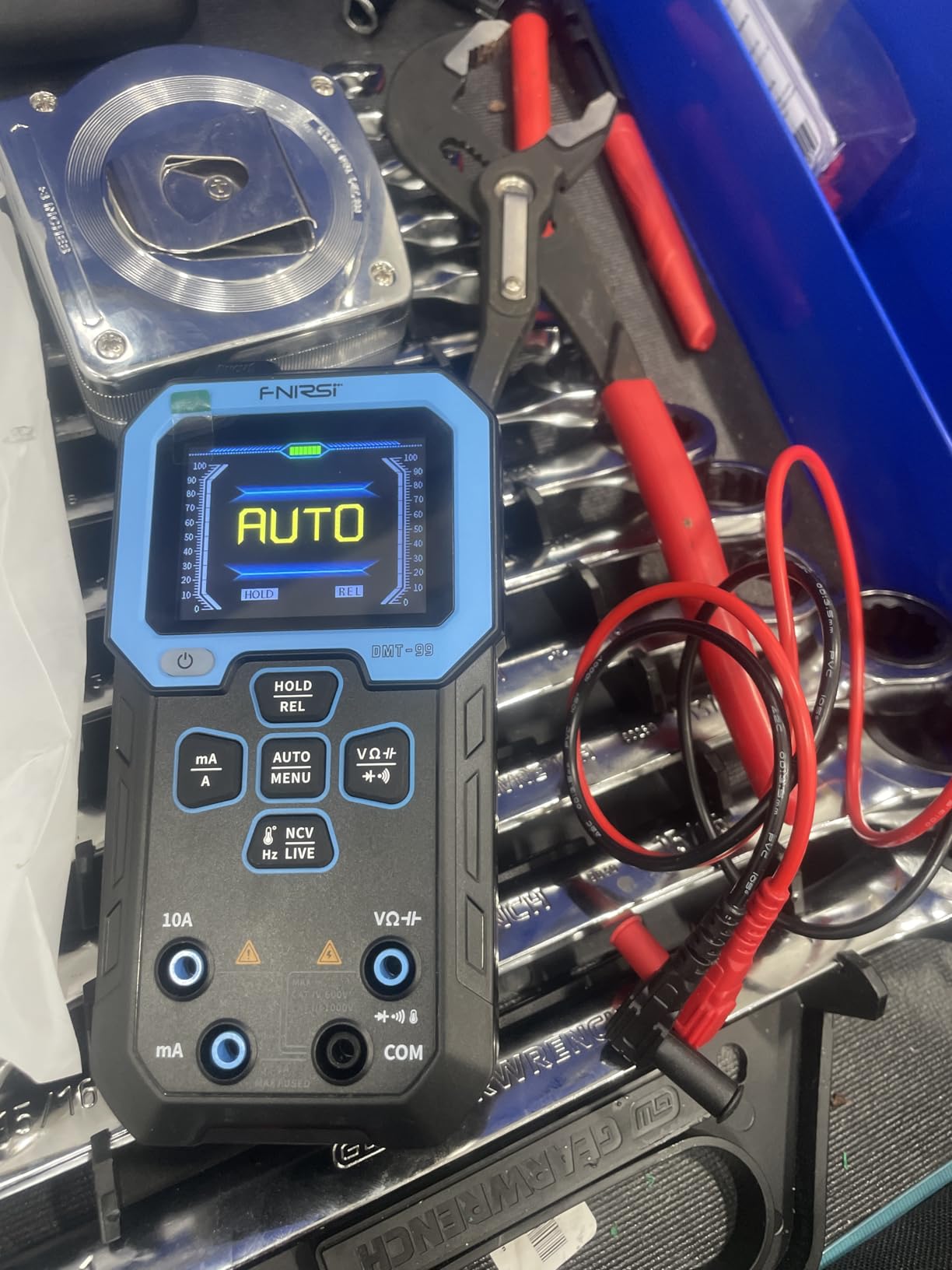
The DMT-99 is the only meter in this group that draws a picture. Its 9999-count true RMS display is the highest count available in this class, and the 2.4-inch HD colour TFT screen will plot a live waveform view so ripple and transient spikes on a supply rail are visible rather than averaged away. It also has a threshold-triggered monitoring mode that alarms when a reading crosses limits, which is aimed squarely at faults that only appear when you wiggle the ribbon cable.
It runs on a built-in 1500mAh rechargeable lithium battery with Type-C charging, so there are no disposable cells to leak inside a meter that will live on a bench for years. That is a quiet but real reliability win, and it is why the meter makes sense for field and mobile repair work.
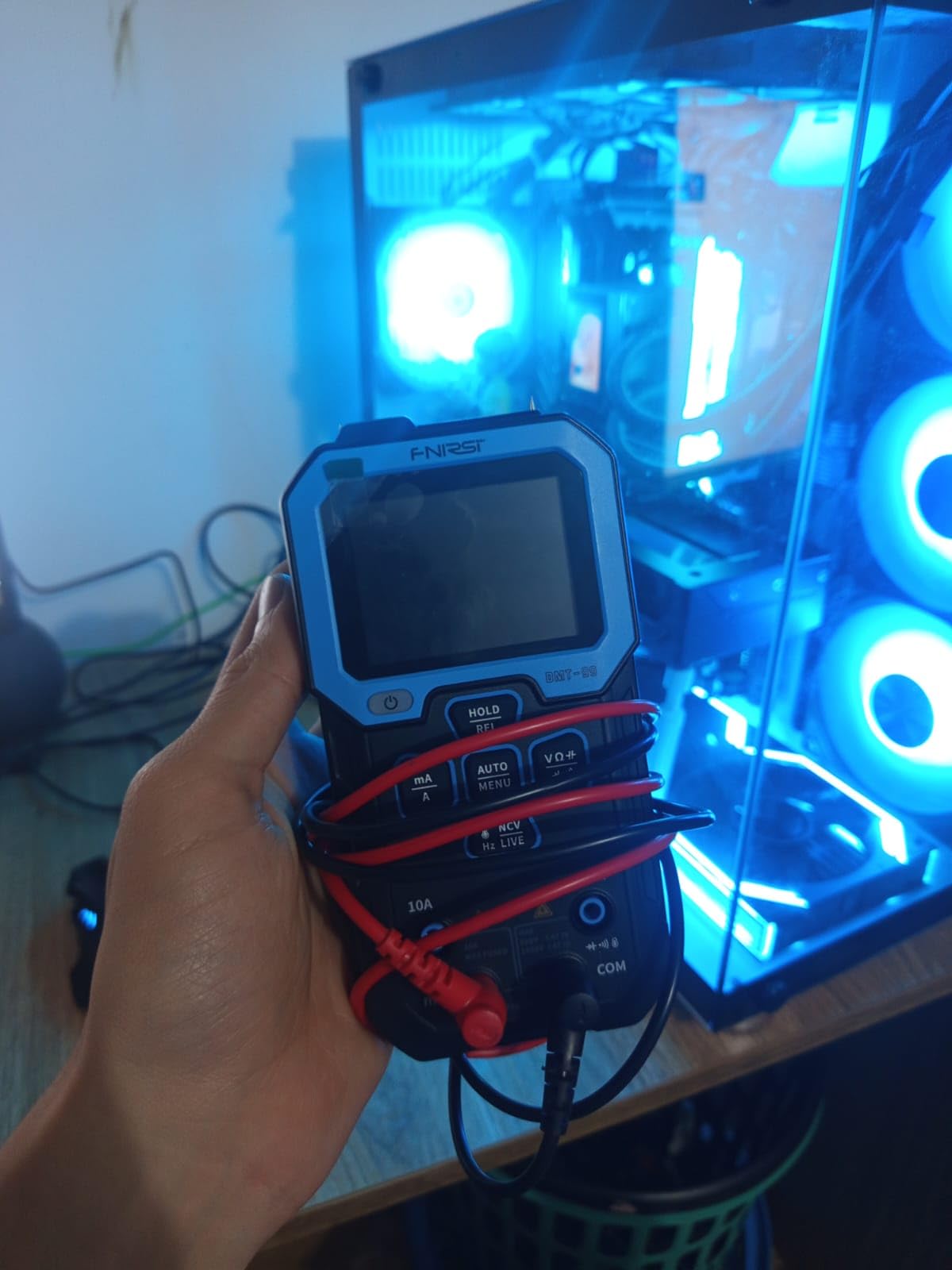
The included test leads are fine-point, sized for SMD work and dense circuit boards, and they come with a back kickstand and storage slots so the whole thing is one object rather than a meter plus a bag of loose accessories. Dual ceramic fuses and anti-burn protection circuitry cover the current inputs.
It is also a 4.6 from 1,356 reviews with an 80 percent five-star share, the highest in the mid-priced group, and the owners who buy it tend to be enthusiasts who already know what a monitoring mode is for. That shapes who will be happy with it and who will not.
The trade-offs are straightforward. A colour TFT is a power draw compared with a plain monochrome LCD, so runtime between charges is shorter than on a cell-powered meter. The menu-driven interface with Auto and Monitoring modes takes longer to learn than a rotary dial, and the screen-first body is thicker than a card meter, so it is not the tool for probing inside a tight enclosure.
When this meter earns its place on your bench
It earns its place when you work on switch-mode power supplies, LED drivers or anything where ripple and rail stability are the question. The waveform view gives you a rough picture of noise on a rail that a DMM reading alone would average into looking fine.
It is also the right pick for intermittent fault-finding, since the threshold monitoring mode turns a needle that is hard to catch by eye into an alarm you can walk away from while you flex the board.
When to pick a different meter instead
Do not choose it as your only meter. A menu-driven screen is slower than a dial when you are probing fast, the battery runtime is shorter than a disposable-cell design, and no colour display substitutes for the resolution and accuracy of a dedicated reference instrument.
5. KAIWEETS HT118A – Best for Automotive and Low-Voltage DC Diagnostics
KAIWEETS Digital Multimeter Automotive TRMS Tester 6000 Counts NCV for Car
6000 counts
CAT III 1000V and CAT IV 600V
Capacitance, temperature, frequency
Double ceramic fuse
Pros
- 6000-count resolution with 1000V DC and 750V AC ranges and 60 MOhms resistance
- Capacitance
- temperature
- frequency
- duty cycle
- diode and continuity included
- Non-contact voltage detection with audible and visual alarm
- CAT III 1000V and CAT IV 600V with double ceramic fuse protection
- Min
- max and average recording with illuminated jack guidance
Cons
- Heavy at 0.55 kg for handheld probing
- True RMS is limited to the upper ranges
- Labeled maximum operating voltage is lower than the stated 1000V DC range
- Thermocouple cap must be removed before using the leads
Where the AstroAI 6000 leads on feature depth, the HT118A leads on reach: 1000V DC, 750V AC and CAT III 1000V plus CAT IV 600V certification, backed by double ceramic fuses and thermistor protection. That is the rating you want if your work straddles 12V automotive circuits and household wiring, and it is a 4.6 from more than 23,000 reviews with 78 percent five-star.
Function coverage is broad: AC and DC voltage and current, 60 MOhms resistance, capacitance, temperature, frequency, duty cycle, diode and continuity, on a 2.9-inch backlit display with a kickstand, a pen slot and a rear flashlight. The flashlight matters more than it sounds when you are tracing a live wire in a dark footwell.
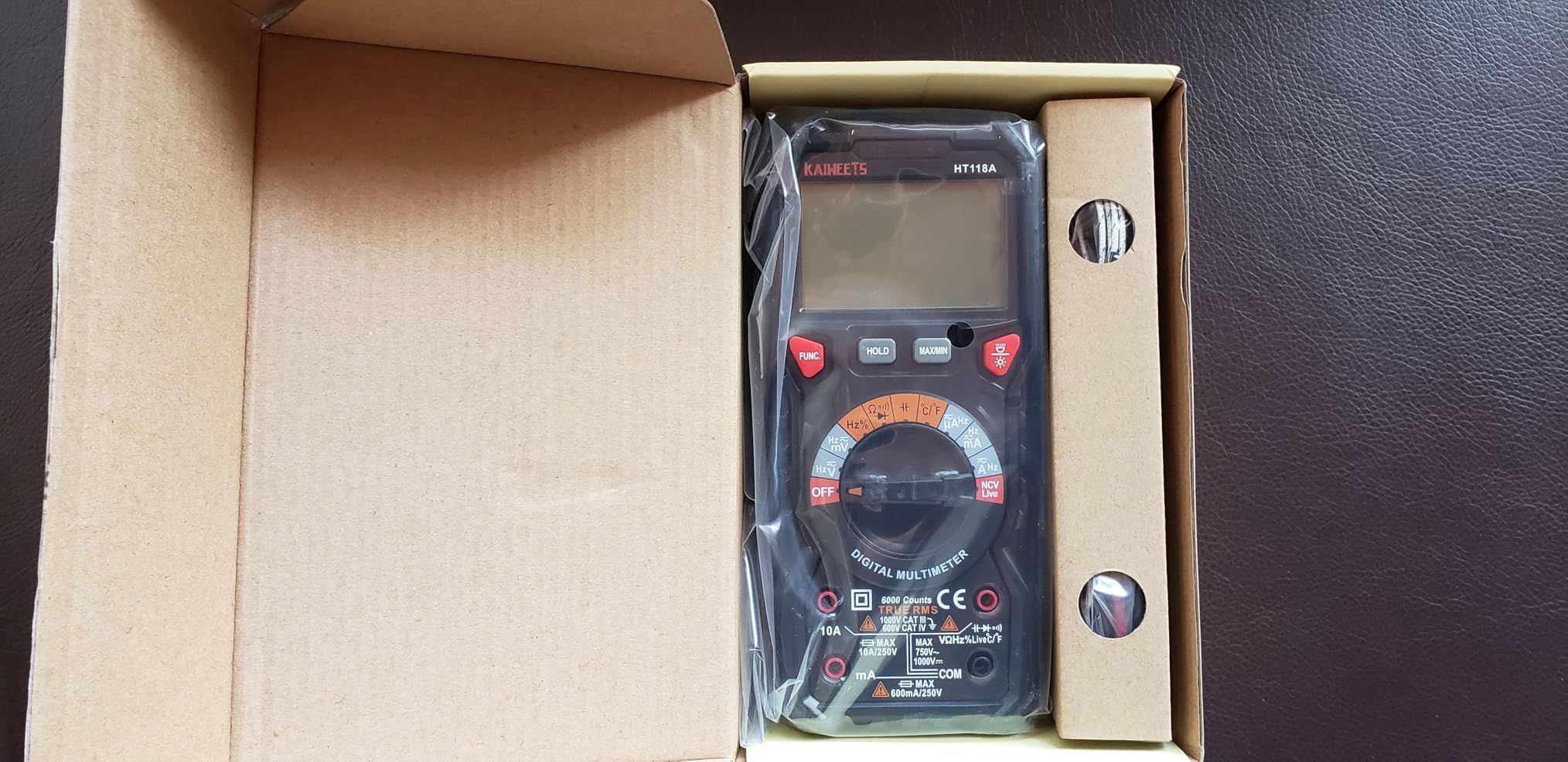
Non-contact voltage detection is the feature owners single out, and the illuminated lead-jack guidance removes the lead-placement guesswork that trips people up. Min, max and average recording is useful when you are watching a rail for drift rather than taking a single sample. The same low-voltage discipline carries over if you also handle vehicle work such as our [tire repair kit picks](https://www.exponation.net/best-tire-repair-kits/), where a meter that reads a battery and a sensor accurately is worth as much as the tool that fixes the puncture.
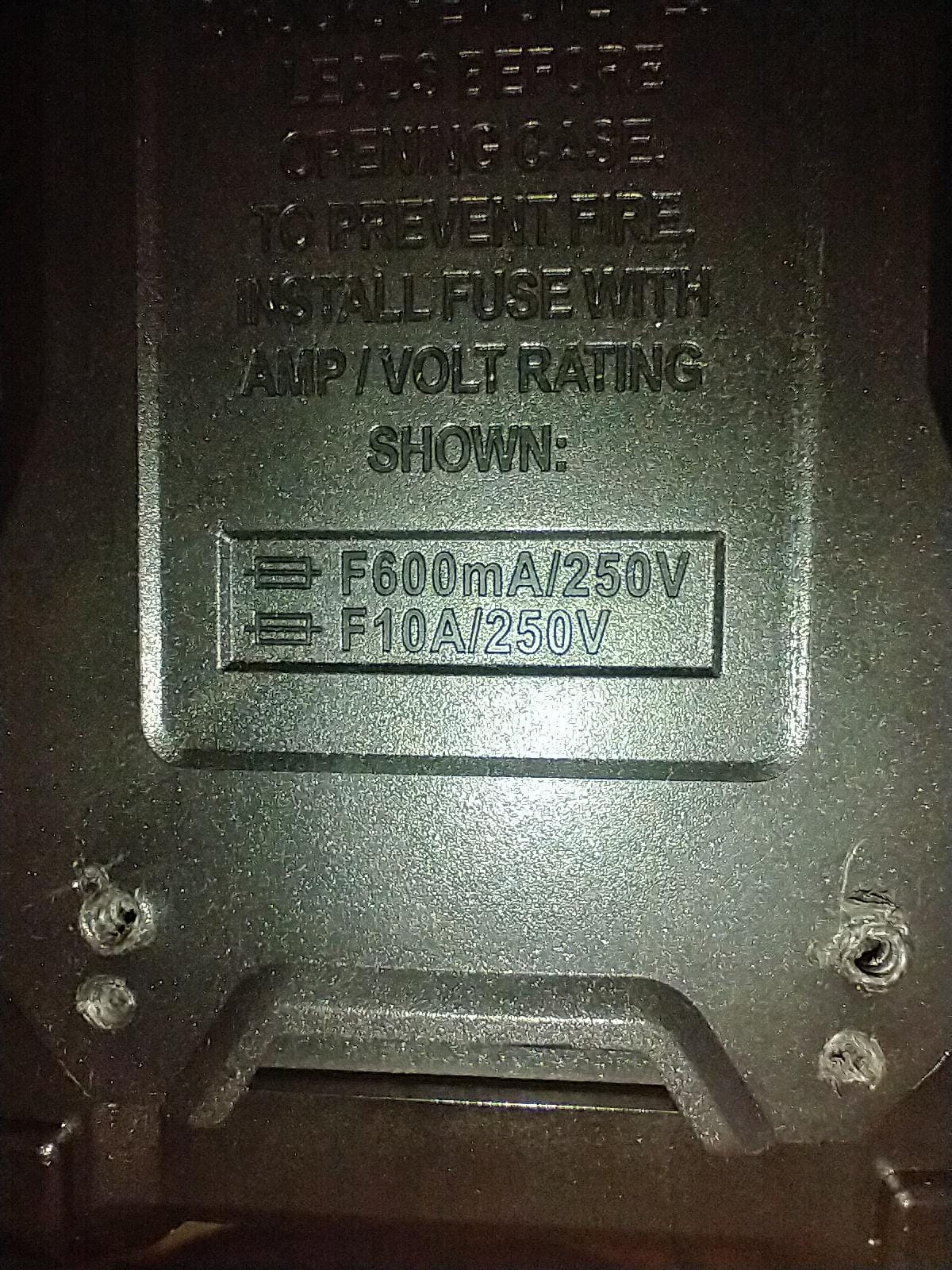
It is also the heaviest meter here at 0.55 kg, and that weight is felt when you are holding it in one hand while probing with the other. Two smaller issues surface in reviews: the advertised 80V maximum operating voltage figure sits oddly against the stated 1000V DC range, which makes the labelling confusing, and the thermocouple cap has to be removed before you use the leads, an instruction buried in the manual that catches out beginners.
True RMS behaviour is restricted to the upper ranges, so if non-sinusoidal accuracy is your main reason to buy, look elsewhere in this list.
When this meter earns its place on your bench
It is built for the technician who moves between a vehicle, an appliance and a bench. The CAT III 1000V and CAT IV 600V rating covers the environments a 12V and mains-adjacent repair shop actually throws at you, and the NCV mode helps you find the live conductor before you commit a probe to it.
For console, laptop and appliance work, the temperature and capacitance functions cover the two checks you do most often on a suspect board, and the kickstand makes it usable hands-free on a crowded work surface.
When to pick a different meter instead
Weight is the deal-breaker for anyone doing long fine-probing sessions, and if you measure distorted waveforms as part of your work, a meter with true RMS across all ranges will serve you better. It is also not the choice for a cramped card connector.
6. Crenova MS8233D – Best Value True RMS With a Complete Kit
Crenova MS8233D Multimeter TRMS 6000 Counts Auto-Ranging Live Wire NCV
True RMS 6000 counts
Capacitance, frequency, duty cycle, temperature
CAT III 600V
Complete accessory kit
Pros
- True RMS 6000-count reading with manual and auto range switching
- Full function set including capacitance
- frequency
- duty cycle and temperature
- Non-contact voltage detection with a buzzer that speeds up as AC voltage rises
- Probe leads
- alligator clips
- carry case and batteries all in the box
- Two fused ranges and an insulated rubber holster
Cons
- Included leads and case are the weakest part of the package
- One-year warranty is the shortest in the roundup
- Bulky 5.51 by 2.76 inch body at 0.55 kg
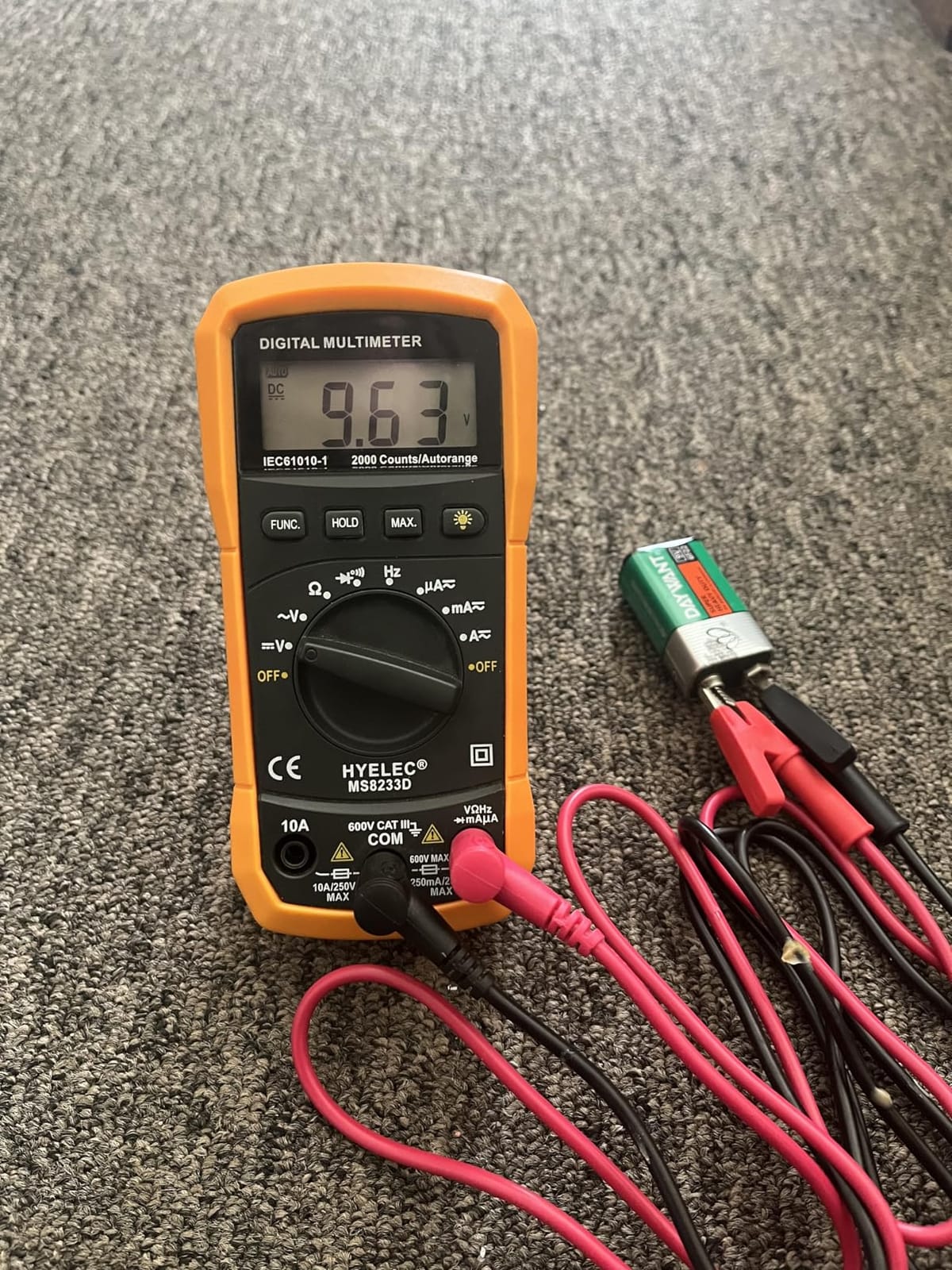
The MS8233D solves the problem most entry meters create: you buy the meter and then spend another week deciding which leads to buy. This one comes with probe leads, alligator clips, a carry case and batteries, so it is usable the moment it arrives. Reviewers repeatedly make that point, and at a 4.6 from more than 9,000 reviews with 77 percent five-star, the function set inside the case is genuinely unusual for the money.
That set is a 6000-count true RMS display with switchable manual and auto ranging, AC and DC voltage and current, resistance, capacitance, frequency, duty cycle, temperature, diode and continuity, with max, min and data hold. Manual ranging is a genuine advantage for board work, because you can pin the range and watch the reading instead of having the meter rescale mid-probe.
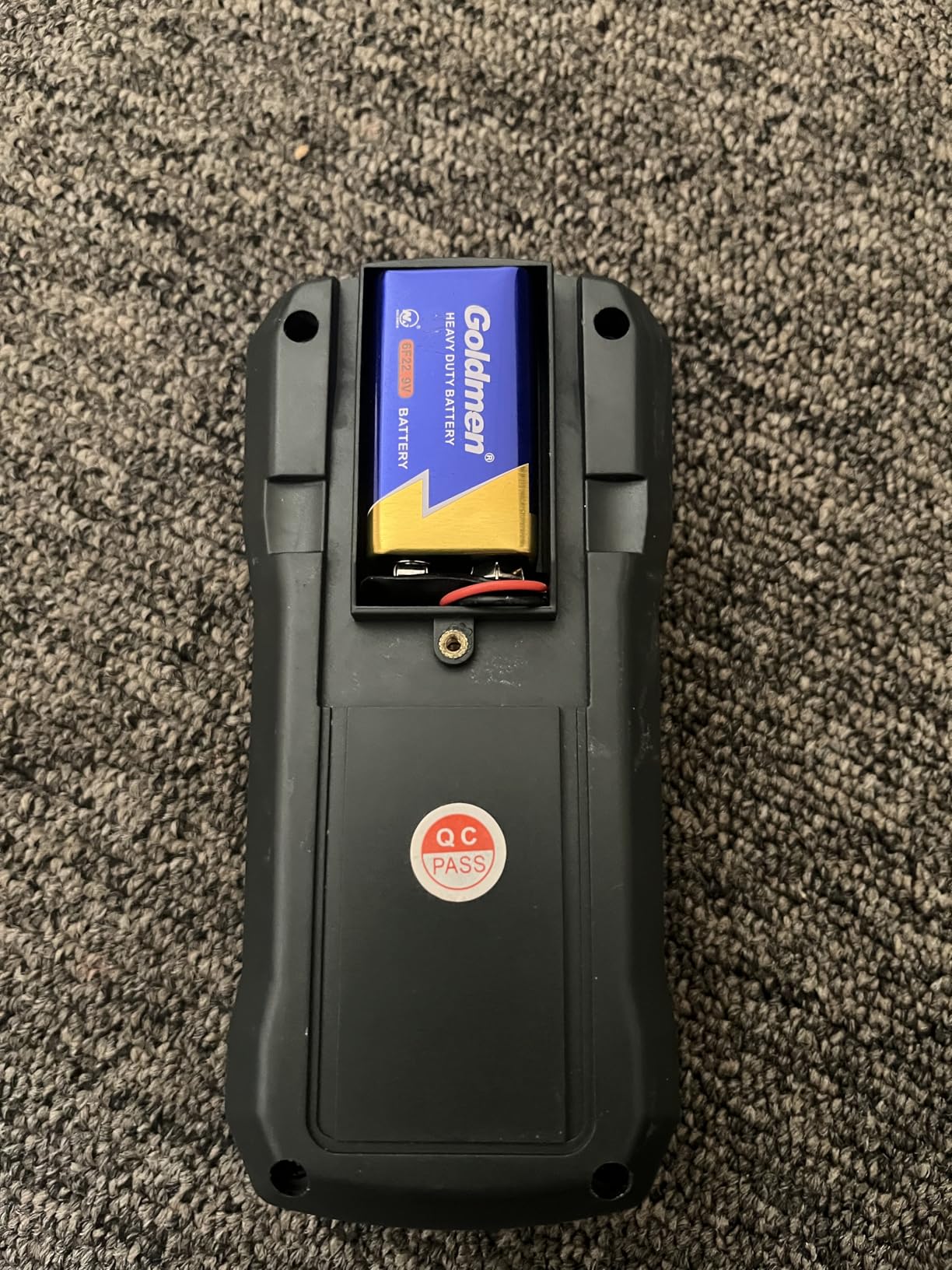
Non-contact voltage detection here has a nice touch: the buzzer pitch increases as the AC voltage rises, so the alert tells you how close you are rather than just that something is there. Two fused ranges and an insulated rubber holster round out the safety picture, and the IEC61010-1 CAT III 600V rating is stated clearly on the box.
Three readings per second keeps continuity tracing quick, which matters more on a dense board than the raw specification suggests.
The weaknesses are known ones. The included leads and case are the weakest link and many owners immediately upgrade to their own leads, which is fine. The one-year warranty is the shortest in the group. And the 5.51 by 2.76 inch body at 0.55 kg is bulky for a bench-top meter, especially if you are working inside a chassis.
When this meter earns its place on your bench
It is the meter to buy if you want true RMS, capacitance and temperature in one box without a second order for accessories. The alligator clips alone make continuity testing on a disconnected board much easier, because you can clip one side and probe with the other.
For students, hobbyists and first-time repairers, the manual ranging option is a teaching tool as much as a practical one, and the rubber holster takes the worry out of a meter that will be dropped.
When to pick a different meter instead
Skip it if you need reference-grade accuracy, if the one-year warranty matters to you, or if you will be holding the meter in one hand for long sessions. The included leads are a starting point, not a long-term solution for fine SMD probing.
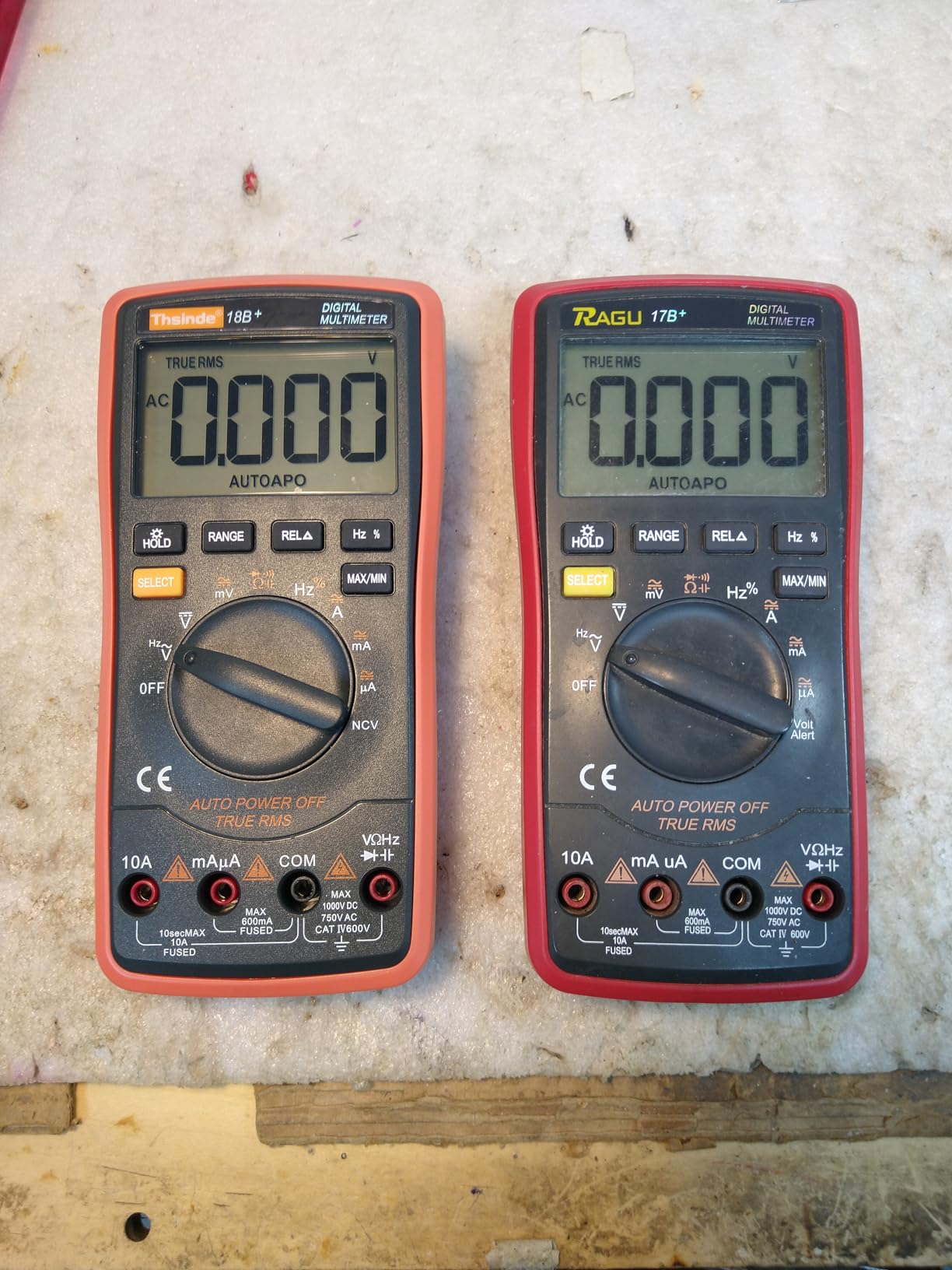
7. Thsinde 43180-66526 – Best for Leak-Resistant Power and Verified Accuracy
Auto Ranging Digital Multimeter TRMS 6000
True RMS 6000 counts
9V battery power
Capacitance to 20000 uF
Two lead sets included
Pros
- 9V battery instead of AA or AAA cells so far less prone to leaking
- Checked against a high-end Fluke on mains
- cell and frequency measurements
- Two complete sets of test leads plus friction-fit alligator clips
- Large backlit display with a smooth positive-turning dial
- High-impact case with probe slots
- wall hanger and flip-down stand
Cons
- Non-contact voltage indication is inconsistent and hold-sensitive
- Backlight times out after roughly 15 seconds with no way to keep it on
- Stiff rubber overmould offers little real drop protection
- Sparse printed instructions
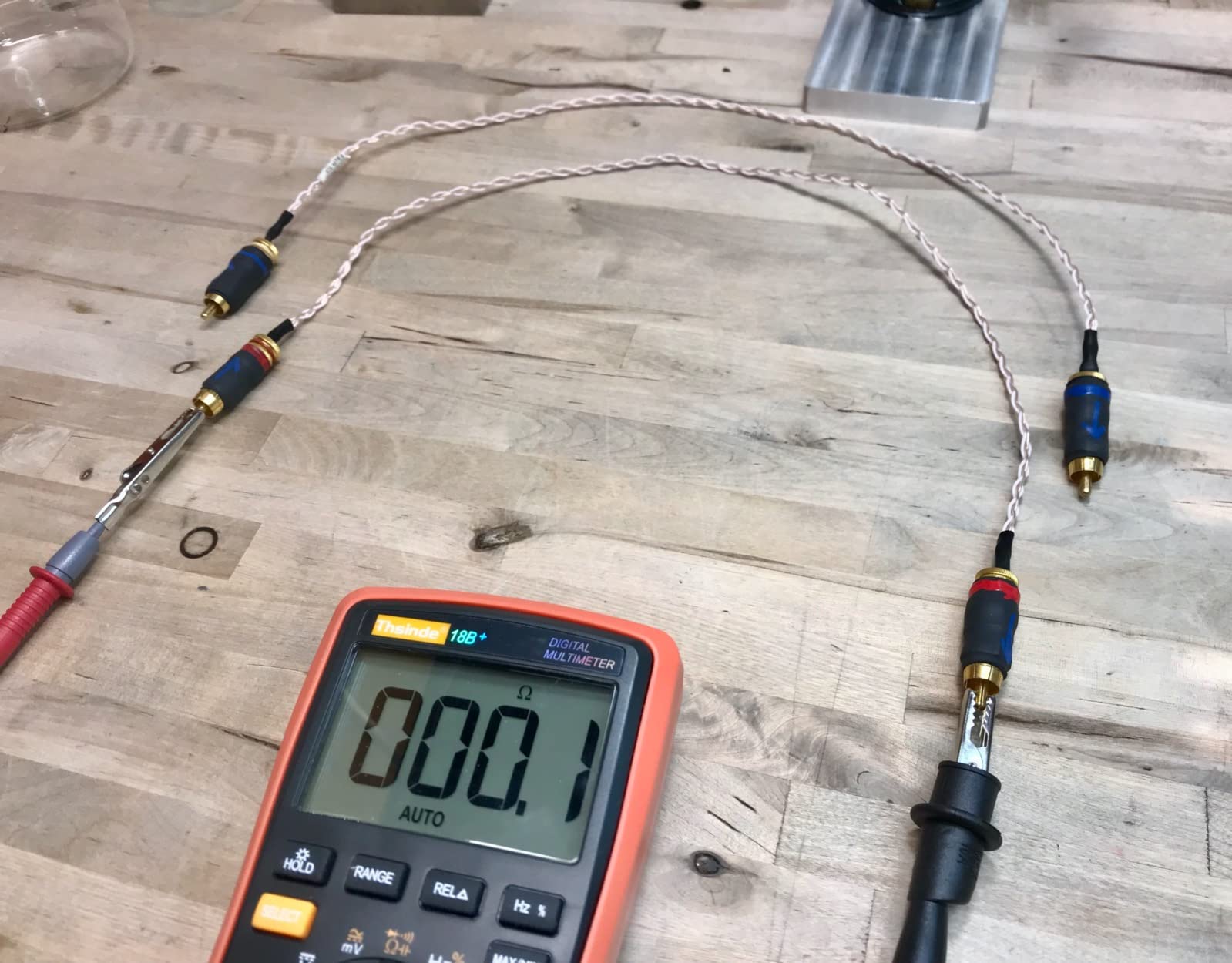
This meter has the most convincing independent accuracy story in the budget group. One owner ran it side by side against a high-end Fluke and found AC RMS on 120V mains, DC on 1.5V and 9V cells, and frequency all measured very accurately. Audio and low-voltage controls professionals report using it daily in preference to meters costing several times more, and it holds a 4.6 from 1,724 reviews with 76 percent five-star.
The 9V battery decision is quietly the best engineering choice on the page. A single rectangular cell will not leak into the case the way AA and AAA cells do, and a meter that sits on a bench for years without being used is exactly the kind of tool that gets destroyed by a leaking cell. Audio restorers on vintage radio forums make the same point when they talk about wanting one dependable all-round meter rather than chasing specifications.
The rest of the package is generous: a 6000-count true RMS auto-ranging meter with ten functions, AC and DC voltage and current, frequency, resistance, diode and continuity, and capacitance and diode handling to 20,000 uF with PTC ceramic protection. You get two full sets of test leads plus friction-fit alligator clips, which means you always have a spare pair and clips that grip a solder pad properly.
The case has a flip-down stand, a keyhole wall hanger and probe storage slots, and the continuity buzzer is fast and loud enough to hear across a bench. That last point is one forum users raise repeatedly: an audible beep is a deal-maker over reading the screen, because your eyes stay on the probe tip.
The drawbacks are consistent. Non-contact voltage indication is unreliable and depends heavily on exactly how the meter is held near the conductor, so treat it as a hint rather than a reading. The backlight times out after about 15 seconds and cannot be kept on. The rubber overmould is stiff and offers little real drop protection, and the printed instructions are sparse with a faint battery polarity marking.
When this meter earns its place on your bench
It suits vintage electronics restoration, audio work and long-term bench use, where the cell chemistry and the included spare leads genuinely reduce the failure modes that kill cheap meters. Two lead sets also mean you can keep one set permanently dressed for continuity tracing with alligator clips.
The 20,000 uF capacitance ceiling is more than most electrolytics on a consumer board, which covers the large bulk capacitors you find in power supplies and amplifiers.
When to pick a different meter instead
Do not rely on its non-contact voltage mode for anything that matters, and skip it if you work somewhere you cannot afford a backlight timing out mid-probe. If you need drop protection, the rubber here will not give it to you.
8. AstroAI DM130B – Most Versatile With Real Capacitance
AstroAI DM130B Multimeter, 4000 Counts, Auto-Ranging, Capacitance Testing
4000 counts auto-ranging
Capacitance testing
Non-contact voltage detection
Compact 9.88 ounce body
Pros
- Capacitance testing at a price point where most rivals stop at resistance and continuity
- Auto-ranging with a bright backlight that is easy to set and read
- Non-contact voltage detection for quickly checking live wires
- Compact hand-sized body that fits a small toolbox
- Owners report accuracy holding up against far more expensive meters
Cons
- Included test leads feel flimsy and need force to seat properly
- Supplied zinc-oxide batteries can short out in storage and leak
- 4000 counts with no true RMS and no frequency or duty cycle
- Instructions are largely non-English
The DM130B is the meter we recommend to someone who wants to start doing real board work without a large outlay. It measures 4000 counts auto-ranging and, crucially for repair, it has capacitance testing, which is the function most cheap meters at this tier omit entirely. It also has non-contact voltage detection, so you can check for a live circuit before you commit a probe.
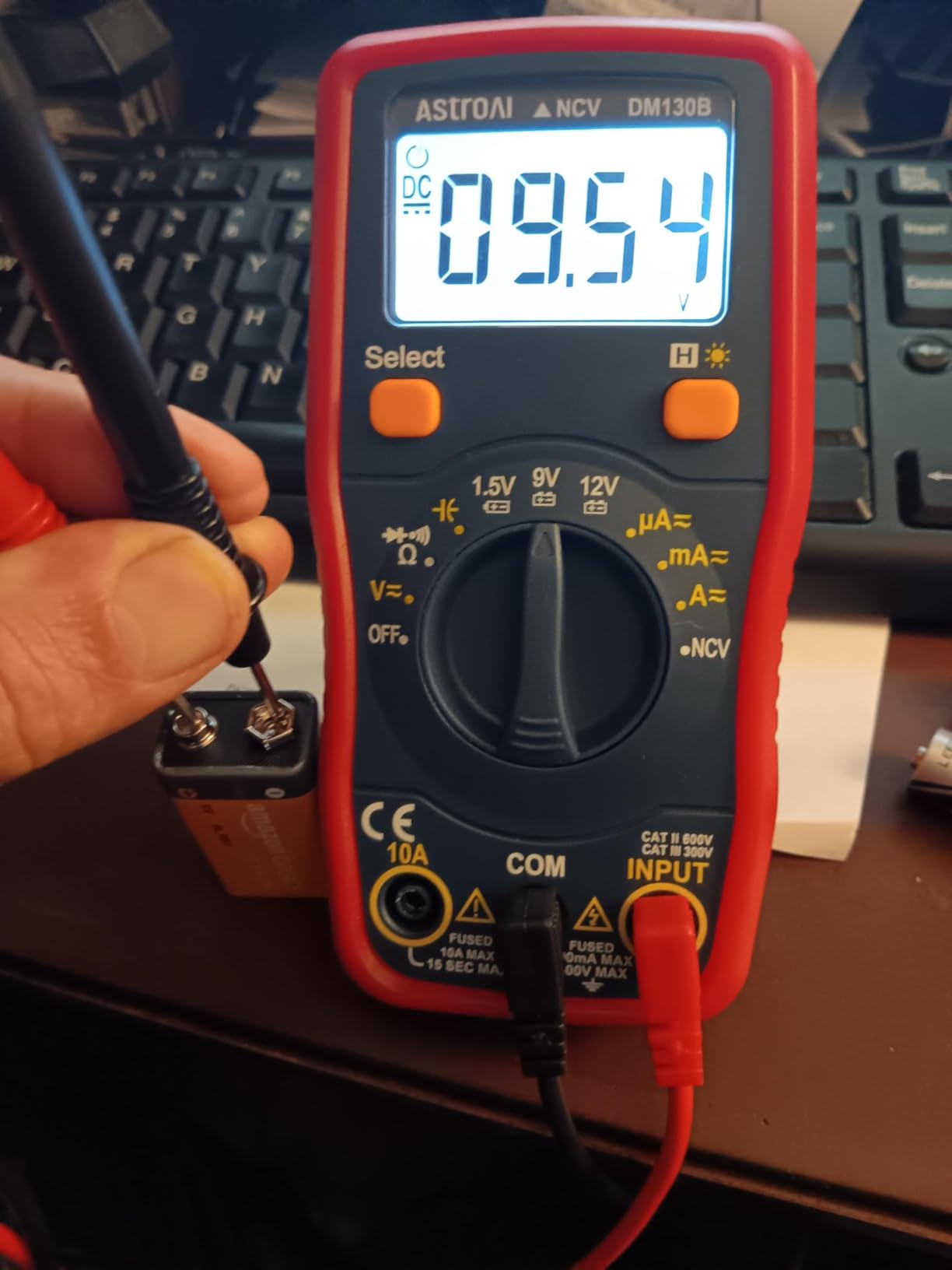
It is a 4.6 across more than 8,300 reviews, and the recurring owner verdict is that it is the ideal entry bench meter. Accuracy is reported as holding up against far more expensive units in routine checks, with one owner verifying it against Snap-on and Fluke meters on a 12V battery test and another using it for audio restoration work.
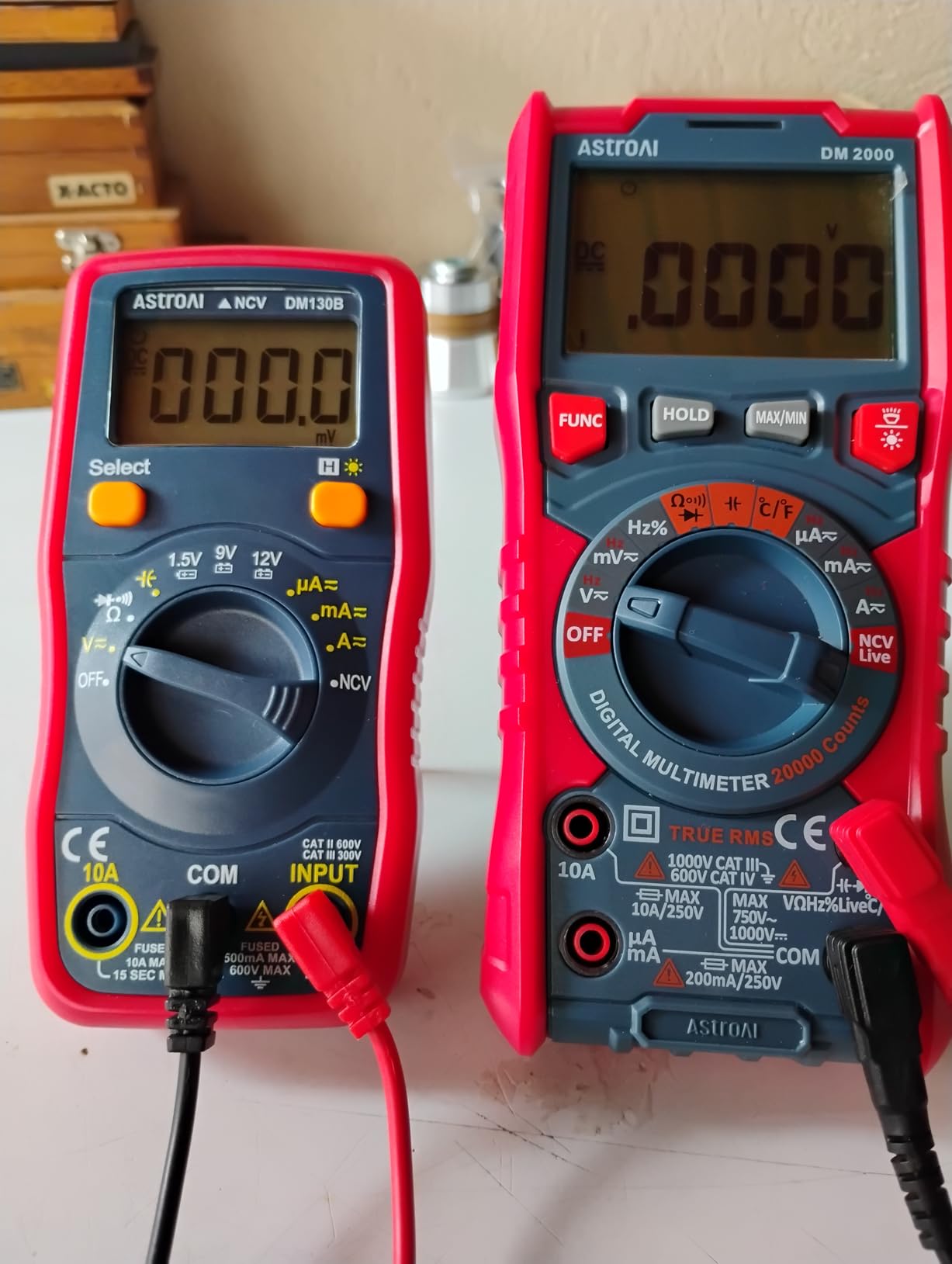
For a first meter, the auto-ranging plus a bright backlight is what removes the two biggest beginner problems: picking the wrong range and giving up because the screen is unreadable in a dim room. The body is 6.3 by 4.53 by 1.57 inches at 9.88 ounces, so it fits a small toolbox and does not take over a crowded bench.
Two practical tips come up again and again in the reviews, and both are worth heeding. Replace the supplied zinc-oxide batteries with alkaline cells, because the supplied ones short out in storage and can leak. And buy better test leads, because the included ones feel flimsy and can need force to seat properly in the jacks.
Be clear about the limits: 4000 counts is a modest resolution, there is no true RMS, and there is no frequency or duty cycle. For 3.3V and 5V rail work the resolution is workable but it is not what separates a marginal reading from a healthy one. The largely non-English instructions also slow first-time setup.
When this meter earns its place on your bench
It is the right first meter for hobby electronics, Arduino and Raspberry Pi projects, and general appliance work, because capacitance testing plus non-contact detection covers more real faults than a cheaper voltage-only meter would. It also works as a second instrument once you outgrow one.
For anyone restoring vintage audio gear, the compact body and capacitance range make it more useful than its tier suggests, especially with better leads fitted.
When to pick a different meter instead
Move up if you need to resolve small voltage drops on low rails, if you measure non-sinusoidal AC, or if frequency and duty cycle measurements are part of your diagnostic routine. Remember to change the batteries before first use.
9. Hioki 3244-60 – Best for Insulation and Leakage Tracing
Hioki 3244-60 Card HiTester and Digital Multimeter, 41.99 Megaohms Resistance, 500V AC/DC Voltage
41.99 MOhm resistance
500V AC/DC maximum
Card format under 1cm thick
Gold-plated 15mm tip pins
Pros
- 41.99 MOhm resistance range is the widest in the group and isolates leaky capacitors
- coatings and FETs
- Card-sized palm-format body under 1cm thick for tight enclosures
- Gold-plated 15mm tip pins give reliable contact on small pads
- Full auto-ranging with automatic power saving
- Backed by an established Japanese instrumentation brand
Cons
- 500V AC/DC ceiling is low next to the 1000V-capable meters
- No capacitance
- frequency
- temperature or current measurement
- No non-contact voltage detection
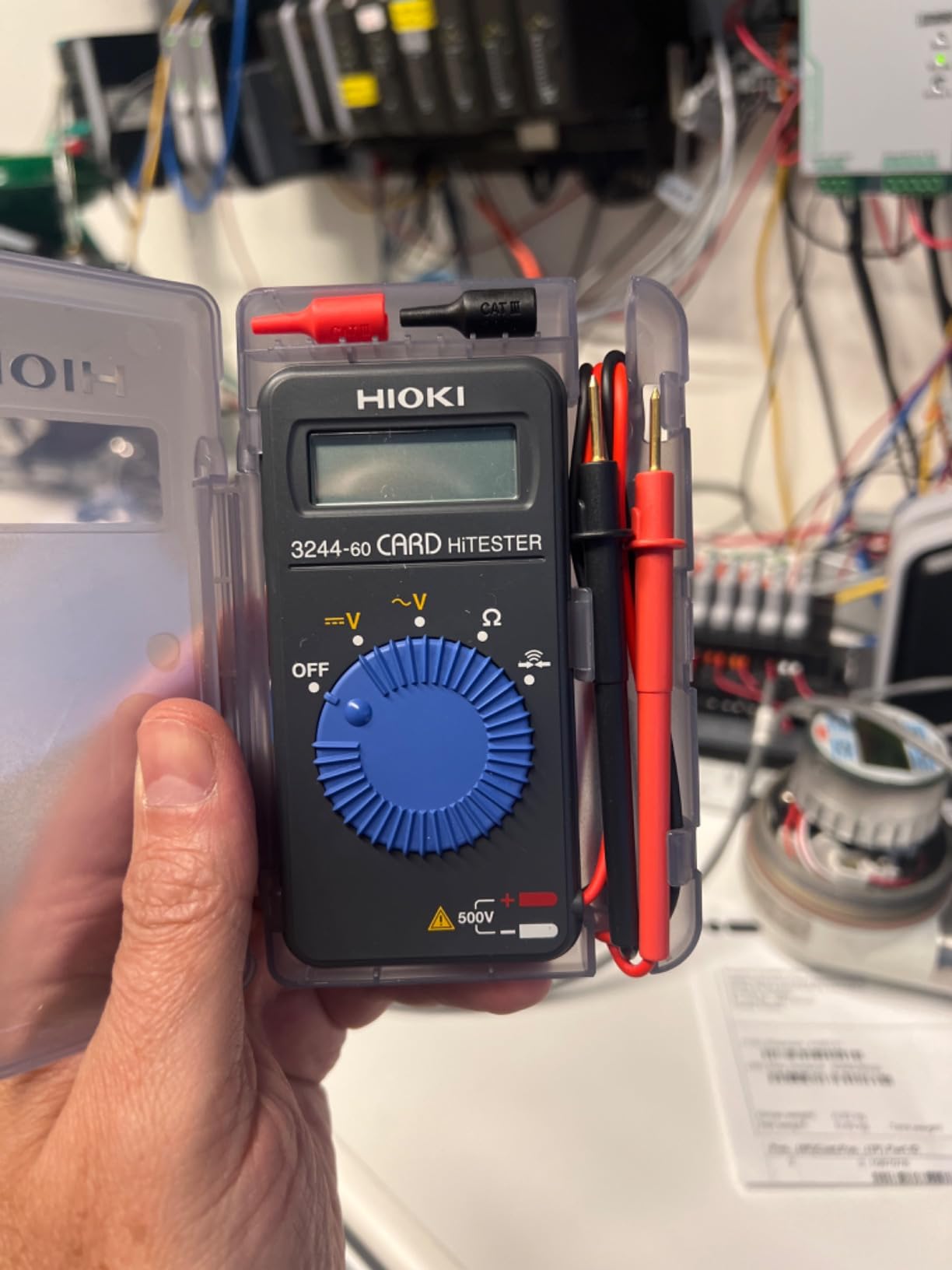
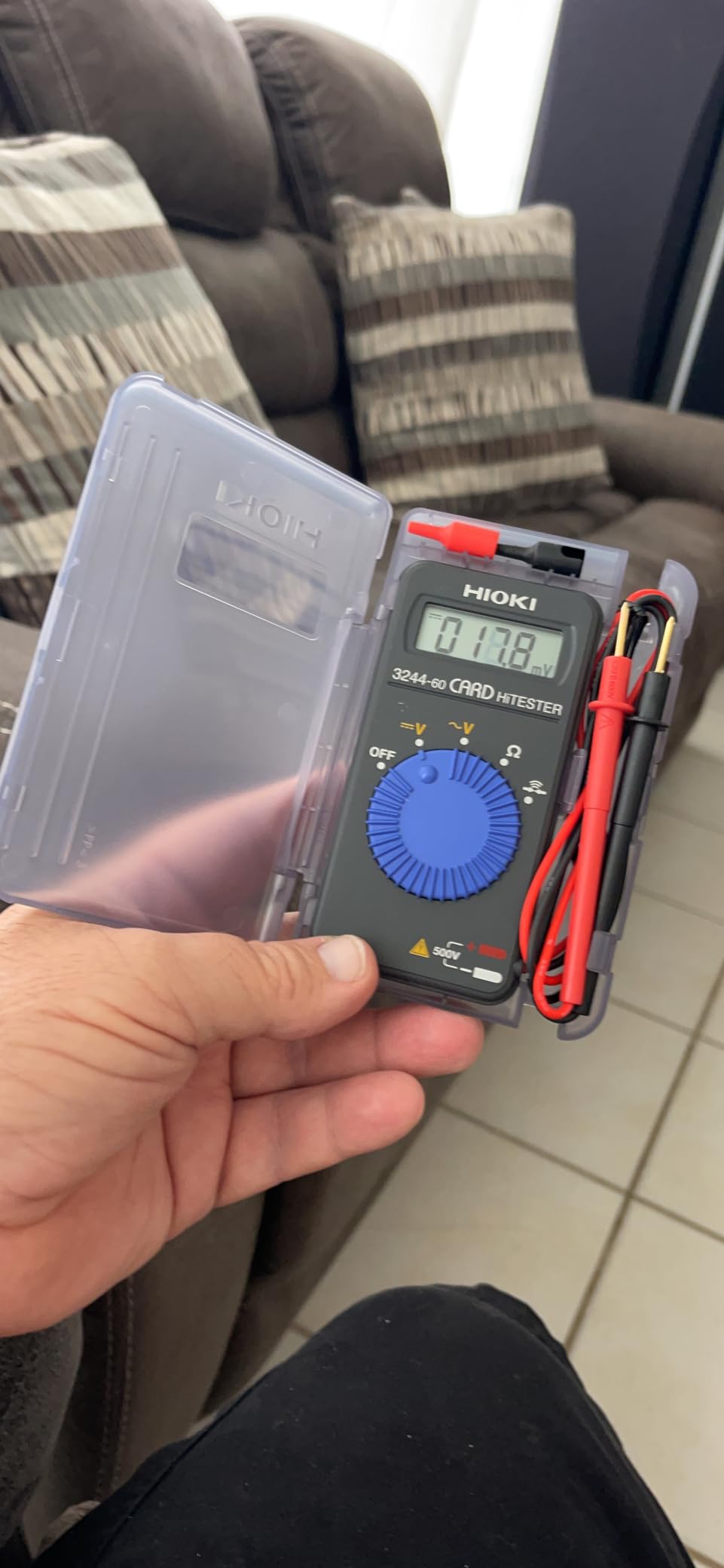
This is the specialist in the group, and its specialism is leakage. The 41.99 MOhm resistance range is the widest in the roundup, and it is the reason electronics repair buyers reach for it: an ordinary multimeter tops out far lower, so a damp trace, a corroded connector or a FET with degraded insulation can look perfectly healthy on a normal meter and obviously wrong on this one.
The other thing that makes it unique is its shape. At 0.37 by 2.17 by 4.29 inches and 0.06 kg, it is a card-format palm meter under 1cm thick, so it goes into connectors and enclosures that a full-size body physically cannot reach. The gold-plated 15mm tip pins maintain dependable contact on small pads where a cheap spring pin would drift.
It is fully auto-ranging with automatic power saving and overload protection to 500V on the resistance and continuity ranges, and it complies with EN 61010-1, IEC 61010-1:2000-1 and RoHS. The 4.5 rating from just over 3,000 reviews reflects a narrow but loyal user base rather than broad appeal, which is exactly what a specialist instrument looks like.
The accepted trade-offs are substantial and you should accept them consciously. The 500V AC and DC ceiling is low next to the 1000V-capable meters here. There is no capacitance, no frequency, no temperature and no current measurement at all, and no non-contact voltage detection. It is not a general-purpose DMM and it is not meant to be.
That means you will want a second meter. Most owners use it as a companion, reaching for the Hioki when a reading does not make sense and something is suspected of being damp, coated or leaking, and switching back to a full function meter for everything else.
When this meter earns its place on your bench
It earns its place on vintage radio and audio restoration, moisture and corrosion investigations, and any board where a suspect reading could be a leakage problem rather than a dead component. The thin card body is also the answer to backprobing a crowded connector where a full-size meter cannot physically sit.
If you restore older equipment, a workshop practice that regulars on vintage radio forums is to have one dependable all-round meter plus one specialist instrument. This is a strong candidate for the specialist slot.
When to pick a different meter instead
Do not buy it as your only meter. It cannot measure current, capacitance or temperature, its 500V ceiling is restrictive on switch-mode work, and it will not help with live-wire tracing. Pair it with one of the full-function meters above.
10. AstroAI AM33D – Best for High-Volume Basic Checks
AstroAI Digital Multimeter Tester 2000 Counts with DC AC Voltmeter and Ohm Volt Amp Meter; Measures Voltage, Current, Resistance, Continuity and Diode, Blue
1999-count backlit LCD
AC/DC voltage, DC current, resistance
Continuity buzzer and data hold
3 year warranty
Pros
- Wide measurement coverage including AC/DC voltage
- DC current
- resistance
- continuity and diode
- Backlit 3.5-digit LCD with data hold and continuity buzzer
- Double-fuse anti-burn protection plus a silicone protective cover
- 3-year warranty with responsive technical support
- Lightweight at 0.15 kg and very compact
Cons
- 1999-count display is the lowest resolution in the roundup
- Cannot test AC current and AC voltage readings below 100mV are unsupported
- 2 samples per second is slow for transient work
The AM33D is here because of its owner base: 56,035 reviews at a 4.5 average, by a wide margin the largest sample of real-world use in the group. Owners treat it as a general-purpose bench and household meter where voltage, resistance, continuity and diode checks are the daily drivers, and the backlight plus data hold are the features most often praised.
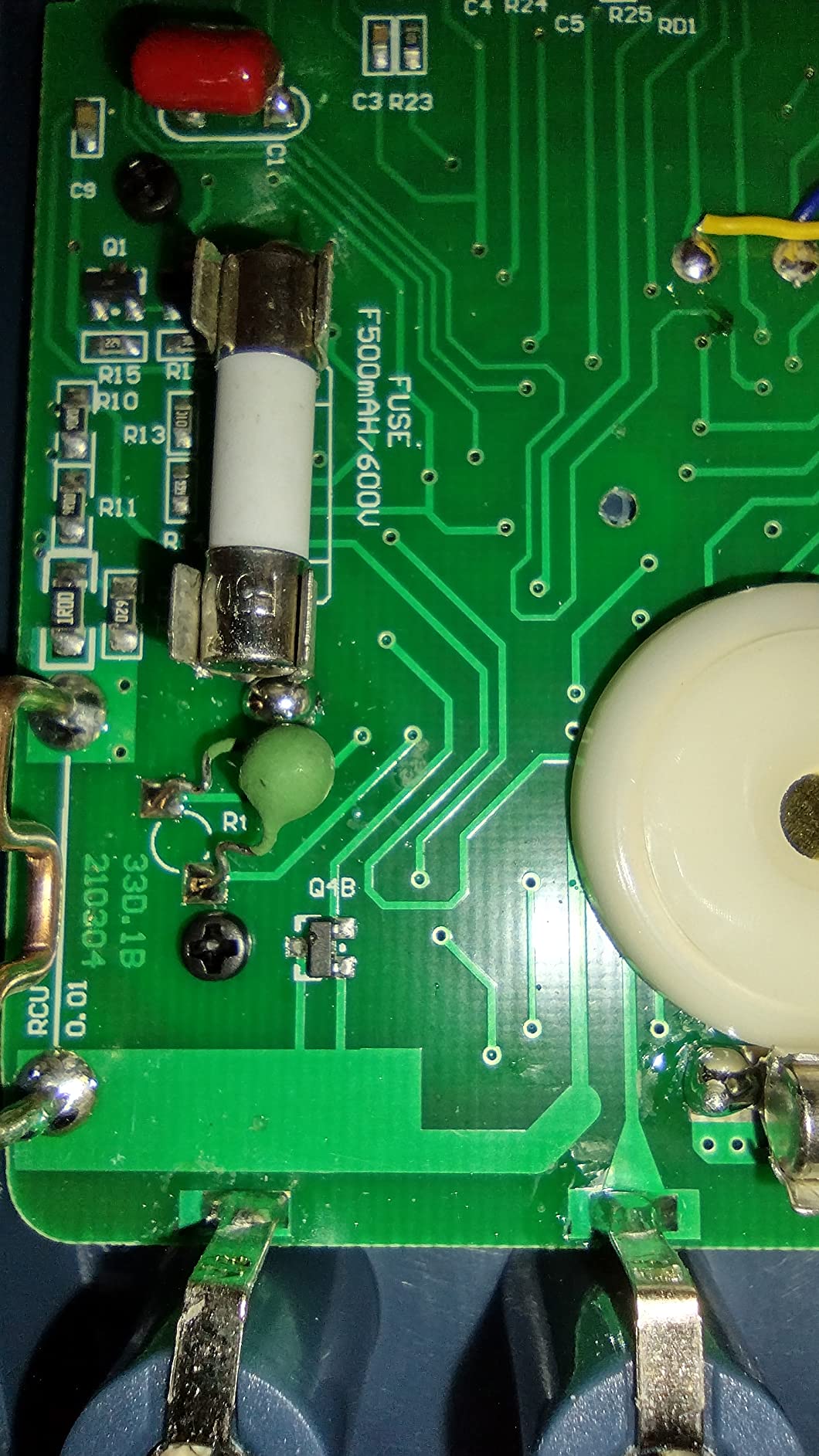
It covers AC and DC voltage, DC current, resistance, continuity and diode, with double-fuse anti-burn circuit protection and a silicone outer cover for shock and drop protection. The 3-year warranty and responsive technical support are unusually generous at this tier, and the 0.15 kg body with a 1.77 by 5.47 inch footprint is genuinely pocketable.
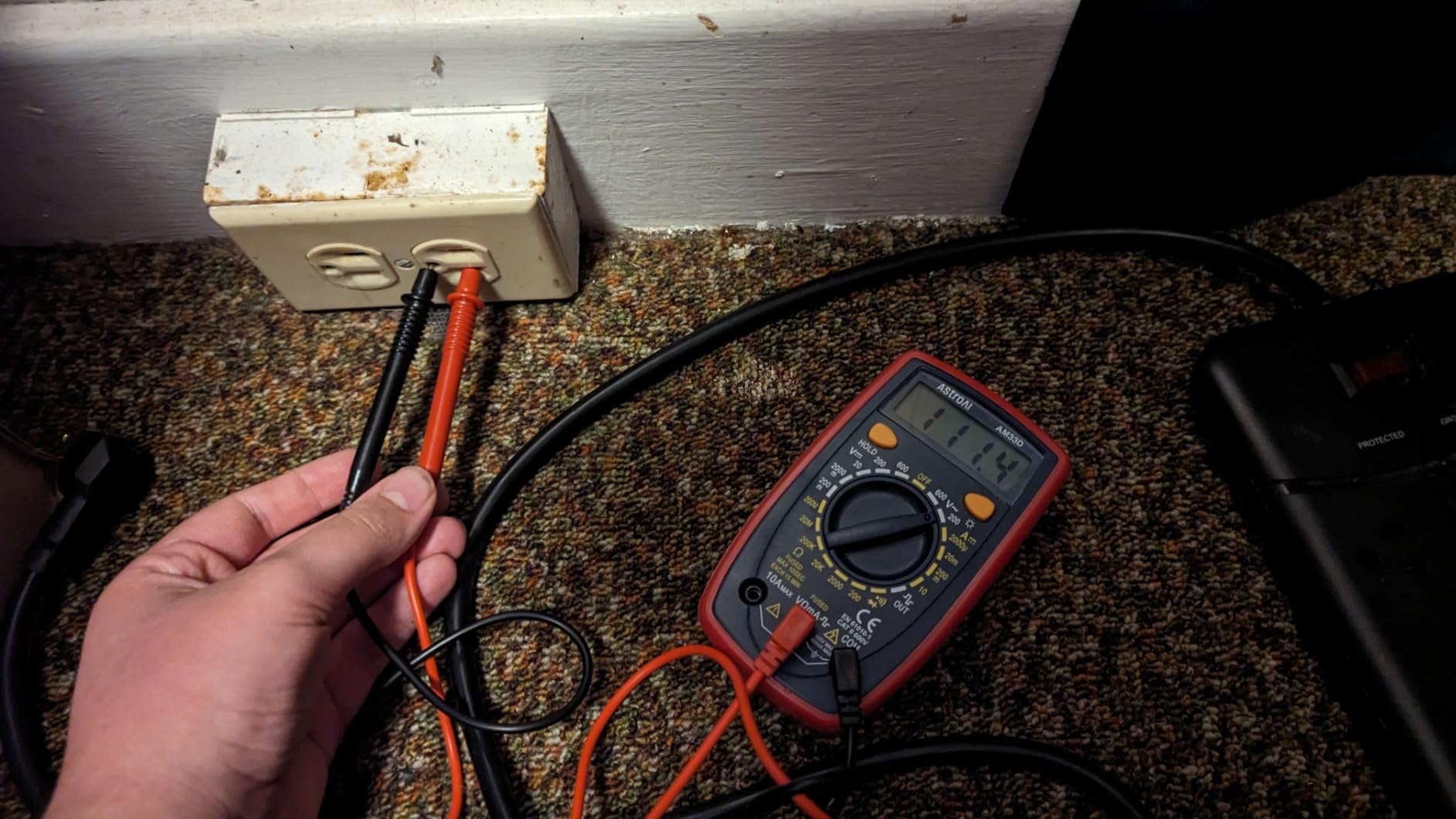
The specification to know before you commit is resolution. A 1999-count display cannot show you the difference between a healthy 3.3V rail and a rail that has sagged to 3.25V, because the last digit on that range is worth about 1mV at full scale. If your work involves diagnosing a board that powers up but misbehaves, that limit will frustrate you.
There is no AC current measurement, AC voltage readings below 100mV are not supported, and the sampling rate of two readings per second is slow for anything transient. A 9V battery, test leads and a manual are included, and the stated maximum operating voltage is 500V with a minimum of 2V.
The honest framing is this: it is a fast, cheap first tool for continuity and voltage checks, and a very reasonable second meter to keep in a drawer, but it is not a board-repair instrument in the sense the rest of this list uses that word.
When this meter earns its place on your bench
It works well as a general-purpose meter for household circuits, batteries, and quick continuity checks across a bench, and the light body plus backlight make it pleasant to carry around. The three-year warranty reduces the risk of a first-tool purchase for someone who will drop it.
It is also a sensible sacrificial meter: the one you keep on a bench for the fast checks so your better instrument stays off the bench and off the risk.
When to pick a different meter instead
Skip it if you are chasing small voltage differences on low rails, if you need AC current, or if you need capacitance at all. At that point you should step up to a 4000-count or 6000-count model with capacitance and diode coverage.
11. TESMEN TM-510 – Best for Pocket-Sized Quick Checks
TM-510 Digital Multimeter, 4000 Counts, Smart Measurement, Auto-Ranging Voltmeter; Voltage Tester with Non-Contact Voltage Function, Measures AC/DC Voltage, Resistance, Continuity – Green
Smart Auto mode
4000 counts
CAT II 600V
0.1 kg with storage bag
Pros
- Smart Auto mode detects AC/DC voltage
- resistance and continuity without choosing a mode or range
- Non-contact voltage detection with visual and audible alarm
- Very light at 0.1 kg and pocket-friendly for mobile repair work
- Storage bag
- two AAA batteries and test leads in the box
- CAT II 600V with internal overload protection and silicone outer cover
Cons
- No current measurement at all
- 4000 counts with no capacitance and no temperature function
- No true RMS so AC readings on distorted signals are indicative only
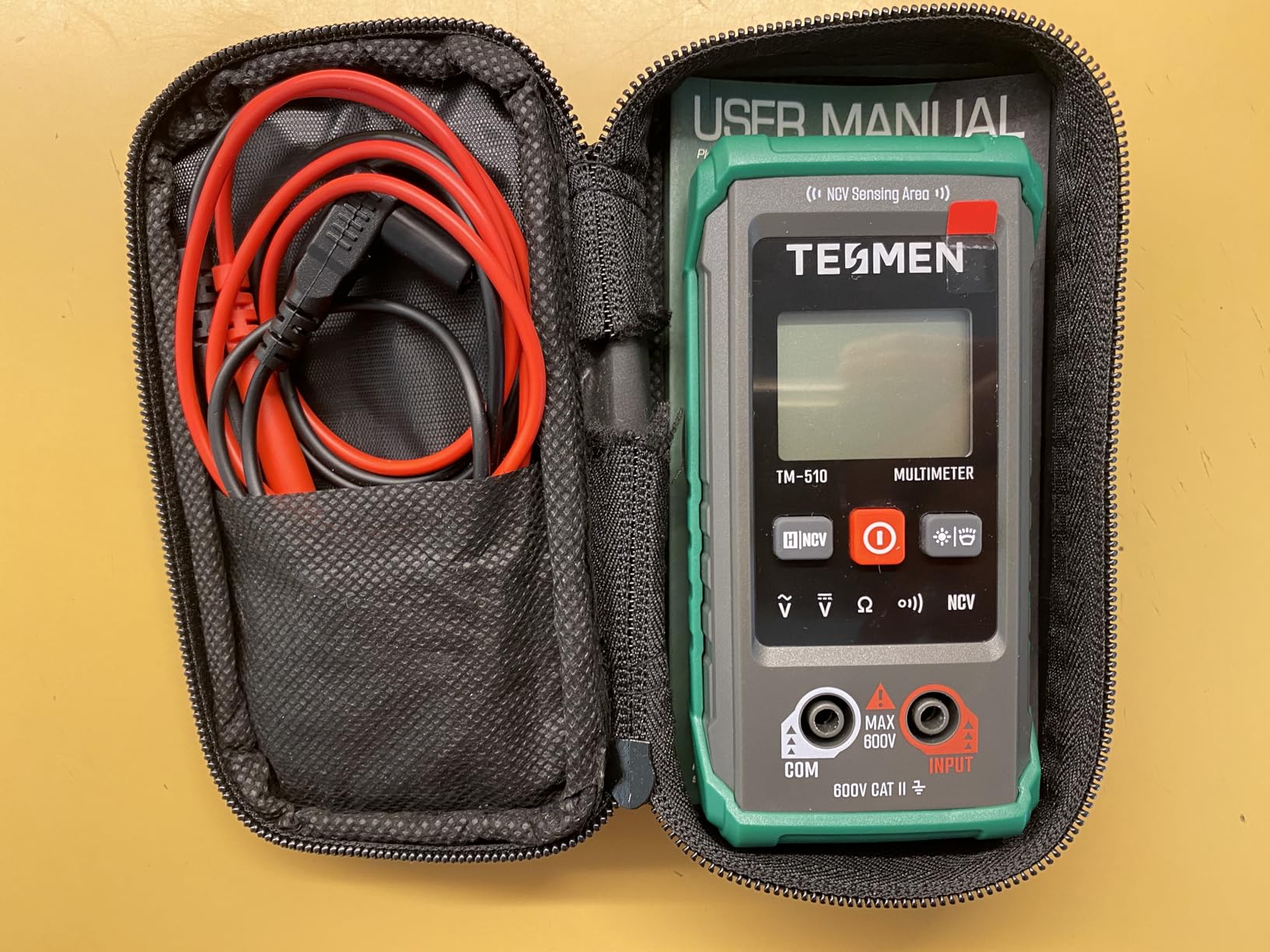
The TM-510 solves a different problem from the rest of the list. It measures voltage, resistance and continuity, and nothing else, but it does the Smart Auto mode well: the meter detects whether you are measuring AC or DC voltage, resistance or continuity, and picks the mode and range itself. You put the probes on and read the answer, which is exactly right for a quick check on a customer machine or a cable in a service bag.
Non-contact voltage detection with a visual and audible alarm lets you trace a live wire without touching it, and the backlight plus flashlight make it usable in dark cabinets. It is a 4.6 from nearly 13,700 reviews with 76 percent five-star, and owners single out the Smart Auto mode and the non-contact detection as the two features that justify the meter.
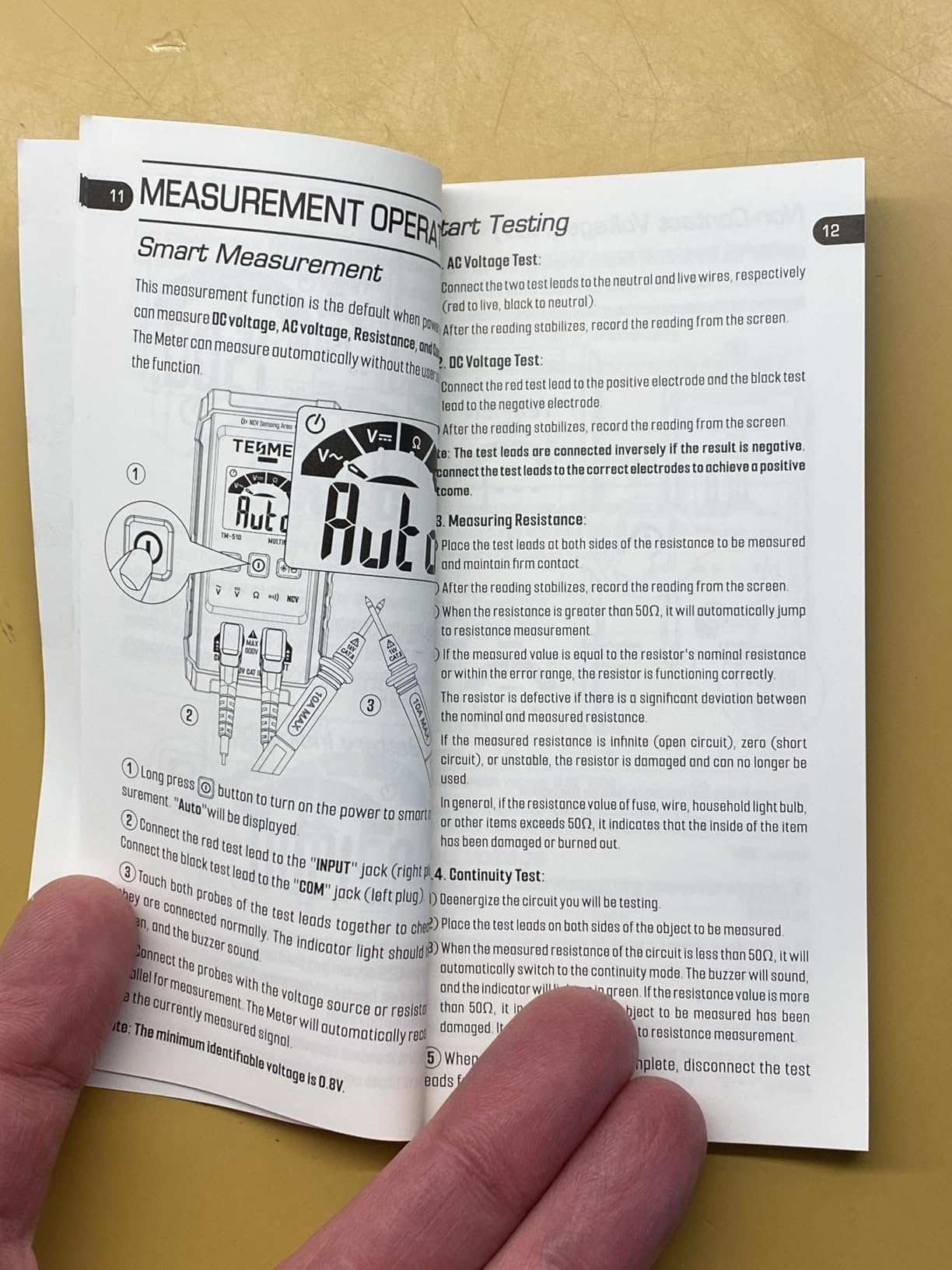
At 0.1 kg and with a storage bag, two AAA batteries and test leads in the box, it is the meter to keep in a tool bag, a van or a laptop sleeve. CAT II 600V certification with internal overload protection and a silicone outer cover make it safe for household and light commercial work.
Be clear about what it cannot do. There is no current measurement at all, no capacitance, no temperature, and no true RMS, so AC readings on distorted or non-sinusoidal signals are only indicative. Owners acknowledge this limit clearly: it rules the meter out of deeper board-level diagnosis.
The 4000-count resolution is a modest ceiling, and while that is fine for a 12V battery or a mains check, it is not fine for resolving a small drop on a 3.3V rail.
When this meter earns its place on your bench
It is the right meter for mobile repair visits, quick verification work and anyone who wants a meter that cannot be configured wrongly. The Smart Auto mode removes the two most common user errors in the field, which is a genuine reliability gain when you are not looking at the screen.
It also makes a good companion to a better bench meter, because the two cover genuinely different jobs and neither is redundant.
When to pick a different meter instead
Do not buy it as your only meter. No current measurement and no capacitance means you cannot check a board’s power draw, test a suspect capacitor, or follow a shorted rail. Choose a 6000-count model with capacitance for repair work.
12. Fluke 15B+ – Best for CAT III Certified Basic Work
Fluke 15B+ Digital Multimeter, for Electrical Applications, Measures AC/DC Voltage and Current Measurements up to 1000V and 10A, Along with Resistance, Continuity, Diode, and Capacitance Capabilities
CAT III 600V
AC/DC voltage to 1000V
Current to 10A
Capacitance and diode
Pros
- Reference-grade accuracy from a recognised calibration standard for validating a bench
- CAT III 600V rating with AC/DC voltage to 1000V and current to 10A
- Resistance
- continuity
- diode and capacitance cover the full first-line set
- Straightforward
- rugged build that feels solid
- The most accessible entry point into the Fluke line
Cons
- No frequency or temperature measurement
- Non-true-RMS so distorted mains readings are not fully accurate
- Premium price against generic meters covering similar basics
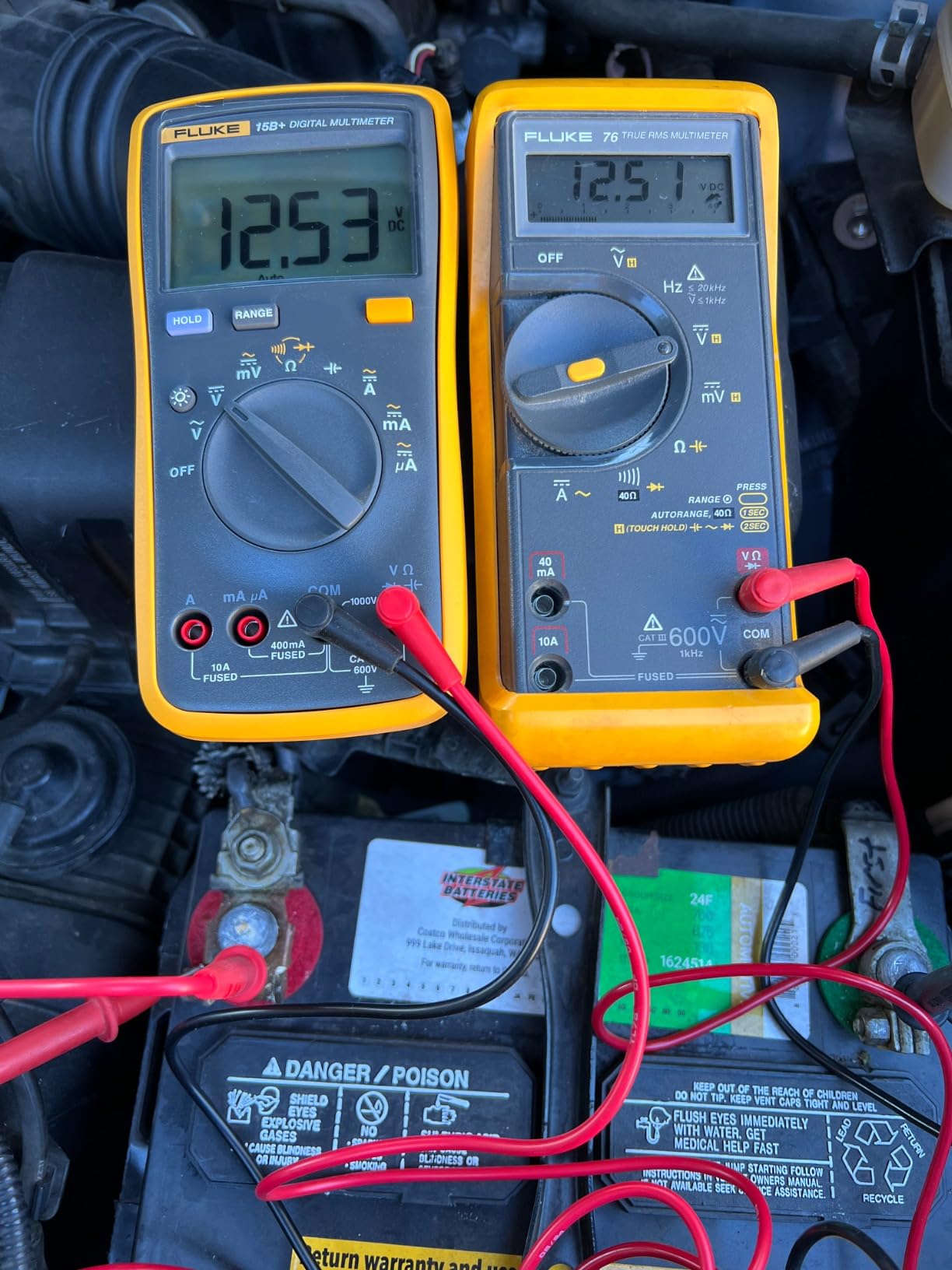
The 15B+ is where we would start if the deciding factor is that the reading has to be defensible. It carries a 4.8 from 987 reviews with 88 percent five-star, and owners upgrading from cheap meters report the difference is immediately obvious: dead-on accurate, rugged and straightforward, with a body that feels solid in the hand.
It is commonly bought as a reference instrument to check other bench meters against, which is a legitimate and underappreciated use. When one meter on a bench is your calibration standard, everything else you diagnose with becomes a measurement you can trust.
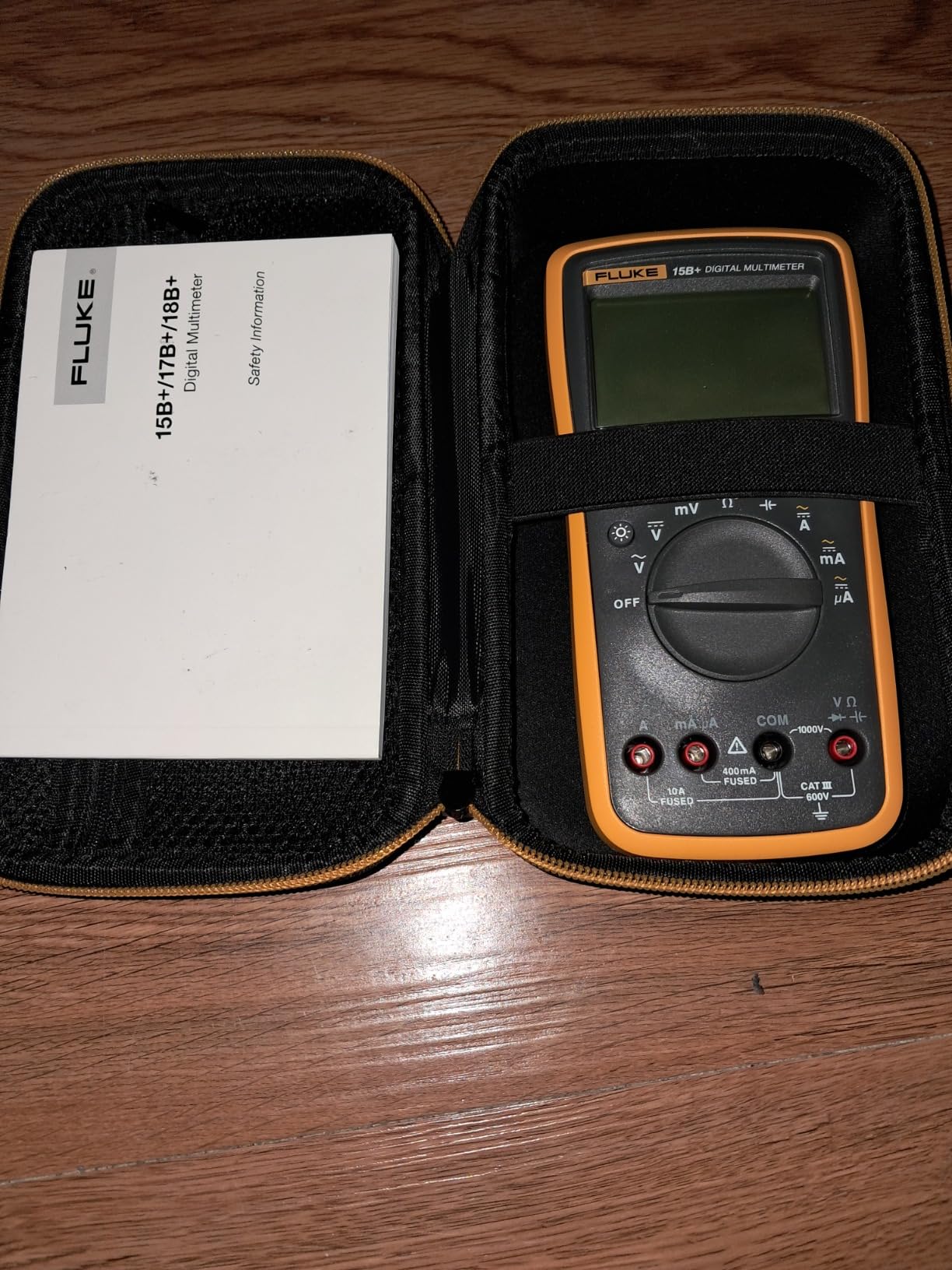
The measurement set is the full first-line diagnostic: AC and DC voltage to 1000V, AC and DC current to 10A on a dedicated input terminal, plus resistance, continuity, diode and capacitance. CAT III 600V certification and CE, CSA, ETL, EN 61010-1, IEC 61010-1:2000-1 and UL marks cover the residential and commercial environments a technician actually works in. Fluke TL75 test leads are included.
The gap that stops it being our top pick is frequency and temperature. That is exactly what the 17B+ adds, and if you are deciding between the two, that is the whole decision. If you only work on low-voltage DC, the 15B+ covers it and the extra spend is unnecessary.
The second gap is true RMS. It is an average-responding meter, so distorted mains readings are not fully accurate. For board-level work on rectified and switched supplies that matters less than you might think, since you are reading DC rails, but it does rule it out for waveform-accurate AC measurement.
When this meter earns its place on your bench
It suits technicians and electricians who need certified safety and repeatable accuracy rather than a long feature list. The CAT III 600V rating is the reason it can go from a board to a distribution board without anyone questioning the reading.
At 460 g with an 8.46 by 2.76 by 5.91 inch footprint it is a full-size handheld, and the straightforward dial layout means it stays fast to use once you know it.
When to pick a different meter instead
Choose the 17B+ if you need frequency or temperature. Choose a true RMS meter if you measure AC on non-sinusoidal signals. Choose a cheaper capacitance-capable model if the premium is the obstacle, since generic meters cover similar basics for a fraction of the outlay.
How to Choose a Digital Multimeter for Electronics Repair in 2026
Most buying advice for multimeters is written for electricians measuring mains. For electronics repair the priorities shift: resolution on low rails, capacitance, a fast continuity beep, and probes that can land on a 0402 pad. Here is how to think through the trade-offs that actually decide your purchase.
Resolution and display counts
Display counts describe how many digits the meter can show at full scale. A 1999-count meter on its 4V range resolves about 1mV per digit, so a 3.3V rail that has sagged from 3.30V to 3.28V reads as indistinguishable from healthy. A 6000-count or 9999-count meter gives you three or four times the resolution, and on modern 3.3V and 5V rails that difference is the difference between finding a fault and guessing at it.
Accuracy is quoted separately, and the number that matters is the full spec: a percentage of reading plus a count term. Two meters can both claim 0.5 percent accuracy when one of them is quoting at full scale. If accuracy is your concern, look for meters whose published specification includes both parts, because that is the only way to know what a reading at 3.3V is really worth.
True RMS, and when it matters to you
True RMS meters measure the actual root mean square of a signal rather than estimating it from an average-responding circuit. On a clean sine wave the two agree. On anything chopped, pulsed or switching, an average-responding meter can read low by a significant margin, and if you are diagnosing a switch-mode supply, a variable frequency drive or a dimmer-driven LED circuit, that error sends you hunting for a fault that is not there.
For pure DC board repair, true RMS is a nice-to-have rather than essential. Note also that on several affordable meters true RMS only applies to the upper ranges, so a specification that reads true RMS in small print can still surprise you at 5V. Check whether the behaviour applies across the range you will use.
Capacitance, diode test and continuity
Capacitance is the single function that separates a meter for repair from a meter for checking a battery. It lets you compare a suspect electrolytic against its marked value, see whether a ceramic has gone short, and screen a bulk capacitor before you commit to a full board-level diagnosis. Remember that capacitance measured in circuit includes everything parallel to it, so expect poor accuracy until the component is lifted, and look for a meter with a generous range that covers the big cans found in power supplies.
Diode test gives you a forward voltage reading, which is the fastest way to check a rectifier, an LED, a flyback diode or a MOSFET body diode. Continuity is simpler but see the note below. Transistor hFE sockets are the most over-hyped feature on cheap meters, because a wrong pinout in the adapter can halve the reading and send you after a healthy transistor. One detailed review in our testing found exactly that on a common adapter wired C-B-E.
Fused inputs and the blown-fuse failure mode
Almost every meter failure we hear about is a blown mA fuse caused by putting the leads in the wrong jack or by measuring current through a short. Check whether the current input is fused, what the fuse rating is, and whether you can replace it yourself with a common type. A meter with accessible ceramic fuses in the battery compartment is a real time-saver, and one with an unfused current input is a genuine hazard on a repair bench.
The lead-alert LEDs on the Klein MM420 are the cleverest mitigation we have seen: light up the correct jack so you cannot get it wrong in the first place. For a beginner, that removes more wasted hours than any other single feature.
Microamp and sleep-current measurement
Forum users ask about this repeatedly, and almost no buying guide covers it. A board that sleeps but drains a battery overnight is drawing current in the microamp range, where a standard 6000-count meter set to its 200mA or 20mA range is completely blind to. You need either a meter with a dedicated microamp range and adequate resolution, or a shunt plus a separate low-current instrument.
The practical warning is about the fused current input. Measuring microamps is current measurement, so you are on the same jack that blows fuses if you get it wrong. Confirm the fuse rating and the maximum measurement time before you start, because the fuse is rated for a duty cycle you may exceed.
Low-impedance mode and ghost voltage
High-impedance voltmeters can make a disconnected cable read tens of volts simply by picking up capacitive coupling from nearby wiring. That phantom reading, sometimes called a ghost voltage, is the cause of a lot of wasted diagnostic time, and it is why a meter reading does not always mean a live circuit. A low impedance mode, often shortened to LoZ, deliberately presents a heavy load that collapses the phantom reading, and technicians on r/electricians name it as the deciding feature that lets them root out ghost voltages quickly. If your work involves long unterminated cable runs, this is a function worth paying for.
CAT rating, probes and safe practice
The CAT rating describes the environment a meter is safe in, not the voltage it can survive. CAT II covers household receptacles, CAT III covers distribution panels and permanently installed equipment, and CAT IV covers the point of origin of an installation. For board work the rating matters less, but the same buying decision covers both if you repair anything electrical alongside electronics.
Probe quality is part of the meter, not an accessory to be chosen later. Standard probes are stiff and too fat for SMD pads, and their tips wear out quickly. Look for included fine-tip or needle probes, alligator clips for hands-free continuity work, and leads rated to the meter’s CAT level. Backprobing crowded connectors is where cheap probes cause shorts, and there is a real technique for it: use thin insulated wire or a fine needle probe, and probe one pin at a time rather than bracing a fat tip between two connectors.
On safe practice, the basics hold. De-energise before measuring resistance or continuity, discharge large capacitors before probing them, keep one hand free when working near mains, select the correct input jack before you touch the circuit, and treat a beep as a strong hint rather than proof.
What a multimeter cannot do
No competitor tells you this plainly, and it is the most useful thing on this page. A digital multimeter has no ESR measurement, so a capacitor that reads the correct capacitance but has climbed in equivalent series resistance will pass right by it. Capacitance measured in circuit is unreliable for the same parallel-path reason noted above. A DMM samples too slowly to catch fast transients, so switching spikes and brief events are invisible. And a DMM cannot replace an oscilloscope for anything involving waveform shape, ripple over time, or noise.
That is not a flaw in the meters. It is a division of labour. A multimeter narrows a dead board down to a component; an oscilloscope tells you what that component is doing. If you have never used one, our [general multimeter roundup](https://www.exponation.net/best-multimeters/) covers the wider category, and good bench lighting matters as much as the instrument once you are working on a dark board. Our picks for [LED lighting for auto repair shops](https://www.exponation.net/best-led-lighting-for-auto-repair-shops/) are worth a look if your bench lighting is the weak link in the room.
Handheld, benchtop, and which tier to buy
A handheld meter with a rotary dial is faster for probing, survives being dropped, and is the right choice for almost all repair work. A benchtop meter with a screen, logging and remote probes earns its space when you want to watch a rail over time, log measurements to a computer, or keep one instrument powered and always visible. Many technicians end up with one of each, and one owner in our testing mentioned buying a second meter specifically so a primary bench instrument is never out of service.
Rather than price bands, tier by function. At the entry level, a 4000-count meter with capacitance and non-contact detection covers hobby electronics and first repairs. At the mid level, a 6000-count true RMS meter with capacitance, temperature and frequency covers professional board work and power supplies, which is where most of this list lives. Above that, a 9999-count or card-format meter with waveform viewing, monitoring or 40 MOhm-plus leakage ranges fills a specific gap. Reference-grade brands sit on top as your calibration standard rather than as your only tool.
One buying criterion that appears repeatedly on forums and is worth weighing is whether the meter gives false readings when its battery is low. Readers on EEVblog treat this as a genuine deal-breaker, and it makes sense: a tired cell in a cheap meter can quietly shift readings, and you will blame a component that is working perfectly. If the manufacturer does not say the meter warns you or holds accuracy until the cell fails, treat that as a question to ask.
Frequently Asked Questions
What is the best multimeter for electronics?
The best all-round choice for electronics repair in this roundup is the AstroAI 6000-count True RMS meter, because it combines true RMS, a wide and accurate capacitance range, a fast continuity beep and a magnetic back mount. If accuracy is your overriding concern, the Fluke 17B+ is the reference-grade option, and if you are new to repair, the Klein MM420 removes the most common beginner mistakes at the hardware level.
What is the best budget multimeter for electronics?
Among budget options, the AstroAI DM130B is the strongest first meter for board work because it includes capacitance testing and non-contact voltage detection on a 4000-count auto-ranging body. The Crenova MS8233D goes further and adds true RMS, temperature and frequency plus a full accessory kit, while the Thsinde 43180-66526 is the one to pick if you want a 9V battery that will not leak on a long-lived bench.
Is a Fluke or Klein multimeter better?
Fluke is the accuracy and certification choice, with the highest ratings in this roundup and CAT III 600V certification on both models listed. Klein is the safety and durability choice, with lead-alert jack LEDs, drop testing to 6.6 feet and easily replaced ceramic fuses. For electronics repair specifically, Klein’s design details prevent more mistakes, while Fluke’s accuracy makes its readings the ones you trust when a reading is borderline.
Is Fluke overpriced?
It is expensive relative to generic meters, but the gap narrows when you account for what you are buying: a published accuracy specification including the count term, a CAT safety certification, and a build that survives years on a bench. The practical question is whether you need a reference instrument. If you only work on low-voltage DC boards, a capacitance-capable 6000-count meter covers most of the work and the Fluke premium buys you very little.
Is a True RMS multimeter better for electronics repair?
True RMS matters most when you measure AC that is not a clean sine wave, such as a switch-mode supply output, a variable frequency drive output or a dimmed LED circuit, where an average-responding meter can read low by a significant margin. For straight DC rail testing on a circuit board it makes little difference, because you are reading DC. Check anyway that true RMS applies to the lower ranges you actually use, since some affordable meters restrict it to the upper ranges.
What does the continuity beep mode mean?
Continuity mode applies a small test current between the probes and beeps when the resistance is below a threshold. A beep is not proof of a good connection, because the threshold varies by meter, and a marginal joint can beep on one meter and not on another. Confirm any important result with the resistance reading in ohms, and remember that a long trace, a corroded connector or a resistor in series will all produce a non-zero reading even when the circuit is fine.
What is a bad continuity reading?
A bad continuity reading is a low resistance where you expected a high one, which is how you find a shorted trace or a failed component bridging two rails. It can also be a rising reading in the many-kiloohm range on a circuit that should read open, which points at contamination, flux residue or moisture. Neither conclusion should be drawn from a beep alone, so take the resistance reading and, where the value matters, lift one end of the component to remove parallel paths.
Why is my multimeter not working for continuity testing?
Check four things in order. First, confirm the battery is healthy, because a tired cell in a cheap meter is a documented cause of false readings. Second, verify the lead jacks are seated properly, since a loose lead fails open and reads infinite. Third, test the meter on a known-good connection such as the probes touching together, which should beep. Fourth, check that you are on the continuity function and not still in a voltage mode, which is the most common cause of silence on a perfectly healthy circuit.
Can a multimeter replace an oscilloscope for basic diagnostics?
No. A multimeter measures a value at an instant or an average over its sample window, so switching spikes, brief transients and waveform shape are invisible to it, and it has no ESR measurement to test a capacitor’s health under load. It also reads capacitance unreliably in circuit because of parallel paths. What it does brilliantly is narrowing a dead board down to a component, which is the step an oscilloscope then takes over from.
Which Digital Multimeter Should You Buy?
Buy the AstroAI 6000-count True RMS if you want one meter that covers the widest range of board-level work and you are starting out or upgrading from something basic. It is our pick because the combination of true RMS, verified capacitance range, fast continuity and a magnetic back mount is hard to find elsewhere at this level, and it carries more than 20,000 reviews at a 4.6 average.
Buy the Klein MM420 instead if you are new to repair and your main risk is user error, or if your work takes the meter out of the workshop. Buy the Fluke 17B+ if the reading has to be defensible and you want frequency and temperature. Buy the FNIRSI DMT-99 if you spend your time in switch-mode supplies and chasing intermittent faults, and the Hioki 3244-60 as a specialist companion if you restore vintage equipment and suspect leakage.
Whatever you choose, replace the batteries before first use, check the current input is fused, and remember that a multimeter narrows the fault to a component. Deciding what that component is doing under load is still an oscilloscope job. Last tested September 2026.