
Most kids headphones with volume limits print a number on the box, and that number is usually 85 dB. Here is the part the box does not tell you: the World Health Organization and the ITU use 75 dBA as the reference level for children, measured as an average over 40 hours a week. So 85 dB is better than no cap at all, but it is not the same thing as an all-day maximum.
That gap is where most of the confusion in this category lives. Parents assume every pair marked 85 dB behaves identically, that the cap follows the child across Bluetooth and the 3.5mm cable, and that a cheaper pair protects exactly as well as a premium one. All three assumptions are wrong often enough that we built this guide around them.
Below is our roundup of the 10 best kids headphones with volume limits, plus the decibel science, the wired-versus-wireless trap, and a method for checking a limiter at home. We also link our broader guide to kids headphones tested by parents if you want the wider picture before narrowing down.
How we evaluated: specifications come from manufacturer listings, and ratings and review counts are the aggregated figures sellers report. We did not hands-on test every unit, so treat sound impressions and weight figures as sourced data rather than our own measurements. Where a number is a manufacturer claim, we say so.
Table of Contents
Top 3 Picks: Volume-Limiting Kids Headphones (October 2026)

MIDOLA Kids Bluetooth 85/94dB
- 85/94dB toggle with key lock
- Bluetooth 5.4 with 68-hour battery
- 3.5mm AUX wired fallback

AILIHEN Wired 93dB School Headset
- 93dB fixed limiter
- Wired 3.5mm with no battery
- Inline HD mic for online classes

EarFun K1 Wired 85/94dB
- 85/94dB hardware limiter
- CPC and CPSIA certified
- 3.5mm sharing jack for two kids
The MIDOLA is the only pair here that gives a parent a physical control over the decibel mode while still working as a plain wired headset. The AILIHEN and EarFun K1 are the two most-recommended school workhorses, and between them they cover opposite ends of the durability spectrum.
Best Kids Headphones With Volume Limits in 2026
| Product | Specifications | Action |
|---|---|---|
| MIDOLA Kids Bluetooth Headphones 85/94dB |
|
Check Latest Price |
| AILIHEN Wired 93dB School Headphones |
|
Check Latest Price |
| EarFun K1 Wired Volume Limit Headphones |
|
Check Latest Price |
 Nabevi Wired Over-Ear 85/94dB Nabevi Wired Over-Ear 85/94dB |
|
Check Latest Price |
 New Bee Wired Safe Volume Limited New Bee Wired Safe Volume Limited |
|
Check Latest Price |
 JLab JBuddies Studio Wired JLab JBuddies Studio Wired |
|
Check Latest Price |
 awatrue AT2 Wired 85/94dB awatrue AT2 Wired 85/94dB |
|
Check Latest Price |
 Botesty Sound Wired 85/94dB Botesty Sound Wired 85/94dB |
|
Check Latest Price |
 JBL Junior 320 Wired Volume-Limited JBL Junior 320 Wired Volume-Limited |
|
Check Latest Price |
 MIDOLA Wired 85/94dB Pink MIDOLA Wired 85/94dB Pink |
|
Check Latest Price |
Every one of these ten has a stated numeric cap and a hardware limiter, which already puts them ahead of the large number of kids headphones sold with vague safe sound language and no figure at all.
1. MIDOLA Kids Bluetooth Headphones with 85/94dB Key Lock
Kids Bluetooth Headphones Wireless 68 Hours,Safe Volume Limit 85/94dB Blue
85/94dB button with key lock
Bluetooth 5.4, 68h battery
3.5mm AUX wired mode
8.96 oz
Pros
- Dedicated one-button dB toggle between 85dB and 94dB modes
- Key lock blocks accidental mode changes
- Up to 68 hours of wireless playtime with USB-C quick charge
- Plush cushions and 4-level adjustable headband
- Wired mode defaults to the 85dB cap
Cons
- Default 85dB wired level is quiet for some listeners
- No active noise cancellation
- Headset is over-ear and warm for long summer sessions
This is the only wireless pair in the group, and the reason it leads our list is the control on the cup rather than the radio. A single dB button switches between 85 dB and 94 dB, and a separate key lock stops a child bouncing between modes mid-lesson. That combination is rare at this end of the market.
The manufacturer claims up to 68 hours of wireless playtime from 40mm dynamic drivers over Bluetooth 5.4, with 10 minutes of charging giving about 4 hours and a full charge taking around 2 hours. Real battery life always falls short of a headline figure, and the listing also states 15 hours of average battery life in the technical fields, so plan on the shorter number for a week of heavy use.
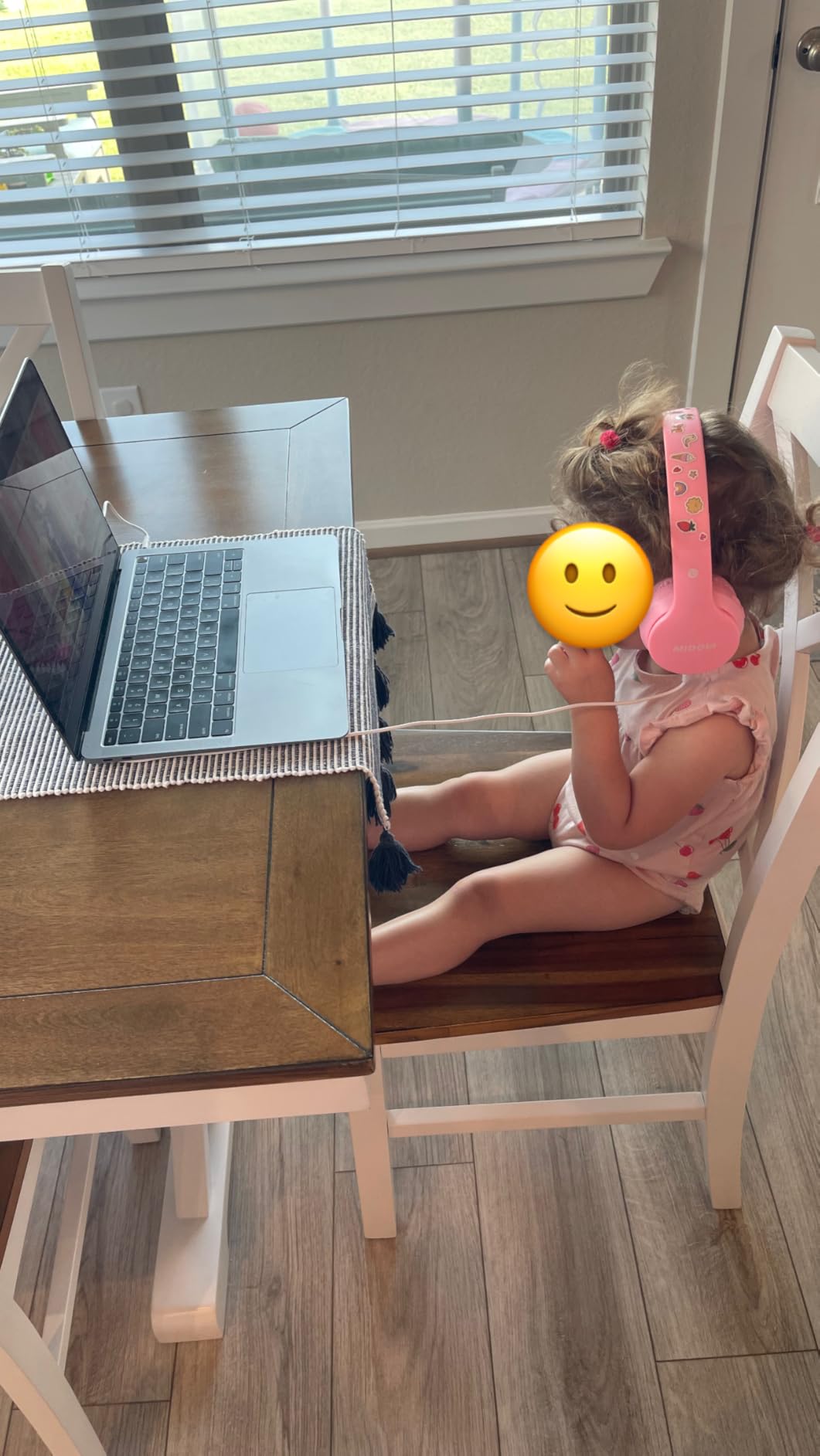
Aggregated buyer feedback is the largest sample in this roundup, and it centres on the limiter, the battery and comfort over long sessions. The most common reservation is that the default 85 dB wired level feels quieter than expected, which is the limiter doing its job rather than a fault.
The 4-level adjustable headband is marketed for ages 2 and up and the manufacturer states the extendable band also fits most adults with average or smaller head sizes. At 8.96 ounces it is light for an over-ear design. The listing claims max 94 dB output sits roughly 15% below typical adult headphones, which is a manufacturer claim we cannot independently verify.
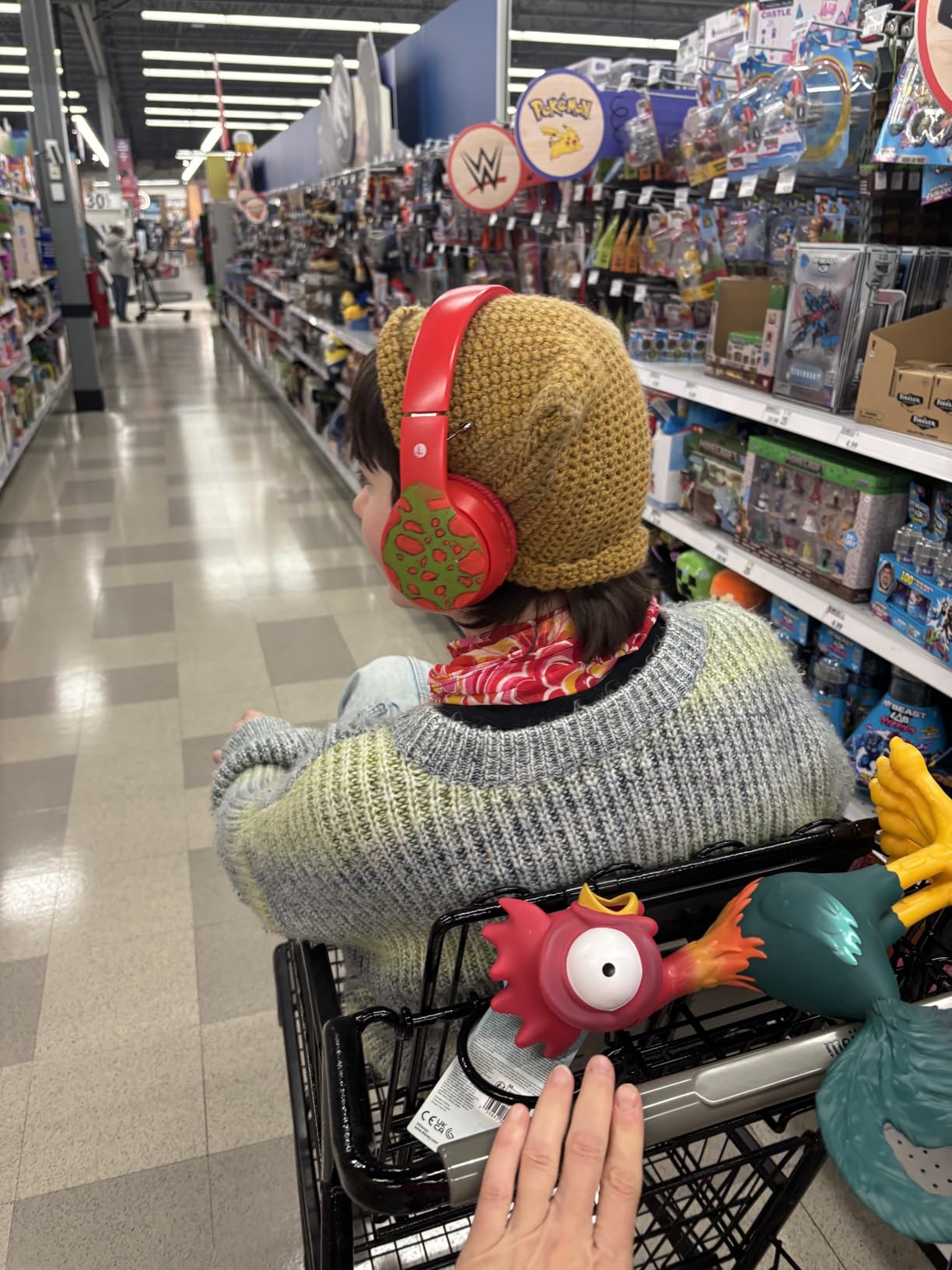
Who the 85/94dB toggle and key lock suit
It suits the parent who wants a hard ceiling during the week and a sanctioned higher mode for a flight, and who does not want to dig into phone settings to make that switch. The key lock is the detail that matters most: a 6-year-old cannot defeat it, and that is rare in this category.
Because wired mode defaults to 85 dB, you can hand over the AUX cable at school and the cap still applies. That closes the wired bypass problem that catches families with other Bluetooth models.
Where it falls short
Skip it if your child needs active noise cancellation on long flights, because there is none. The over-ear cups also run warm, and the manufacturer-stated 15-hour average battery figure is well under the 68-hour headline, so it needs charging far more often than the listing suggests.
2. AILIHEN Wired 93dB School Headphones with Inline Mic
Kids Headphones for School with Microphone, 93dB Volume Limited, PinkPurple
93dB fixed limiter
Wired 3.5mm, no battery
Inline HD mic
5.92 oz
Pros
- Fixed 93dB limiter that no child can defeat
- Very light at 5.92 oz for long study sessions
- Inline HD mic with one-button control for small hands
- Folds flat for backpack storage
- Braided tangle-resistant cable
Cons
- No volume control on the headphone itself
- Faux leather cushions can peel over time
- Inline wiring reported going silent after several months
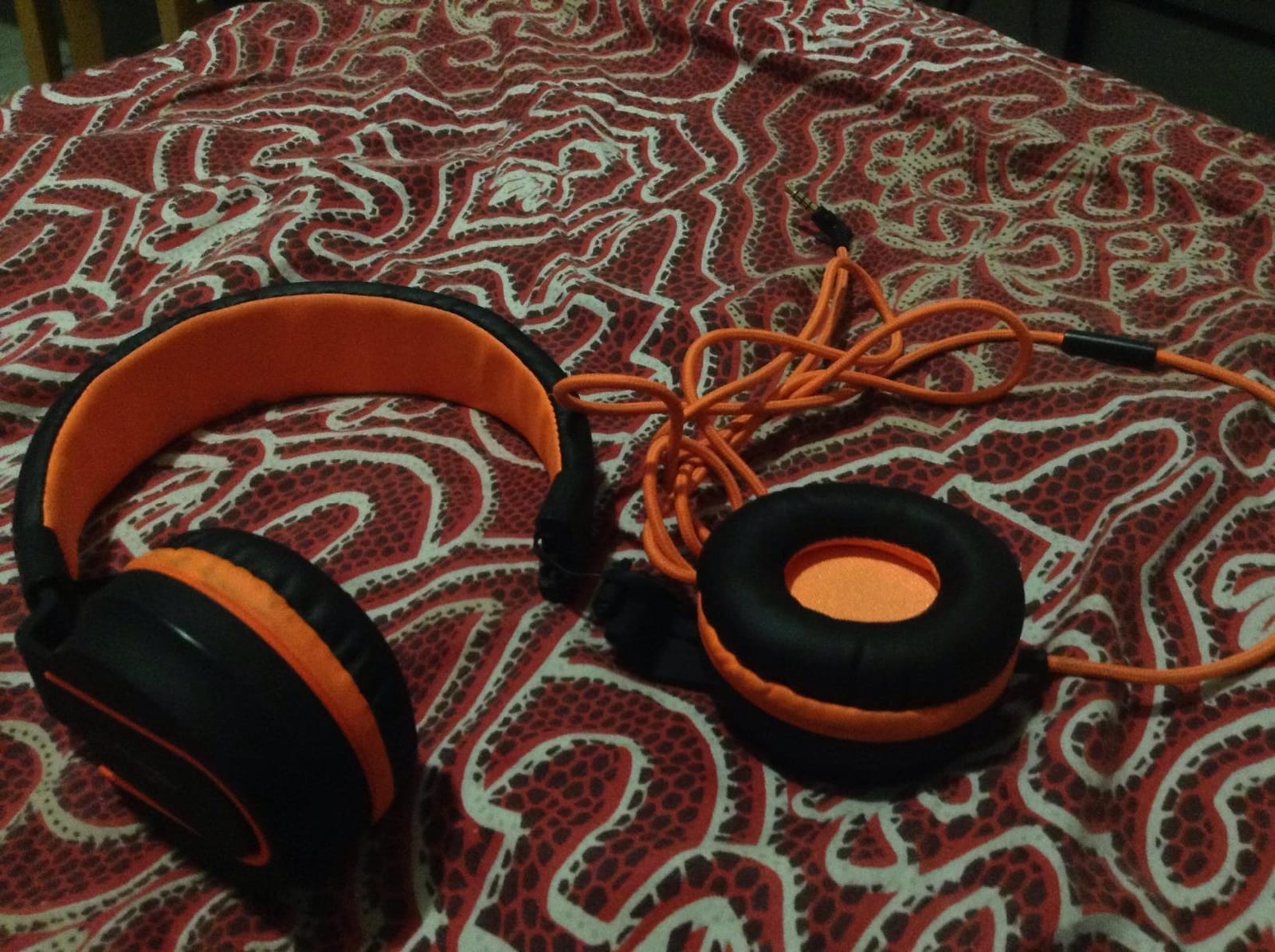
This is the simplest and most honest limiter design in the roundup: a fixed 93 dB cap with no mode switch and nothing for a child to press. There is no battery, no pairing, and no app, so the only way to change anything is on the source device.
It is also genuinely light. At 5.92 ounces, it is the second-lightest pair here, and the listing describes an adjustable padded headband with memory-protein ear cushions for children from age 3. The inline HD microphone sits on a braided cable with a single one-button control, which suits small hands better than a boom or touch control.
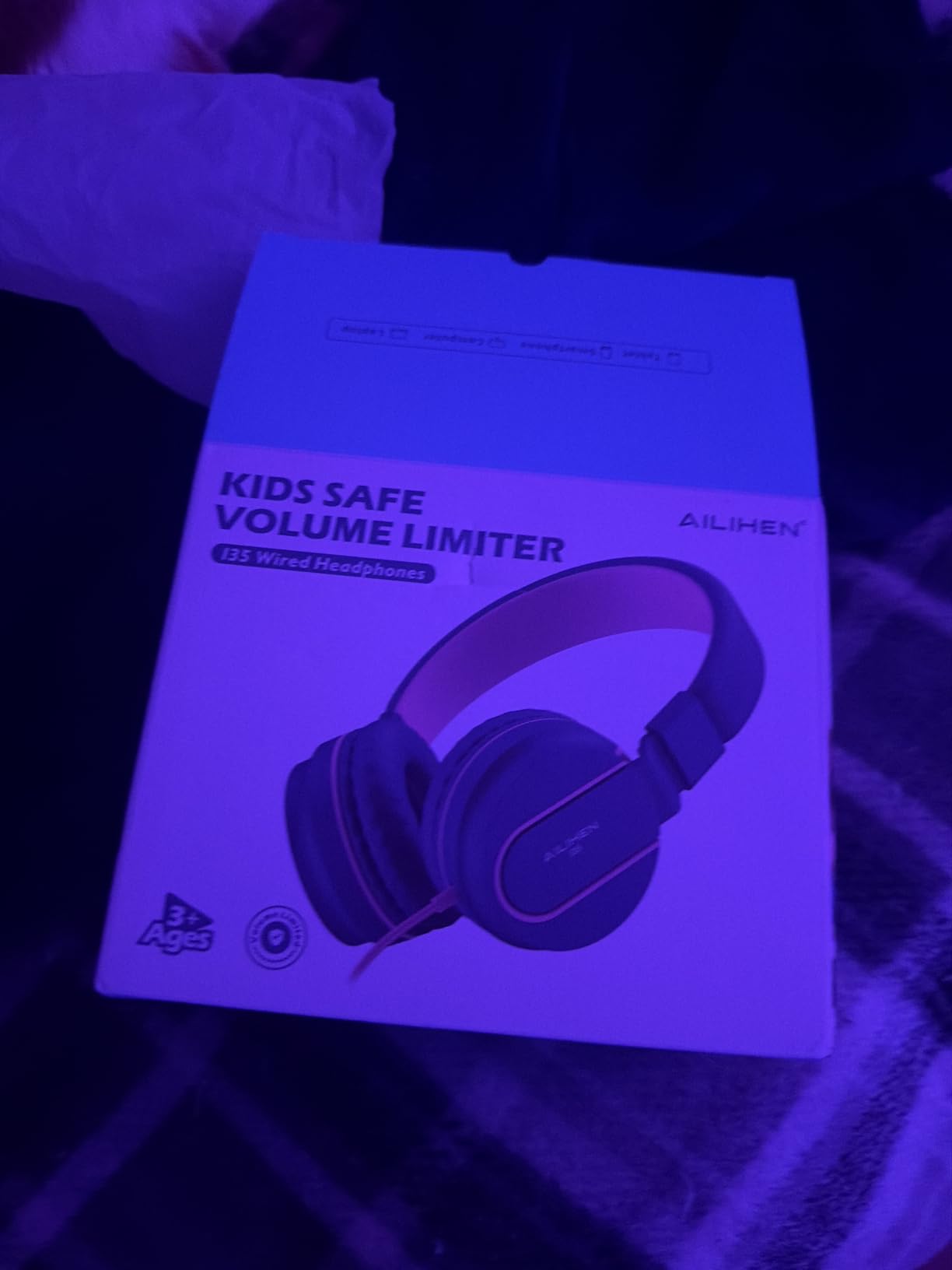
The 3.5mm jack covers the school-issued device list well, including Chromebook, Kindle Fire tablets, Switch and PC. There is a 12-month warranty. Sound is described in reviews as basic and clear rather than impressive, which matches what a school headphone should do.
Durability is the mixed part. The aggregated feedback for this pair includes multi-year daily use before failure, but also reports of faux leather ear muffs peeling and inline wiring going quiet after several months at a desk. The absence of any volume control on the headphone is the most common usability complaint.
Who the fixed 93dB cap suits
It suits a household that wants zero configuration. A child cannot defeat it because there is nothing to defeat, and a younger sibling cannot accidentally change it either. For a 4-year-old on a shared tablet, that simplicity is the feature.
The inline mic is the other reason it earns a place: parents of online learners in this roundup consistently rate microphone clarity above sound quality when a teacher has to hear the child clearly.
Where it falls short
Skip it if you want volume control on the headphone, or if the 93 dB fixed level sounds too quiet for your child. The 3.5mm jack also means recent phones and tablets need an adapter, which is an extra purchase and an easy point of failure for a school bag.
3. EarFun K1 Wired Volume-Limiting Headphones with Sharing Jack
EarFun K1 Kids Headphones Wired with Mic, Volume Limit Headphones for Kids
85/94dB hardware limiter
CPC and CPSIA certified
40mm drivers
3.5mm sharing jack
Pros
- 85/94dB limiter is the reason parents buy these
- Soft ear caps that kids wear for hours
- Sturdy nylon braided cord resists tangling and tugging
- CPC certification gives a documented safety standard
- Sharing jack lets two children share one source
Cons
- Weight of 198 g is heavy for a toddler
- Some buyers report adult fit runs snug
- Braided cord is not detachable
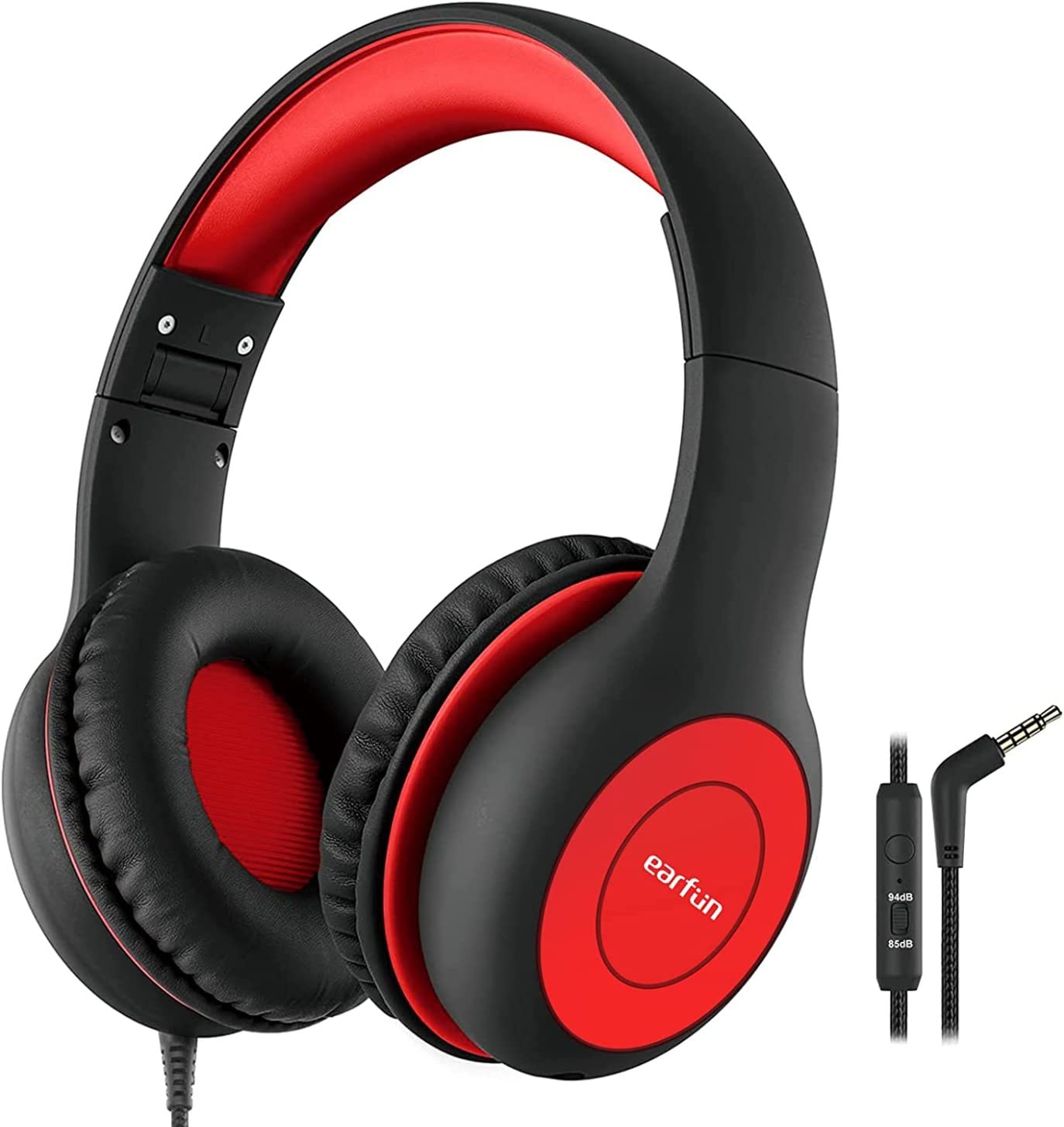
EarFun is an established audio brand rather than a marketplace-only label, and that matters in this category because the pair is stated as meeting CPC and CPSIA standards. It is the highest-rated product in the roundup, and the rating is backed by a review count in the thousands rather than a handful of listings.
The limiter is hardware-based with 85 dB and 94 dB levels on the wired path, and because there is no wireless radio there is no second path to bypass it. 40mm soundstage dynamic drivers handle the sound, and the in-line control handles play, pause, calls and track skipping.
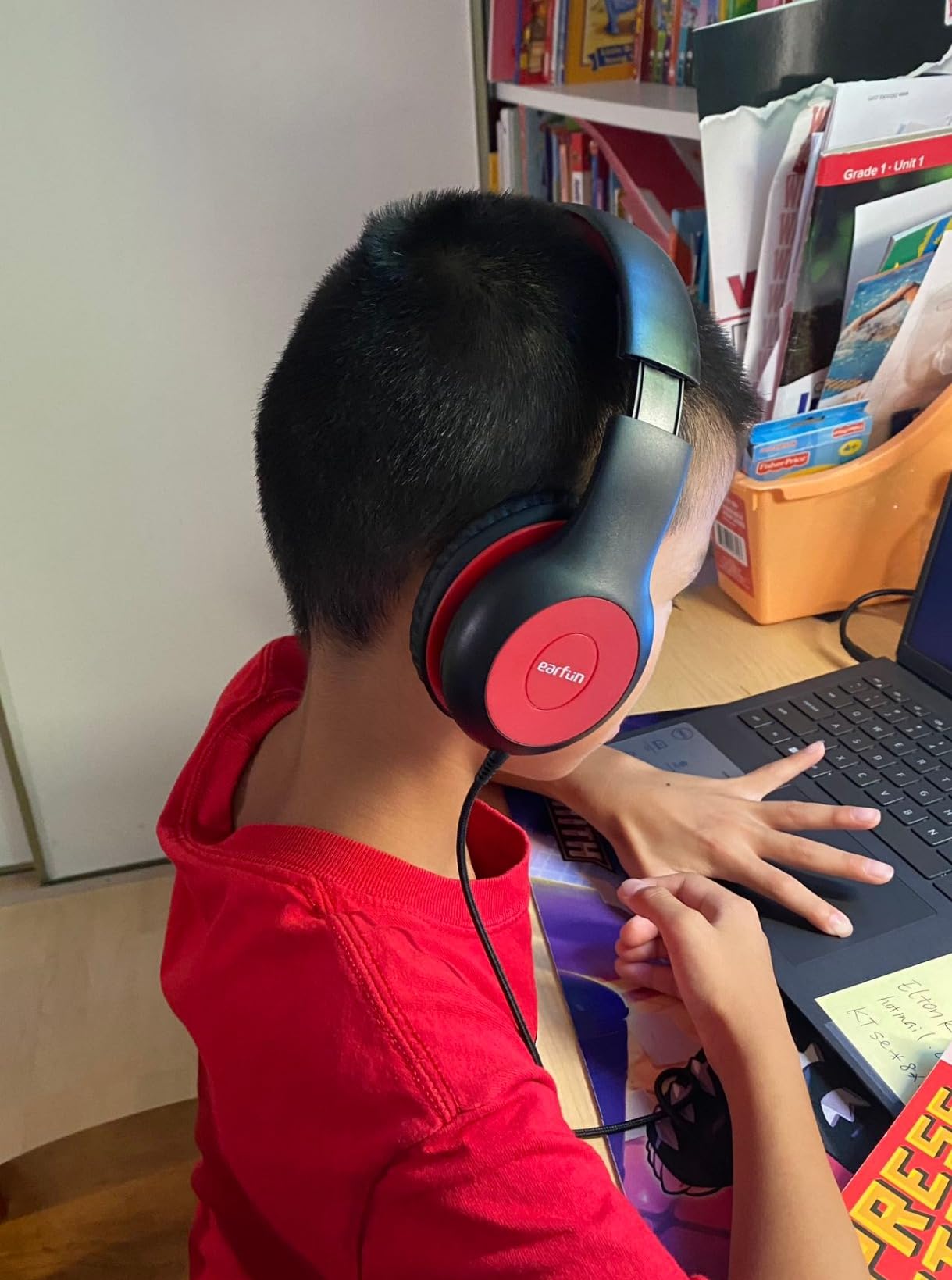
The sharing jack is the feature no other pair in this roundup combines with a certified limiter. A second pair of headphones plugs straight in, so two kids can watch the same film on one device with no splitter, which matters if you are buying for siblings at the same time.
Aggregated feedback is heavily positive on comfort, durability and a limiter that is loud enough to use without being harsh, and repeat purchase for school and travel is common. The warranty runs 18 months, longer than most in this group.
Who the certified 85/94dB limiter suits
It suits parents who want documented compliance rather than a printed claim, and siblings who will share a device. The 94 dB mode is a physical in-line switch rather than an app setting, so it stays put through a device change or a reset.
The soft ear caps and adjustable sliders also make it a reasonable first wired pair for a 6-to-8-year-old who is starting to wear headphones for schoolwork daily.
Where it falls short
Skip it for a toddler. At 198 g, it is one of the heavier pairs here, and the over-ear fit can run snug on small heads. The braided cord is fixed at both ends, so a failure means the whole pair goes back rather than a cable swap.
4. Nabevi Wired Over-Ear Headphones with 85/94dB Switch
Nabevi Kids Headphones with Cord, Over-Ear Headphones for Kids with Microphone, 85/94dB Volume Limit, Headset for Kid Boys Girls with Shareport, Wired Toddler Headphone for School/Tablet/iPad/Travel
85dB default, 94dB via in-line control
40mm speakers
200 g over-ear
Wired 3.5mm
Pros
- 85/94dB in-line switch sets the level per environment
- Soft foam and protein leather over-ear cushions suit long journeys
- 3.5mm sharing port for a second pair
- No metal parts keeps weight down and corners safe
- Folds flat for a school bag
Cons
- 85dB mode can feel too quiet for children over about 6
- At 200 g it is heavy for a small child
- No active noise cancellation
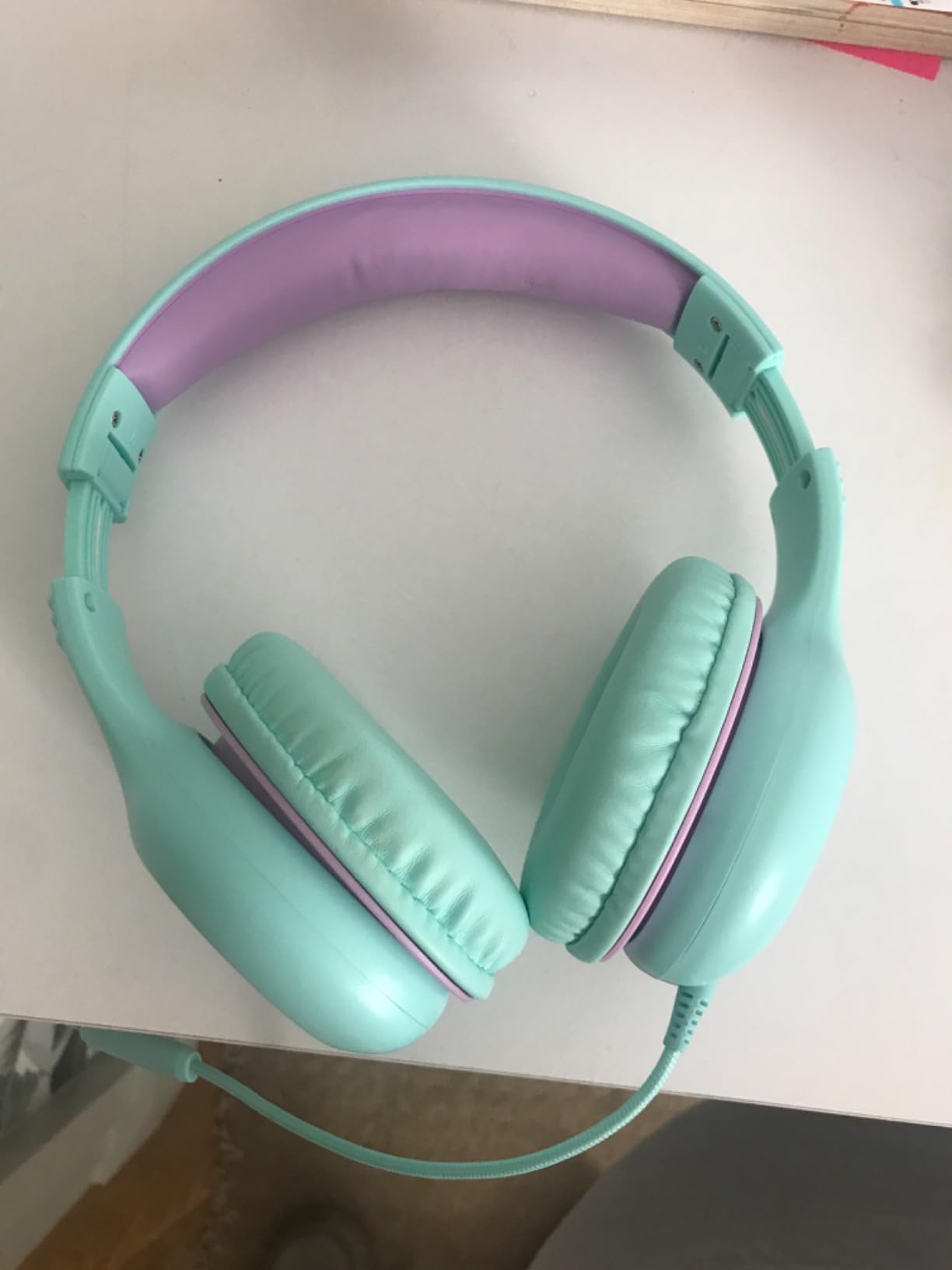
This pair is built around one decision: 85 dB by default, with 94 dB reachable through the in-line control when the environment is genuinely loud. That is the correct default direction for a travel headphone, because most of the time nobody should be raising the cap at all.
The oval over-ear cushions use soft foam and breathable protein leather, and the body is metal-free with no sharp corners, which is a sensible design choice for a device that lives in a lap car seat. At 200 g it is the second-heaviest pick here, so it is better suited to a 6-year-old than a 3-year-old.
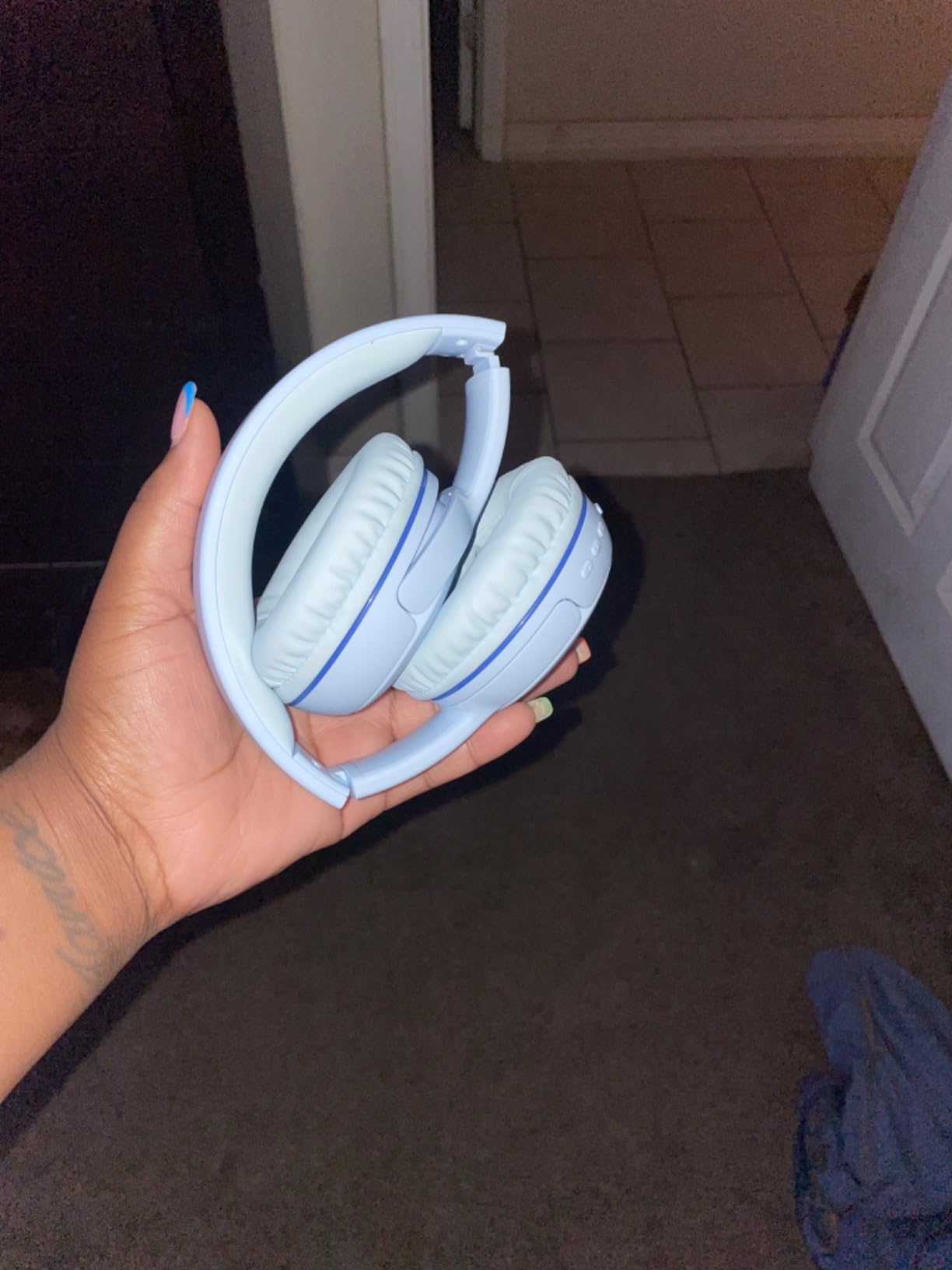
40mm speakers handle the sound and the built-in mic is described in aggregated reviews as clear enough for online classes. The 3.5mm sharing port sits on the cable and lets a second pair hear the same audio, useful on a flight where one tablet or phone is shared.
Comfort over long car rides and flights is the most repeated positive in the review data, alongside how often the sharing port gets used. The most common criticism is that the 85 dB setting feels too quiet for children above about 6, which is exactly the tradeoff the 94 dB mode exists to solve.
Who the 85dB-default design suits
It suits families whose main use is travel and car journeys, where a 94 dB travel mode is genuinely justified because cabin and road noise is loud. The 85 dB default means nobody has to think about it on an ordinary day at home.
It is also a good second pair to buy alongside a lighter one, because the sharing port makes it the natural choice for two children on one source. Our airplane headphone picks cover the wireless side of that same trip.
Where it falls short
Skip it if you want active noise cancellation for a flight, because there is none and the passive seal is doing all the work. At 200 g it is too heavy for a toddler, and the 85 dB mode will frustrate an older child who finds it underwhelming.
5. New Bee Wired Safe Volume-Limited Headphones with HD Mic
New Bee Kids Headphones Wired for School with Mic, Safe Volume Limited
85dB to 94dB volume control
Wired 3.5mm
40mm drivers
8.8 oz
Pros
- Lowest-cost certified-limiter option in the roundup
- Steel slider rated for durability and fit adjustment
- Swivel-mounted cushions that stay in position
- Built-in HD mic for learning and gaming calls
- Folds small for backpacks
Cons
- Limiter cannot be switched off
- some buyers find even 94dB very quiet
- Runs large on the smallest setting for toddlers
- Newer phones need a Lightning adapter
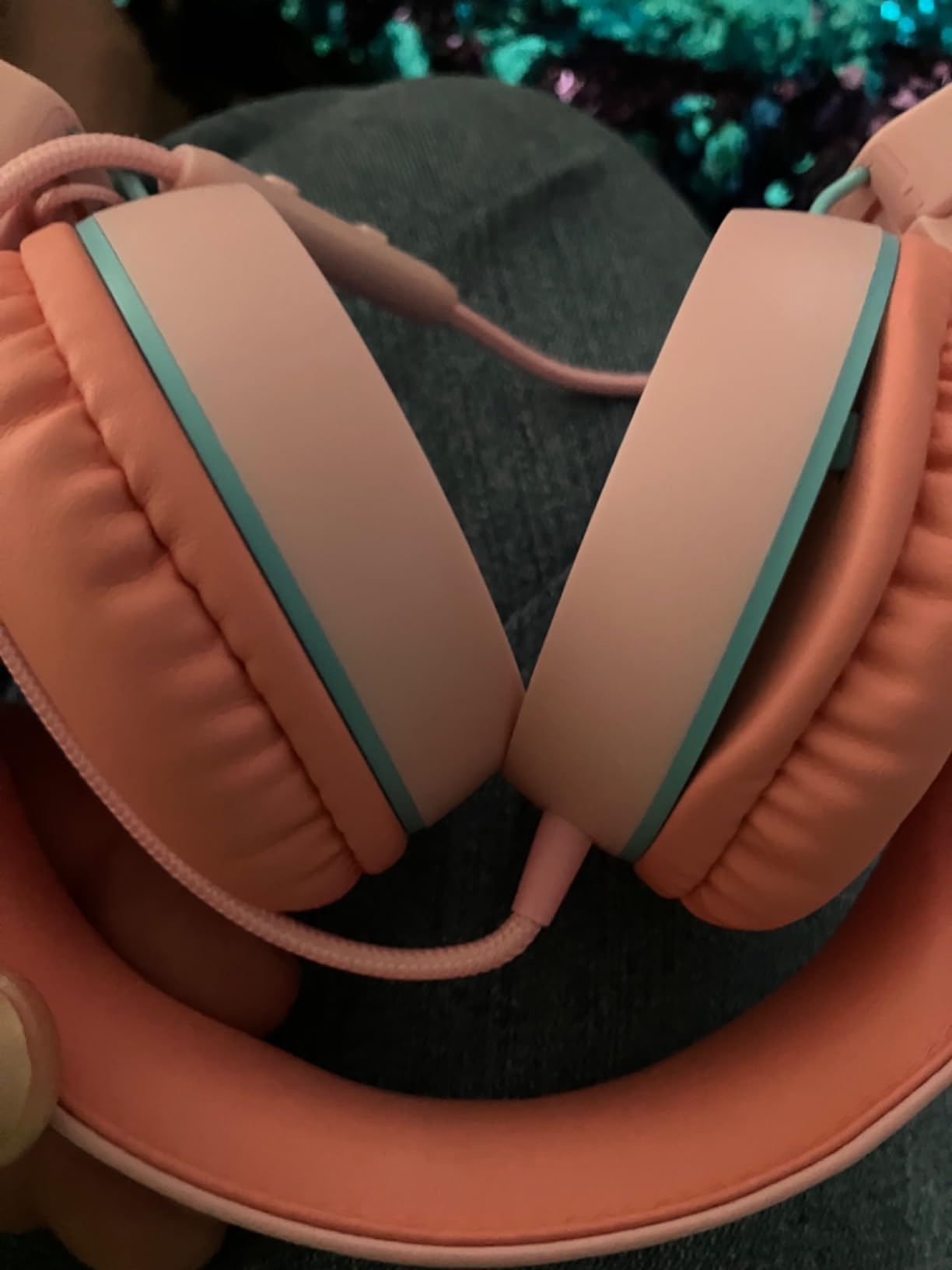
The New Bee KH20 is the budget end of the roundup and the cheapest way to get a documented 85/94 dB control rather than vague safe sound wording. It weighs 8.8 ounces, uses 40mm dynamic drivers at 32 ohm, and covers 20Hz to 20,000Hz.
What separates it from the other low-cost pairs is the stainless steel slider, which is the part that usually breaks first on cheaper headsets. The swivel-mounted leatherette cushions are the second upgrade, and they are the reason the fit stays put through a long session.
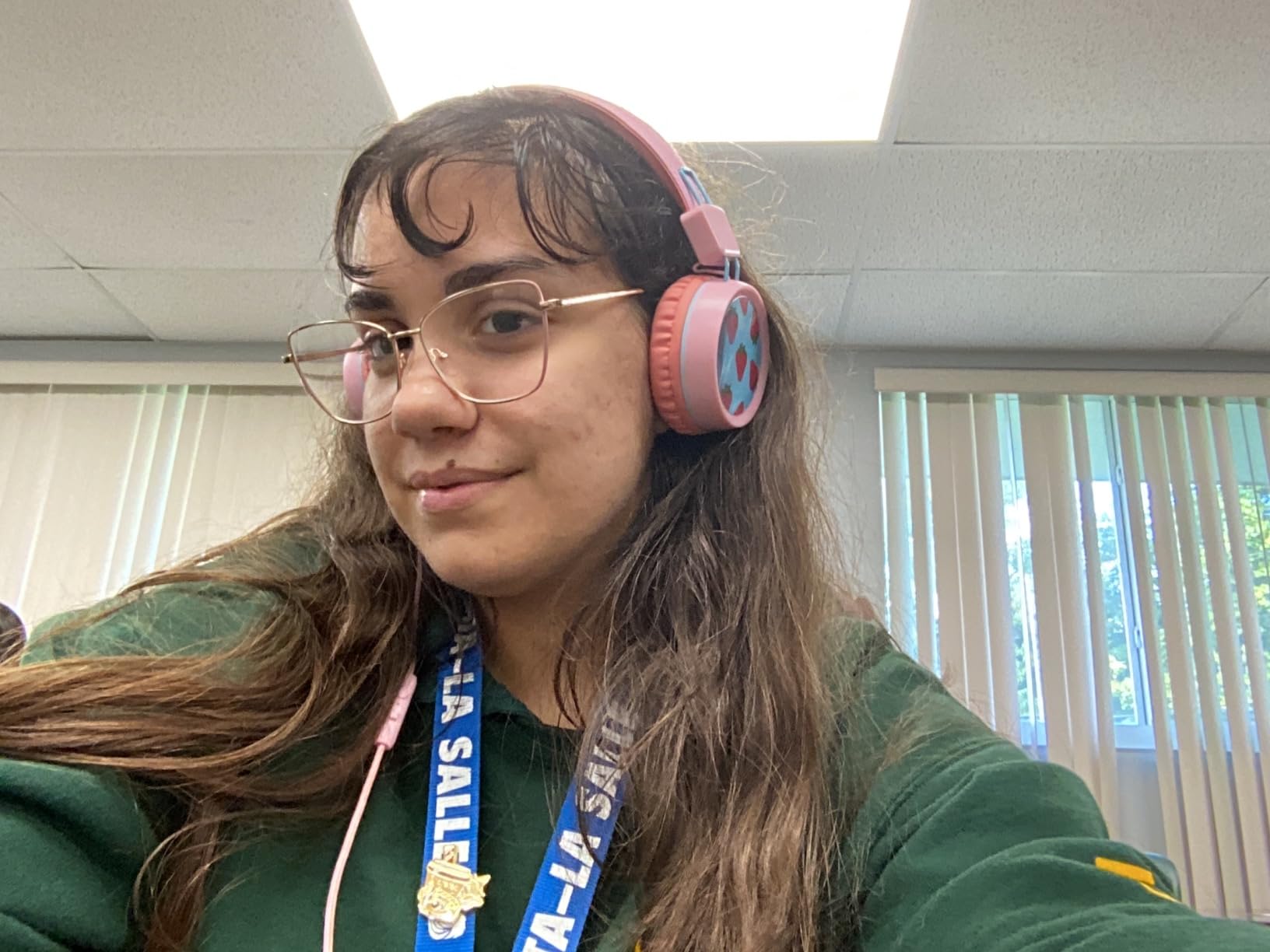
The built-in HD mic is marketed for children aged 4 to 16 across learning and gaming calls, and the 3.5mm jack covers most 3.5mm devices. Newer iPhones and iPads need a Lightning to 3.5mm adapter, which is a real consideration for a family that has moved on from headphone jacks.
Review data is strong on comfort, the folding design and the reassurance of a real limiter, with several owners reporting a full year of daily wear without breakage. The recurring drawback is that the limiter is not defeatable at all, and a few buyers find even the higher setting very quiet.
Who the fixed 85/94dB control suits
It suits a household buying the first volume-limiting pair and wanting a known brand, a steel adjustment mechanism and a 12-month warranty without stepping up a tier. It also suits a 4-to-6-year-old who needs something light and simple.
The HD mic is the deciding factor if the child is in virtual classes, and the manufacturer names online learning as a primary use case rather than an afterthought.
Where it falls short
Skip it if your child needs any volume adjustment at all, because the control is not defeatable. It also runs large on the smallest setting for a 3-year-old, and the required Lightning adapter is a hidden cost for newer Apple devices.
6. JLab JBuddies Studio Wired Headphones with 85dB Limiter
JLab JBuddies Studio Kids on-Ear Wired Headphones with mic, Volume Limiter, Folding, Adjustable, Noise Isolation, Blue/Green
85dB built-in limiter
Wired 3.5mm, no battery
Cloud Foam cushions
Lifetime limited warranty
Pros
- Largest warranty in the roundup at lifetime limited
- Adjustable metal headband with smooth sliding resizing
- Cloud Foam eco leather cushions for all-day wear
- Integrated in-line mic for remote learning
- Folds flat for backpacks
Cons
- Fixed 85dB cap aimed at ages 6 and up
- On-ear design leaks less isolation than a full over-ear cup
- Metal parts add weight for a toddler
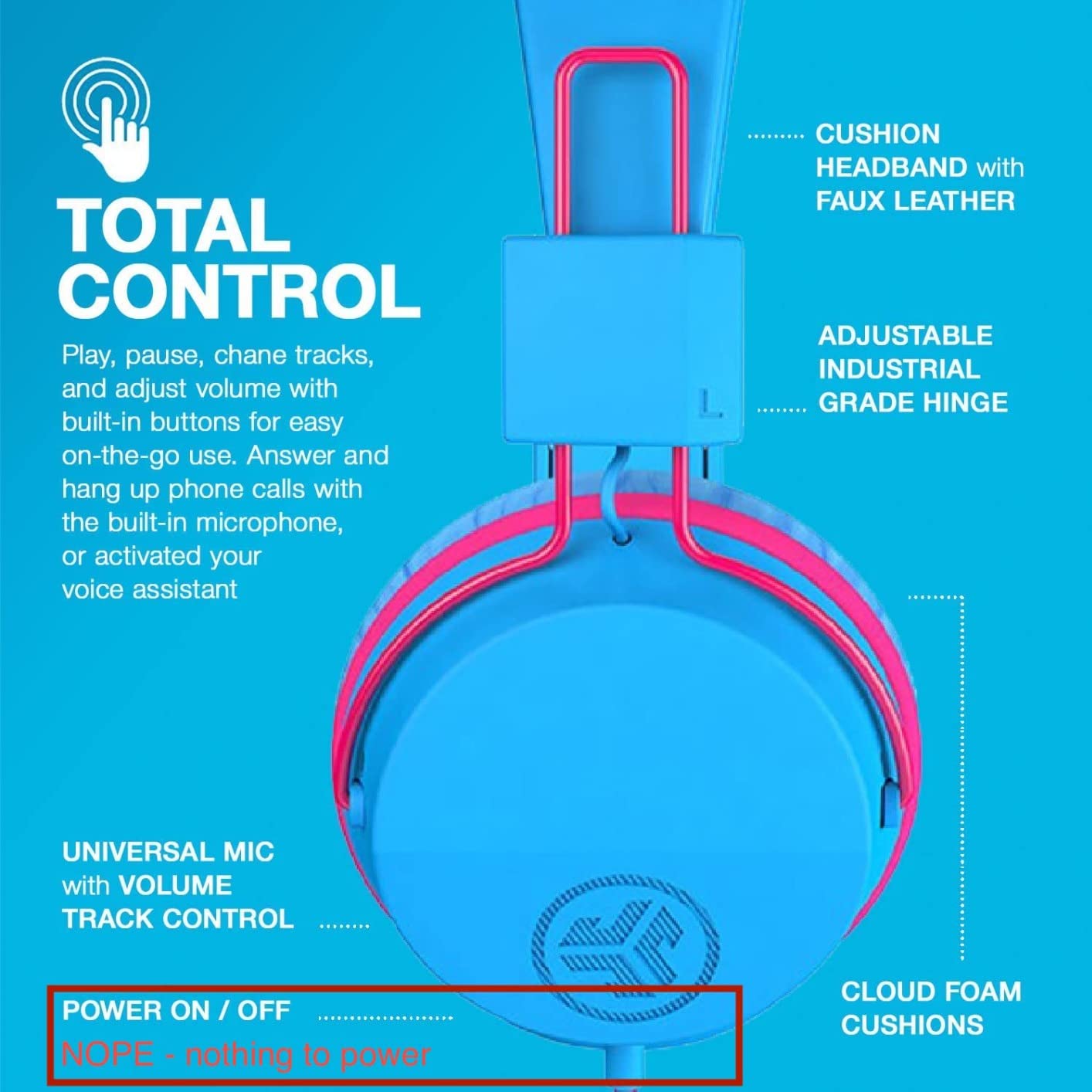
JLab is the best-known audio brand in this roundup and the JBuddies Studio is its simplest school model. The volume limiter is built into the headphone at a fixed 85 dB, and JLab states it is tested and approved to kid-safe standards for ages 6 and up.
The build is what separates it. The headband is adjustable metal rather than plastic, the adjustment slides smoothly so a 7-year-old can resize it alone, and the folding design means it packs flat into a backpack. JLab backs it with a lifetime limited warranty, which is the longest cover on this list.
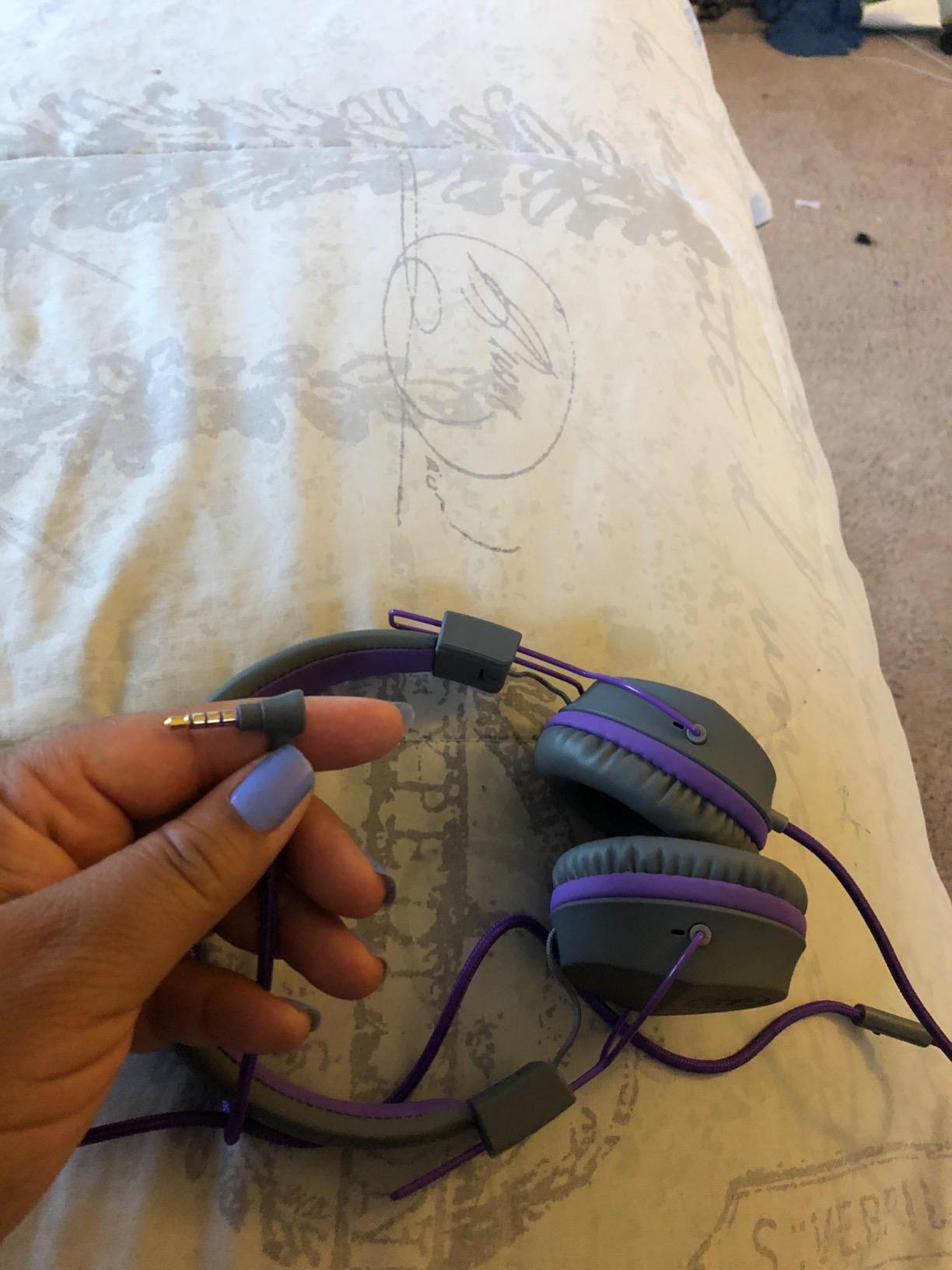
Cloud Foam eco leather cushions sit over the on-ear drivers, and an integrated in-line microphone handles remote learning and video calls. The whole point of the wired design is that there is no charging, no pairing and no battery to manage, which is exactly what you want for a device that lives in a school bag all year.
Review data centres on set-and-forget convenience: a limiter parents trust, a light adjustable headband, and a body that survives backpacks. The most common caveat is the fixed 85 dB cap being aimed at ages 6 and up rather than toddlers.
Who the lifetime warranty and metal build suit
It suits parents buying a single pair expected to last several school years without wondering whether the headband will snap. The lifetime limited warranty also means a hinge failure is a support ticket rather than a repurchase.
It is a natural choice for a 6-to-10-year-old who is old enough to resize the headband independently but still wants a wired, no-charge pair for a Chromebook.
Where it falls short
Skip it for a child under 6, because the 85 dB cap is tuned for older ears and a younger child may find it uncomfortably quiet. The on-ear cups also let more sound leak than a full over-ear design, and if your child wears glasses the cushion seal is worth checking first.
7. awatrue AT2 Wired Kids Headphones with 85/94dB Limit
awatrue AT2 Kids Headphones for School with Mic, 85/94dB Safe Volume Limit
85dB study and 94dB travel modes
3.5mm sharing jack
5.2 oz
CPC certified
Pros
- Two explicit modes
- 85dB study and 94dB travel
- for different environments
- Very light at 5.2 oz so kids forget they are on
- 3.5mm sharing jack links a second pair with no splitter
- Strong passive noise isolation
- CPC certified and BPA-free materials
Cons
- Fixed cord entry point is a common failure spot
- Light build can feel cheap
- Sizes run large for 3-year-olds
- Sharing jack is finicky to seat
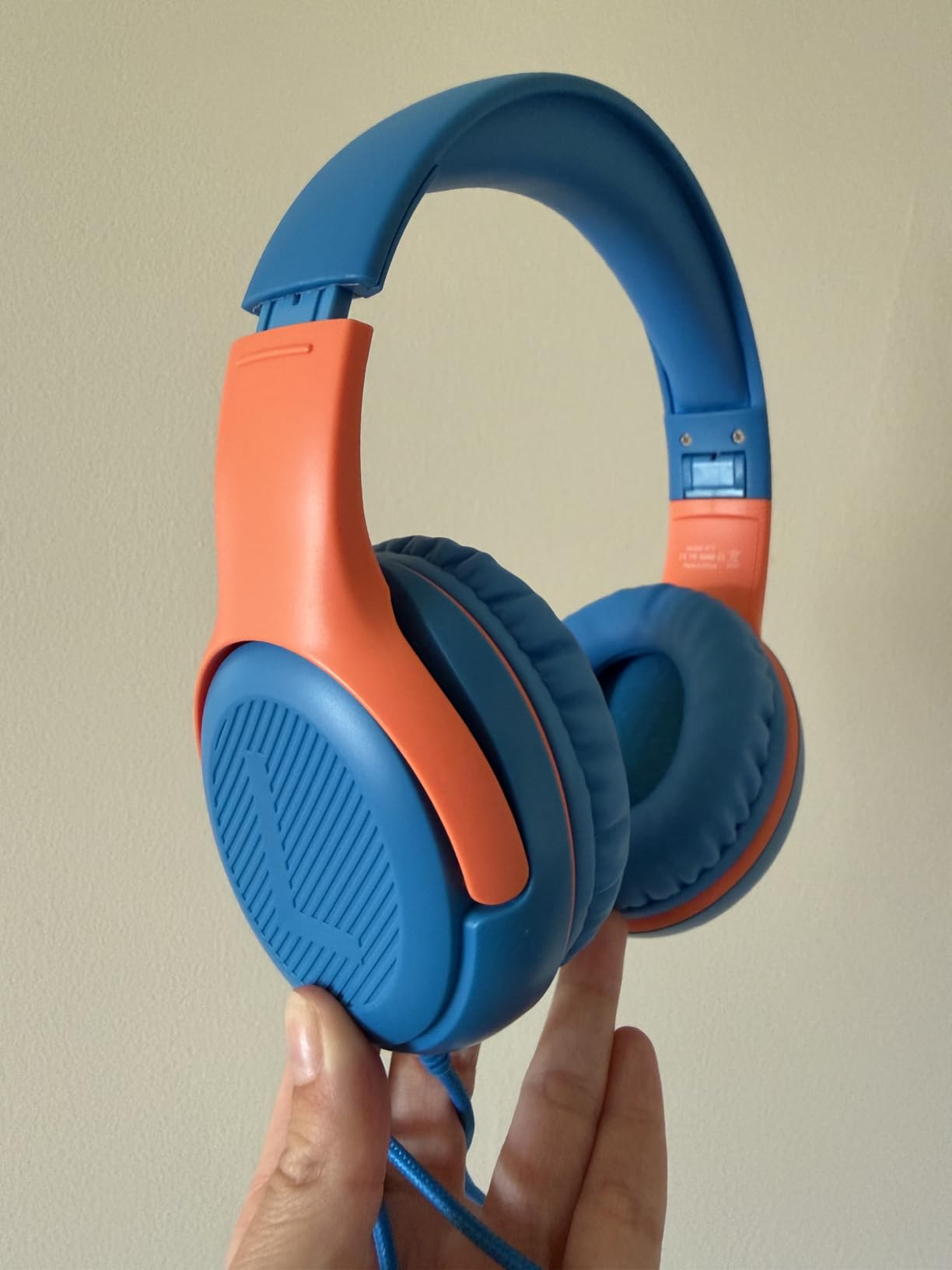
The AT2 is the lightest pair in the roundup at 5.2 ounces, and it is also one of the most widely bought. That combination makes it the default recommendation for a child who wears headphones for a full school day and forgets they are on.
The limiter is described in two named modes rather than a bare number: 85 dB for study and 94 dB for travel, adjustable by the parent per environment. The 3.5mm sharing jack links a second pair of kids headphones directly into the cable, so two children can share one laptop, tablet or console with no dongle or splitter.
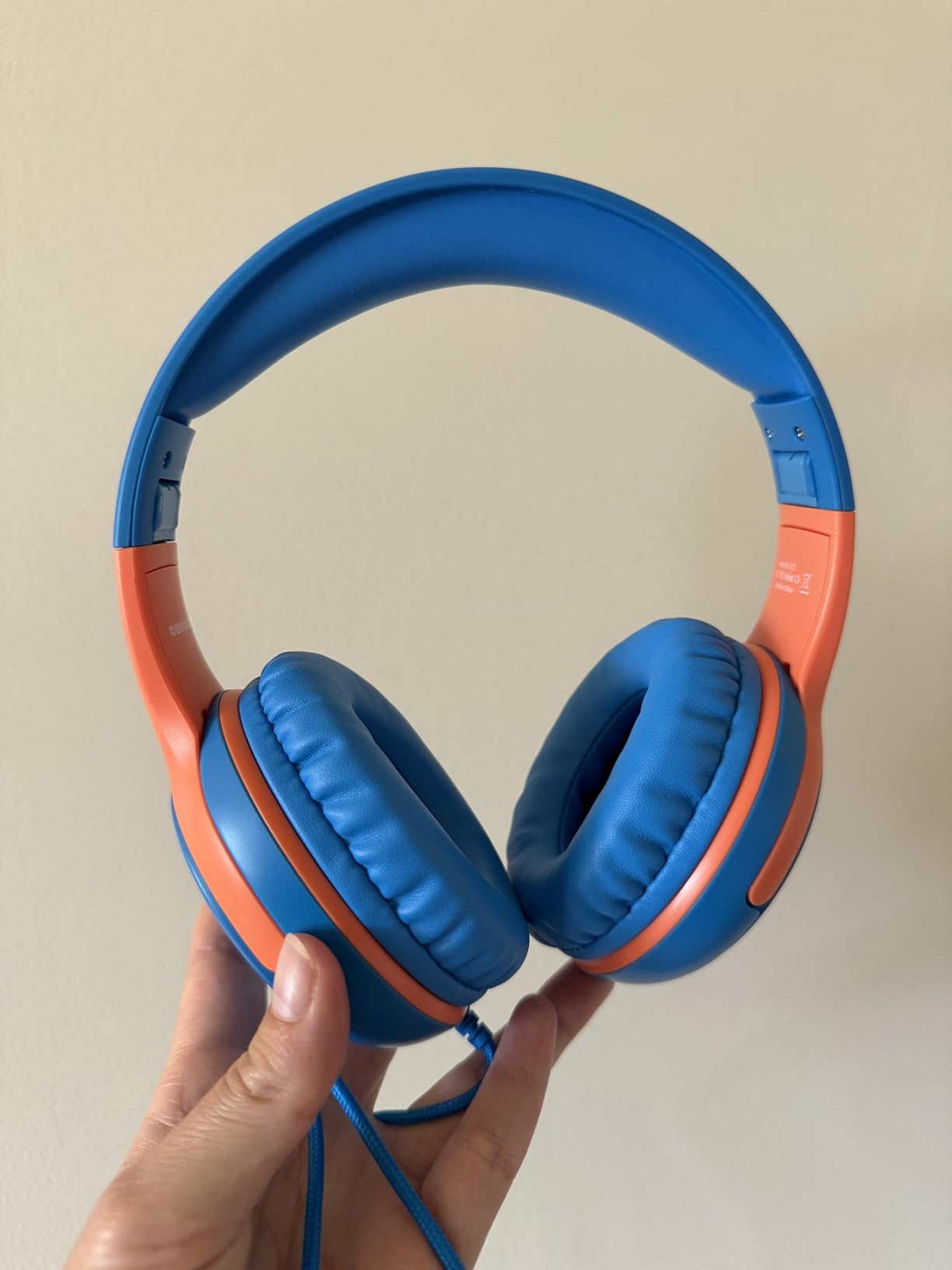
Isolation is the other story here. Parents report having to call a child by name to get their attention while these are on, which comes from the 40mm drivers and passive noise cancelling rather than electronics. CPC certification and BPA-free materials give the safety argument a document behind it, and the headband is adjusted for ages 2 to 15.
Review data describes it as a dependable back-to-school standard with heavy repeat purchase and multi-year wear stories. The recurring weakness is the fixed cord where it enters the ear cup, which has snapped out on a number of pairs, plus a few reports of early total failure and a finicky sharing jack.
Who the sharing jack and 5.2 oz weight suit
It suits two-child households buying at the same time, because the sharing jack removes the need for a splitter and a second device. It also suits a 3-to-5-year-old who needs something light enough to wear through a long car ride.
The named 85 dB study mode is a genuine advantage over a single fixed cap, because a child can learn that the safe level is the default and that 94 dB is a special case for a loud car.
Where it falls short
Skip it if your child is rough with cables, because the cord entry point is the known weak spot and there is no detachable or reinforced jack. The build is light enough to feel inexpensive, and the earcups can run large for a 3-year-old even on the smallest setting.
8. Botesty Sound Wired 85/94dB Headphones with 24-Month Warranty
Kids Headphones Wired for School, 3.5mm Safe Volume Limited with Mic, Navy
85dB study and 94dB travel modes
Wired 3.5mm
In-line call controls
24-month warranty
Pros
- Hardware limiter a child cannot override on the tablet
- Two named modes for study versus travel
- Soft over-ear cushions for long sessions
- Braided 4.9ft cord resists fraying and internal wire breaks
- 24-month warranty with prompt seller replacements
Cons
- Runs large on the smallest setting for 3-year-olds
- 90-degree swivel earcup is an extra breakage point
- One reported failure after a single school year
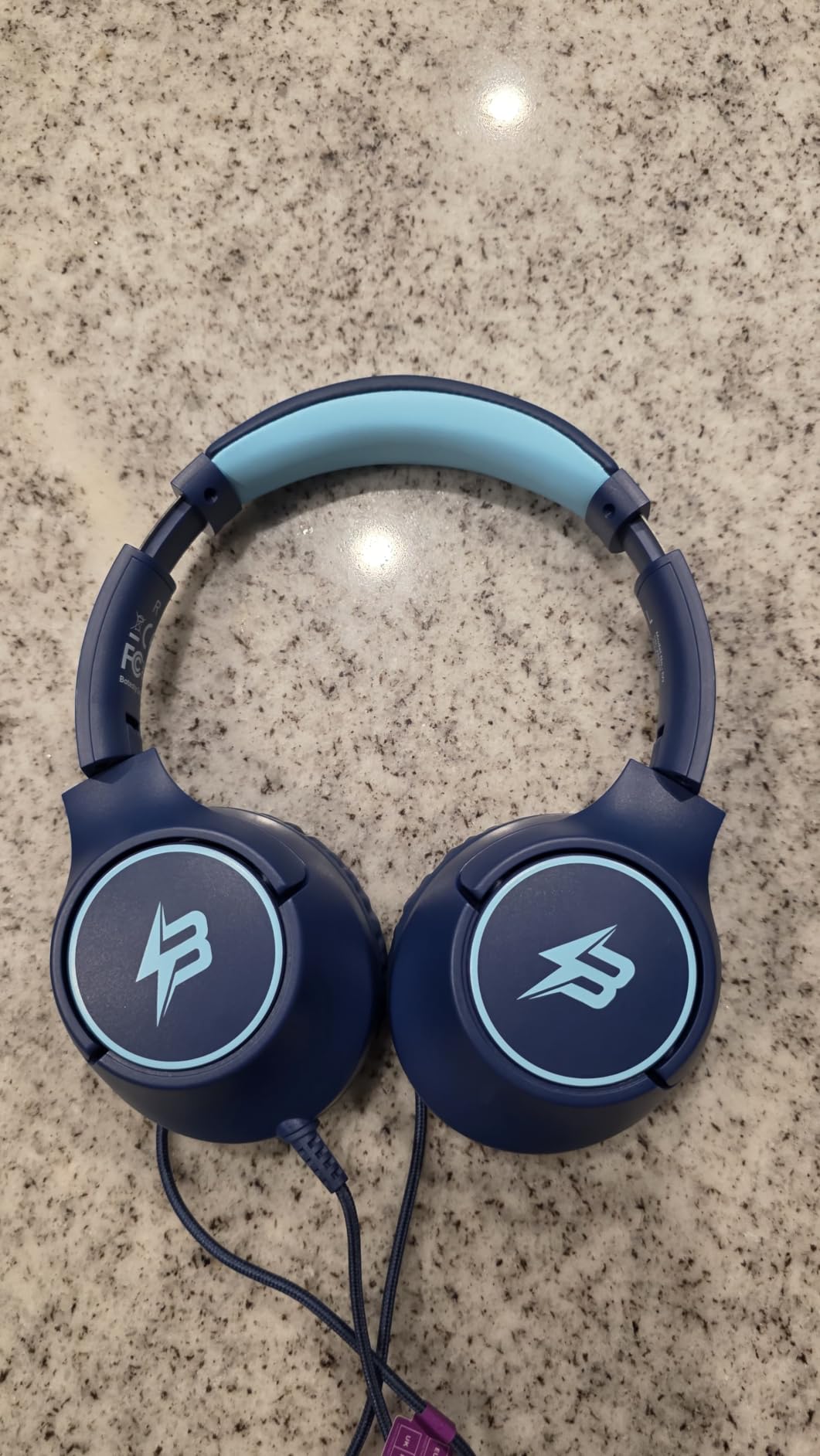
The Botesty Ivy is the one pick where the review data specifically singles out the limiter as the decisive feature, with owners noting that a child cannot override it on the tablet. In a roundup where every product claims a cap, that is the distinction worth shopping for.
As with the awatrue AT2, the limiter is described in two named modes: 85 dB for study and 94 dB for travel. In-line control buttons answer and end calls, which is a small thing that matters more than it sounds when a six-year-old has to find the right control mid-lesson.
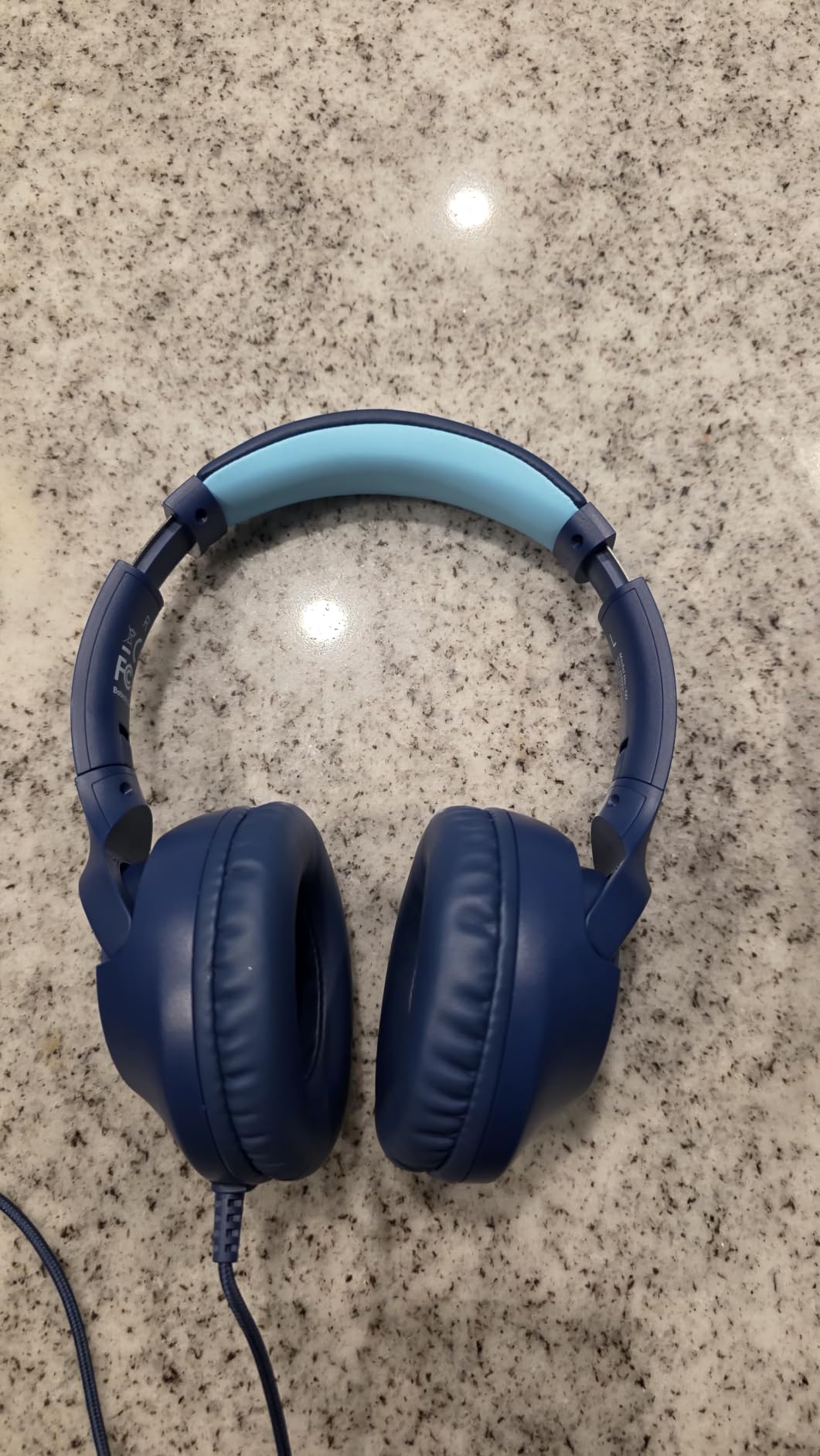
The cord is the build highlight: 4.9 feet of tangle-free, tear-resistant nylon braid, which addresses the fraying and internal wire break that shows up first on cheaper wired headsets. 40mm drivers handle stereo, and the foldable structure with 90-degree swivel earmuffs is designed for a backpack or a carry-on.
The 24-month warranty is the second-longest in the roundup, and the feedback reports that sellers have replaced faulty pairs quickly. Comfort over long study sessions and car rides is a repeated positive. The main sizing note is that the earcups can be too big for a 3-year-old even on the smallest setting.
Who the unoverrideable hardware cap suits
It suits a child old enough to work a tablet but not old enough to resist the safe level, because the limit is in the hardware and there is nothing to find. The in-line call controls are the deciding factor for a child in daily virtual classes.
The long braided cord is also useful for a child who leaves headphones plugged in at a desk, where a thin cable at the strain relief is the usual failure point.
Where it falls short
Skip it for a very young child, because the earcups run large at the smallest setting. The 90-degree swivel is a joint, and joints are what break; one pair reported failure after a single school year.
9. JBL Junior 320 Wired Volume-Limited Kids Headphones
JBL Junior 320 Kids Headphones, Wired, Volume-Limited – Purple
JBL Safe Sound 85dB cap
Wired 3.5mm
32mm drivers
116.8 g
Pros
- JBL Safe Sound cap states output never exceeds 85dB
- Lightest full-feature pick at 116.8 g
- Soft round earcups that stay on small heads
- Folds flat and needs no recharging
- Customizable sticker set included in the box
Cons
- Earpiece padding can detach from the cups
- Fit runs tight on larger heads
- Fixed cord that cannot be replaced
- Only two colour options
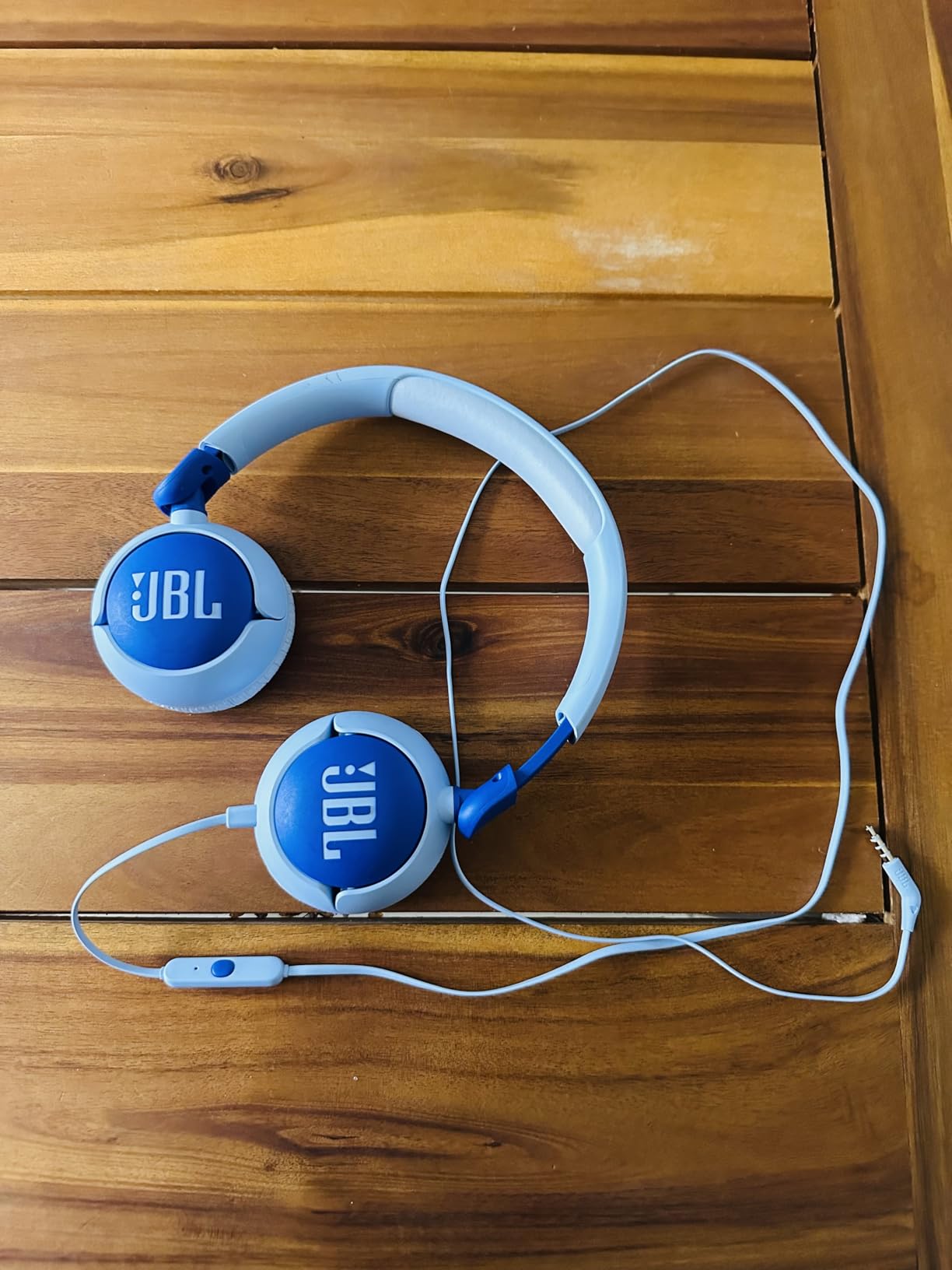
The JBL Junior 320 is the pick for parents who want the reassurance of buying from a major audio brand with Safe Sound naming on the box. The cap is stated plainly: output never exceeds 85 dB. There is no 94 dB mode, so there is no higher setting for a child to find.
At 116.8 g it is one of the lightest pairs here, and the soft 12mm padded headband with round earcups is designed for grip and reduced sound leakage. The cord enters one side only, which some parents prefer to a two-sided wire on a school bag.
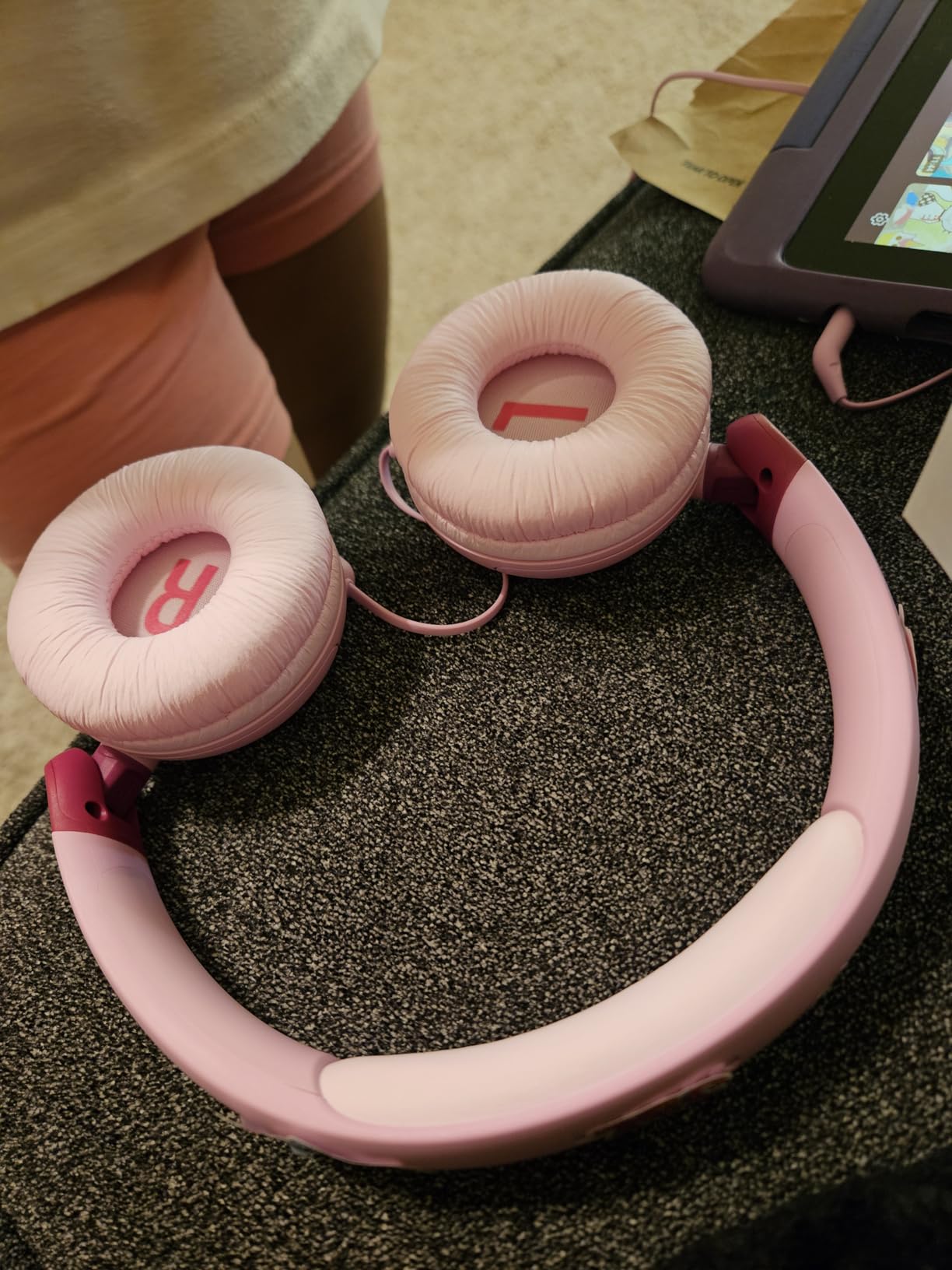
Sound quality is consistently described as good in the review data, which is not a sentence you can write about most wired school headphones. The 32mm dynamic drivers run at 34 ohm across 20Hz to 20kHz, and the built-in microphone handles calls with teachers and family. A customizable JBL sticker set is included, which does more for a child who refuses to wear childish gear than any colour option does.
The most cited drawback is the earpiece padding detaching from the cups after light use, along with a fit that runs tight on larger heads and a non-detachable cord. Colour choice is limited to two options.
Who the fixed 85dB Safe Sound cap suits
It suits a child who will find a 94 dB mode and use it, because there is no second setting to find. It also suits a tween who wants a real audio brand rather than a toy-looking headset, and the stickers help with that.
The single-side cord and folding design suit school and travel, and 116.8 g is light enough for a child who is genuinely uncomfortable wearing headphones for long.
Where it falls short
Skip it if your child has a larger head or wears glasses, because the fit runs tight and the padding is the first part to give. The cord is fixed, so cable damage ends the pair, and there are only two colours to choose from.
10. MIDOLA Wired 85/94dB Pink Headphones for Toddlers and Small Children
Wired Kids Headphones for School with Cord Mic,Safe Volume Limit 85/94dB
85dB default, 94dB option
4-level adjustable headband
Self-folding
210 g
Pros
- 4-level extendable headband fits from toddler through adult sizes
- Folds inside itself into a compact package for travel
- Wired design means no charging and no pairing
- 85dB safe limit is the default rather than the option
- Soft breathable over-ear cushions
Cons
- Cord and inline mic failures reported within months
- Foam earpiece padding can detach quickly
- Heaviest pick here at 210 g
- Lowest average rating in the group at 4.3
This is the pair in the roundup designed around a very small head. The 4-level extendable headband is sized for ages 3 and up and the manufacturer states it also fits most adults with average or smaller head sizes, so it can be handed down rather than replaced.
The limiter defaults to 85 dB with a 94 dB option reachable through the in-line control, and the listing states that even at maximum 94 dB output stays roughly 15% below typical adult headphones. That is a manufacturer claim, but the default being the safe level is the right direction.
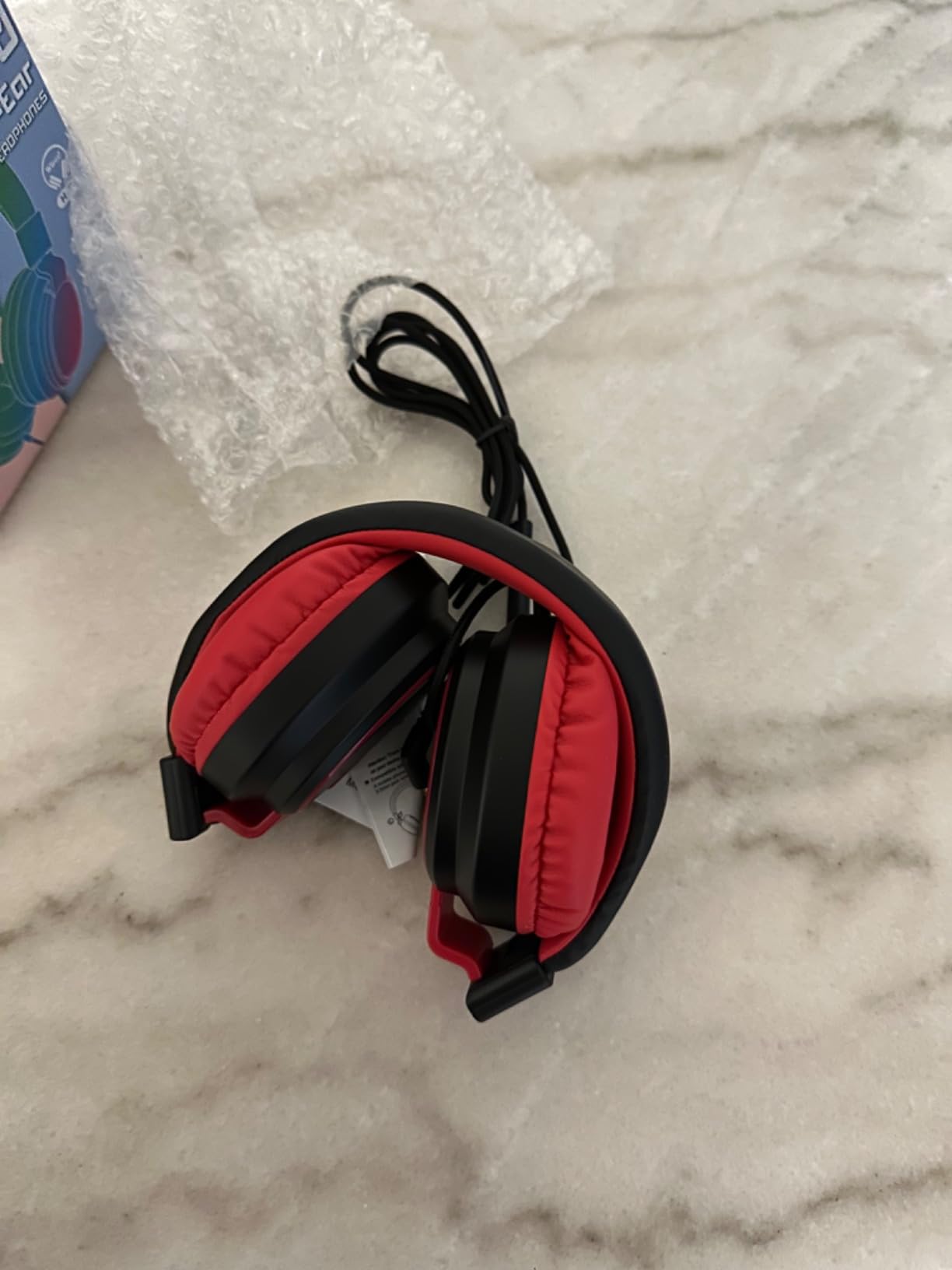
The self-folding design collapses inside itself, which makes it the most genuinely portable pick for a toddler on a long flight or car journey. 40mm dynamic drivers at 32 ohm, an in-line microphone for calls and online classes, and a tangle-free tear-resistant nylon braided cord complete the package. A one-year warranty is included.
Review data is positive on toddler sizing, the folding design and having nothing to charge. Durability is the recurring complaint: several owners report one side going silent when the inline mic position changes, or a broken cord after a few months, though the manufacturer has replaced faulty pairs quickly under warranty. It has the lowest average rating in the group at 4.3.
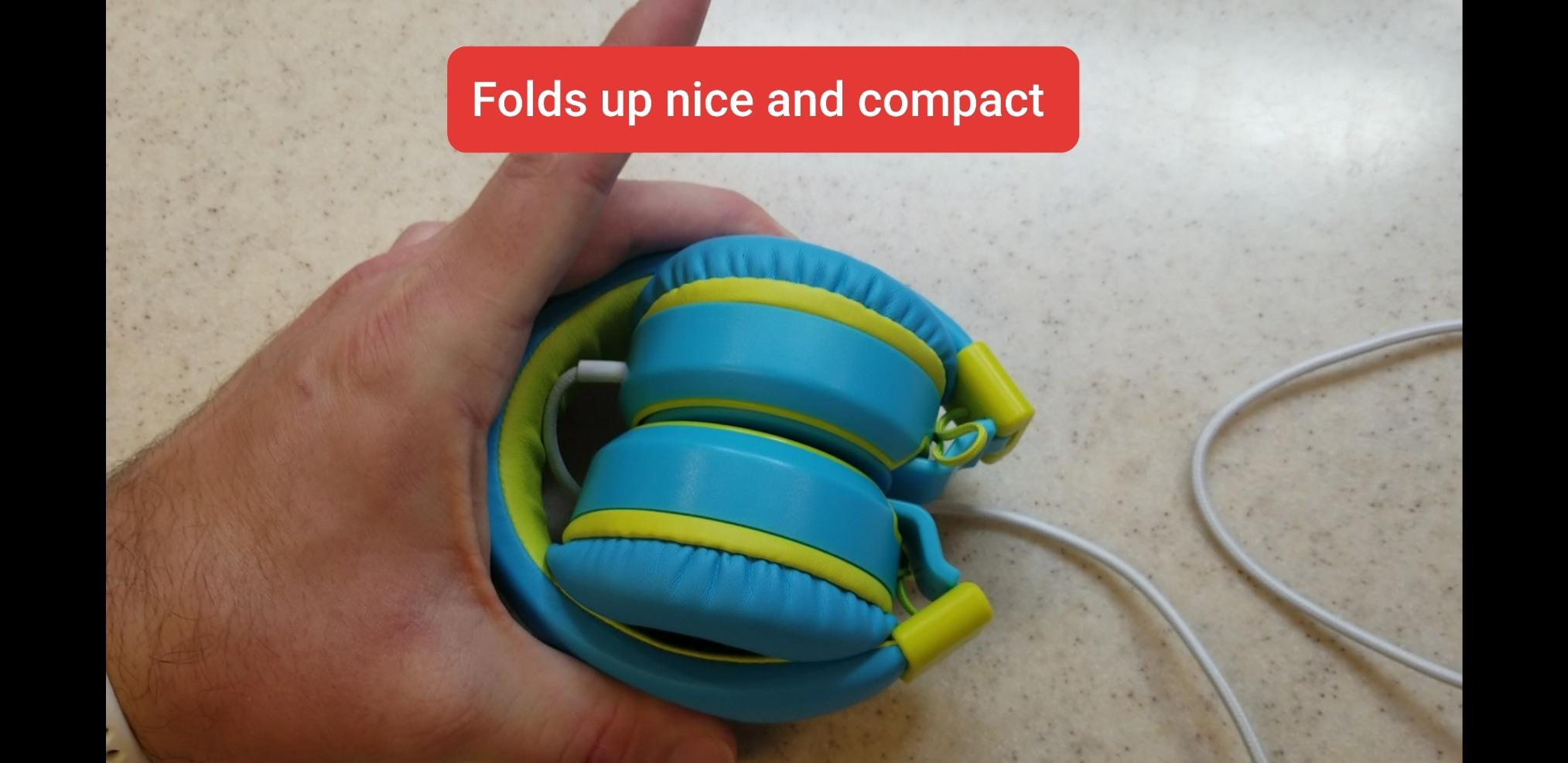
Who the 4-level headband and self-folding body suit
It suits a 3-to-5-year-old, which is the age band most of the other picks here are a stretch for. The extendable band also makes it a hand-me-down pair, so a single purchase can cover a toddler and later a tween.
For travel, the self-folding body means it disappears into a carry-on, and the wired design removes charging from the list of things a parent has to remember before a trip.
Where it falls short
Skip it if you need a pair built to survive years of rough handling, because cord and inline mic failures are the most common reported problem and the 4.3 rating reflects that. At 210 g it is the heaviest pick in the roundup, and over-ear cups are hot for a small child on a long summer journey.
How to Check a Volume Limiter at Home Before You Trust It
The honest answer is that a printed number is a claim, not a measurement, and parents have reported that safe sound wording on a listing cannot be trusted without checking. Here is a repeatable way to check, using a free sound level meter app on a phone and a spare pair of wired headphones.
Play a pink noise or sweep file from a phone at full device volume through a spare pair of ordinary wired headphones.
Hold the phone microphone close to the left earcup of the child’s headphones while the child wears them, and watch the app reading.
Turn the headphone volume to maximum with the 85 dB mode engaged. The reading should sit near the stated figure and stop climbing as you turn further.
Switch to the 94 dB mode and confirm the reading rises by roughly 9 dB rather than jumping to something far higher.
Repeat the test over the AUX cable, not just Bluetooth. If the number rises sharply when you plug in, that limiter does not hold in wired mode.
Check whether a 6-year-old can find the mode switch. If they can, the limiter is a suggestion rather than a limit.
Phone microphones are not calibrated lab instruments, so treat the result as a relative check rather than a certificate. A reading that refuses to go above roughly the stated cap is the useful signal.
How to Choose Volume-Limiting Kids Headphones You Will Not Regret
Match the fit to the child, not the age label. Headphones marked for ages 6 and up routinely do not fit a 5-year-old, and toddler models frustrate 9-year-olds who think they are babies. Weight is the quickest proxy: 5.2 ounces works for a 3-to-5-year-old, while 200 g or more is better suited to a 6-year-old and up. If your child wears glasses, an on-ear cushion seal is worth checking before buying, and our glasses-wearer headphone guide covers that fit problem in more detail.
Choose hardware over app-based limits. A limiter enforced inside the headphone holds across every source, every device and every app. A limit set in a phone app can vanish after a reset, a device swap or a change of music app, and a child playing audio from a different program may not hit the cap at all.
Pick a brand with a document behind it. CPC and CPSIA compliance, a stated warranty and a replaceable-parts policy tell you more than any marketing phrase. The strongest answers to what the best brand for kids headphones are not about logo loyalty; they are about whether the brand publishes a numeric cap, states whether it applies in wired mode, and stands behind the build.
Buy for the microphone if online learning is real. Every wired pick here has an in-line mic, and in-line call buttons are the difference between a child finding the control mid-lesson and fumbling for it. If the child is in daily virtual classes, put the mic first and the sound second.
Treat ANC as isolation, not protection. Active noise cancelling lets a child listen at a lower volume in a noisy cabin, which is a genuine benefit on a plane. It does not reduce the exposure from the drivers and should not be counted as an extra safety layer.
Check what happens at the cable entry. Across the review data in this roundup, the most common hardware failure is the fixed cord where it meets the ear cup, followed by inline mic wiring going silent. Braided cords and steel sliders cost little and address most of it.
How to Limit Volume on iPhone, Android, and Chromebook
Do not rely on device settings alone, but do set them anyway. A hardware limiter caps the ceiling; a device setting reduces the chance of a surprise in the first place.
iPhone and iPad: open Settings, then Sound and Haptics, then Headphone Safety. Set the listening limit, choose between a fixed dB cap and a time-based option, and turn on Hearing Protection. Set a Screen Time passcode so a child cannot simply tap it back off.
Android: Android has no universal dB ceiling. Use the manufacturer’s own control app where one exists, enable Do Not Disturb or a scheduled bedtime routine to cap session length, and rely on the headphone’s hardware limiter for the volume ceiling itself.
Chromebook: school-managed Chromebooks usually have audio limits set by the school administrator rather than the parent. Ask the administrator what the enforced cap is before you assume your child’s headphone limiter is the only one in play.
If a listening limit is enforced by an app, write down the PIN in a place your child cannot reach. That is the whole protection.
What to Do When Volume-Limited Headphones Sound Too Quiet
First, understand that a child who cannot hear you through the headphones is probably at the cap, not looking at a defect. That is the limiter working. Then work down the list.
Check the source device volume first, because a low phone volume plus a working limiter reads as broken.
Confirm the limiter is in the lower mode. Several pairs in this roundup default to 85 dB and require a deliberate button press for 94 dB.
Confirm the lock is engaged. The MIDOLA key lock, for example, prevents a mode change entirely until released.
If you plugged in the AUX cable, expect a different level from Bluetooth on some models and check the listing for what the wired mode does.
Swap the source cable before assuming the headset is faulty, since inline wiring is the most common reported failure in this category.
If a child with hearing sensitivities finds even the low mode uncomfortable, that is a fit and sensitivity issue rather than a volume problem, and worth raising with a clinician rather than solving with a higher cap.
One thing to expect: safety advice conflicts with real supervision needs. If you cannot hear a child who needs you, no decibel cap is the right answer, and using the headphones without them for those windows is the correct call.
Frequently Asked Questions
What is the decibel limit for safe headphones for kids?
The most common printed cap on kids headphones is 85 dB, and that is the figure you should look for on the box or listing. For a stricter reference, the WHO and ITU use 75 dBA for children, averaged over 40 hours a week. Treat 85 dB as a reasonable ceiling rather than an all-day maximum.
Is 85 dB safe for kids?
85 dB is safer than an uncapped headphone, but it is not safe indefinitely. Exposure guidance treats 85 dB as roughly an eight-hour level, and the children’s reference sits lower at 75 dBA over 40 hours a week. A budget pair and a premium pair with the same stated cap are not automatically identical, because some measure peak output and some measure an average.
Is 85 dB too loud for headphones?
It depends entirely on duration rather than on the number alone. 85 dB sustained for a long session is where the risk accumulates, and dropping to 80 dBA roughly doubles the tolerated time. If a child is wearing headphones for hours, choosing a pair that defaults to the lower mode matters more than the headline figure.
Is 80 dB too loud for headphones?
80 dBA is the adult reference level for 40 hours of exposure per week, and it is also the threshold many phones use to warn you. For a child it is a sensible target, and it is close to the WHO children’s reference of 75 dBA. Very few kids headphones cap that low, so it usually means using the device volume to sit well below the 85 dB ceiling.
Do volume limited headphones work the same when plugged in?
Not always, and this is the trap most parents miss. A limiter built into the headphone’s signal path holds on both Bluetooth and the 3.5mm cable, while a figure quoted only for the wireless path can be bypassed by plugging in. Every pair in this roundup is either wired only, or states explicitly that its wired mode holds the cap.
What are some good headphones for kids with volume control?
The MIDOLA Bluetooth pair leads for a parent-adjustable 85/94 dB toggle with a key lock, the AILIHEN wired headset is the simplest option with a fixed 93 dB cap and a light 5.92 oz build, and the EarFun K1 is the strongest certified pick with an 85/94 dB hardware limiter and a sharing jack. For a major audio brand, the JBL Junior 320 holds a fixed 85 dB cap under Safe Sound.
The Bottom Line on Best Kids Headphones With Volume Limits
The best kids headphones with volume limits are the ones where the cap is real, low, and hard for a child to defeat. That points to a hardware limiter with a stated number, a mode that defaults to the safe level, and a warranty long enough to cover a school bag.
Our pick for most families is the MIDOLA Bluetooth pair, because the 85/94 dB toggle and key lock give you a ceiling and a sanctioned exception, and the wired mode holds the 85 dB cap. If you want the simplest possible setup for school, take the AILIHEN wired headset. If certification and a sharing jack matter most, take the EarFun K1.
Whatever you choose, check the limiter yourself before handing it over, keep the source device volume sensible, and remember that 85 dB is a ceiling rather than a target. If your child has hearing sensitivity or a family history of hearing loss, raise the volume question with a clinician before shopping rather than after.