
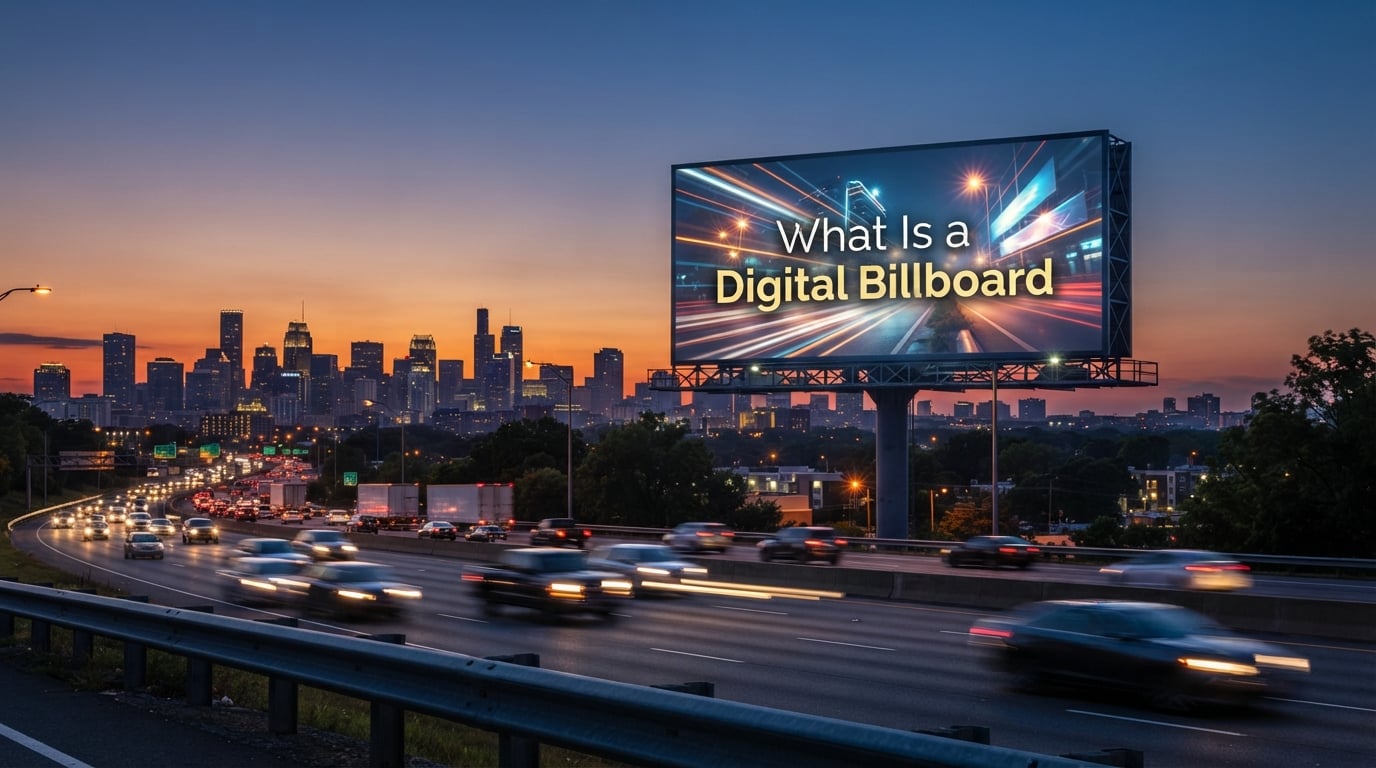
A digital billboard is a large, computer-controlled LED display that shows digital images which can be changed remotely every few seconds, used primarily for outdoor advertising in high-traffic locations. Unlike traditional static billboards, these electronic displays allow multiple advertisers to share screen time, update content instantly, and deliver dynamic messages that capture attention in ways paper billboards never could.
If you have ever driven past a glowing highway sign displaying rotating advertisements or city-center displays showing eye-catching visuals, you have already experienced digital billboard advertising. This technology has transformed how businesses reach audiences outdoors, making it one of the fastest-growing segments in the advertising industry today.
In this guide, our team will walk you through exactly what a digital billboard is, how the underlying technology functions, the benefits it offers over traditional options, and what you can expect regarding costs and effectiveness. Whether you are a business owner exploring new advertising channels or simply curious about the technology shaping urban landscapes, this article covers everything you need to know about digital billboards as of 2026.
Table of Contents
What Is a Digital Billboard?
A digital billboard is an electronic outdoor advertising display that uses LED (light-emitting diode) or LCD technology to show dynamic visual content. These displays are controlled by computer systems that allow advertisers to upload, schedule, and change their messages remotely without any physical installation or printing costs.
The core distinction between a digital billboard and a traditional static billboard lies in content delivery. Traditional billboards require printed vinyl panels that remain fixed until manually replaced. Digital billboards eliminate this constraint entirely by displaying images, videos, and animations that can rotate every 6 to 10 seconds, allowing multiple advertisers to share a single display location.
Digital billboards are part of the broader out-of-home (OOH) advertising category, specifically falling under digital out-of-home (DOOH) advertising. The OOH industry, led by organizations like the Out-of-Home Advertising Association of America (OAAA), has seen significant growth as more advertisers recognize the unique advantages of digital displays for reaching consumers outside their homes.
According to industry data, there are now more than 10,000 digital billboards operating across the United States alone. Major metropolitan areas like New York, Los Angeles, Chicago, and Miami feature prominent digital billboard networks, with locations ranging from busy highway corridors to urban pedestrian zones and even iconic spaces like Times Square.
How Does a Digital Billboard Work?
Understanding how digital billboard technology functions helps advertisers appreciate what makes these displays so effective. The system consists of three primary components working together seamlessly.
The Display Panel
The visible portion of a digital billboard is a large-format LED or LCD screen specifically designed for outdoor use. These displays feature high brightness levels, typically ranging from 5,000 to 10,000 nits, ensuring content remains visible even in direct sunlight. The screens are also weather-resistant, built to withstand rain, snow, extreme temperatures, and humidity without deteriorating.
LED displays use individual light-emitting diodes to create images, with red, green, and blue diodes combining to produce millions of possible colors. This technology offers superior brightness and energy efficiency compared to older LCD alternatives. Many modern digital billboards use 10mm to 16mm pixel pitch, which determines image resolution and viewing distance recommendations.
The Content Management System (CMS)
Behind every digital billboard is specialized content management software that allows advertisers and media companies to control what displays on screen. This cloud-based platform enables users to upload creative assets, set rotation schedules, and monitor display status from any internet-connected device.
The CMS handles the logistics of multi-advertiser rotation. When multiple businesses purchase time on a single digital billboard, the system automatically cycles through each advertisement according to the predetermined schedule. Advertisers can specify exact times for their content to appear, implement dayparting (showing different ads during different times of day), and even trigger real-time updates for time-sensitive messaging.
The Network Connection
Digital billboards connect to their control systems through wired ethernet, cellular networks (4G/LTE), or satellite connections. This network infrastructure enables remote updates without requiring anyone to physically visit the display location. When an advertiser uploads new creative through the CMS, the system transmits the content across the network to update the billboard in real time.
This connectivity also enables centralized monitoring, allowing operators to track display performance, temperature, brightness levels, and content playback status. If a technical issue arises, maintenance teams receive immediate alerts, minimizing downtime and ensuring consistent advertising delivery.
Types of Digital Billboard Displays
Digital billboards come in several formats, each suited to different advertising objectives and installation environments.
Large-Format Highway Billboards: These are the most recognizable digital billboards, typically measuring 14 feet tall by 48 feet wide. Positioned along major highways and freeways, they target commuters and travelers with high-speed, high-impact visuals designed for quick comprehension.
Urban Digital Bulletin Boards: Slightly smaller than highway displays, urban bulletins are commonly found in city centers and residential areas. Their placement prioritizes pedestrian and lower-speed vehicle traffic, often featuring more detailed creative due to closer viewing distances.
Mobile Digital Billboards: Mounted on trailers or vehicles, these portable displays can be repositioned to follow event crowds, construction zones, or promotional tours. They offer flexibility that permanent installations cannot match.
Indoor Digital Signage: While not technically billboards, indoor digital displays in shopping malls, airports, stadiums, and corporate lobbies use similar technology. These smaller-format screens serve targeted audiences in specific environments.
Digital Billboards vs Traditional Static Billboards
When evaluating advertising options, understanding the key differences between digital and traditional static billboards helps businesses make informed decisions.
Content Flexibility: Traditional billboards require printed vinyl panels costing hundreds to thousands of dollars per installation. Changes require new prints and physical installation crews. Digital billboards eliminate these costs entirely, allowing unlimited content updates at no additional charge. An advertiser can change their message daily, hourly, or even minute-by-minute if desired.
Multi-Advertiser Capability: A single traditional billboard belongs to one advertiser at a time. Digital billboards can display content from multiple advertisers simultaneously through time-based rotation. This shared model makes premium locations more accessible to smaller advertisers while generating higher revenue for display operators.
Update Speed: Traditional billboard updates take weeks from design finalization to physical installation. Digital billboards can display new content within minutes of upload. This speed proves invaluable for time-sensitive promotions, breaking news responses, or weather-based messaging.
Dynamic Content: Digital billboards can display static images, animated sequences, and video content. Traditional billboards are limited to printed graphics. The ability to incorporate motion and multiple frames significantly increases engagement and message retention.
Targeting and Context: Digital billboards enable contextual advertising that traditional displays cannot match. Advertisers can schedule different content for morning commuters versus evening traffic, align messaging with local events, or even integrate real-time data like current temperatures or sports scores.
Benefits of Digital Billboard Advertising
Digital billboard advertising delivers measurable advantages that have driven its rapid adoption across the industry.
High Audience Reach: Research from Nielsen and the OAAA demonstrates that 62% of people notice digital billboard advertisements. This reach extends across demographics, making it an effective channel for building brand awareness among broad audiences. Unlike online ads that target specific user segments, billboards expose your message to everyone passing by.
Consumer Action: The same research indicates that 65% of people who notice digital billboard ads take some form of action. This action might include visiting a website, searching for a product, or making a purchase. The OAAA also reports that 50% of adults have noticed or engaged with a digital out-of-home advertisement in the past month, indicating strong consumer interaction with the medium.
Cost Efficiency Over Time: While the initial cost to advertise on a digital billboard can be significant, the elimination of print and installation fees makes ongoing campaigns more economical compared to static alternatives. Advertisers can test multiple creative variations without incremental production costs, optimizing their messaging based on real performance data.
Environmental Benefits: Digital billboards reduce paper waste and chemical runoff associated with traditional vinyl printing. A single digital display can eliminate thousands of square feet of printed materials over its operational lifetime. For environmentally conscious brands, this sustainability angle resonates with increasingly eco-aware consumers.
Campaign Agility: Real-time content updates enable rapid response to market conditions. Retailers can promote same-day sales, restaurants can highlight menu changes, and event organizers can drive last-minute ticket purchases. This flexibility distinguishes digital billboards from every other traditional outdoor advertising format.
Where Are Digital Billboards Used?
Digital billboards appear across diverse environments, each offering unique advantages for advertisers.
Highway and Freeway Corridors: The most common digital billboard locations target commuters along major transportation routes. These displays reach captive audiences during predictable commute times, with messaging designed for quick comprehension at highway speeds. Highway billboards typically offer excellent visibility and extended viewing windows.
Urban Centers and Downtown Districts: City-center digital billboards serve pedestrian and slow-moving traffic audiences. These locations often feature higher demographic diversity and enable more detailed creative due to closer viewing distances. Urban digital displays frequently support longer-form content that pedestrians can absorb while waiting at intersections.
Times Square and Landmark Locations: Premium locations like Times Square in New York City represent the pinnacle of billboard prestige. These iconic advertising spaces feature some of the largest and most technologically advanced digital displays in the world, commanding premium rates from brands seeking maximum visibility and cultural impact.
Public Service Applications: Beyond commercial advertising, digital billboards serve community functions including emergency alerts, traffic updates, weather warnings, and public health announcements. Government agencies and nonprofits use these displays to communicate critical information to large audiences quickly.
Event Venues and Sporting Facilities: Stadiums, arenas, concert venues, and convention centers increasingly deploy digital signage for wayfinding, sponsorship activation, and real-time event updates. These installations serve both commercial and operational purposes.
Digital Billboard Advertising Costs
One of the most common questions about digital billboard advertising involves pricing. Understanding the cost structure helps businesses evaluate whether this advertising channel fits their budget.
Digital billboard advertising costs vary significantly based on several factors. Location dramatically impacts pricing, with premium urban and Times Square displays commanding thousands to tens of thousands of dollars per month. Highway billboards in secondary markets often start at a few hundred dollars per week, making them accessible to smaller businesses.
Display size and rotation share model also influence costs. A billboard displaying content from multiple advertisers (rotating several ads per hour) typically costs less per advertiser than exclusive-use displays. The more advertisers sharing a display, the lower each advertisers cost but also the less exclusive attention your ad receives.
Programmatic digital out-of-home (pDOOH) platforms have emerged as a cost-effective entry point for advertisers. These self-serve platforms allow businesses to purchase digital billboard time similar to online advertising, with bidding systems that match budgets to available inventory. Programmatic buying reduces friction and often provides better pricing transparency than traditional sales processes.
Industry data suggests that digital billboard CPM (cost per thousand impressions) typically ranges from $3 to $15, depending on location and market size. For context, a prime Times Square display might cost $50,000 or more for a four-week campaign, while a regional highway billboard might run $2,000 to $5,000 for the same period.
Safety and Regulations Around Digital Billboards
Digital billboard regulation remains an evolving area balancing advertising interests with public safety concerns. Understanding the regulatory landscape helps advertisers navigate compliance requirements.
Driver Distraction Concerns: Some safety advocates have raised concerns about digital billboards potentially distracting drivers. Research conducted by the Federal Highway Administration (FHWA) found no significant safety impact from properly placed digital billboards, though the agency continues monitoring. Display operators must maintain brightness limits and prohibit flashing or rapidly changing content that could impair driver attention.
State and Local Regulations: Zoning laws vary significantly across jurisdictions. Some states have banned new digital billboard construction entirely, while others permit them with specific restrictions on location, brightness, and content. California, Texas, and Florida host substantial digital billboard networks, while states like Hawaii and Vermont have more restrictive policies. Advertisers should verify compliance requirements for their target markets.
Industry Standards: The OAAA publishes guidelines for digital billboard operation, including recommendations for brightness levels, animation speed, and content standards. Member companies typically adhere to these voluntary standards, which exceed many state requirements and demonstrate commitment to responsible advertising practices.
The Future of Digital Billboards
Digital billboard technology continues evolving, with several trends shaping the industry future.
Programmatic DOOH Growth: Programmatic digital out-of-home (pDOOH) advertising represents the most significant shift in how billboards are bought and sold. Automated buying platforms enable real-time bidding on available inventory, similar to digital display advertising. This technology makes digital billboard advertising accessible to businesses of all sizes and enables sophisticated audience-based targeting.
Integration with Mobile: Leading advertisers increasingly integrate digital billboard campaigns with mobile advertising. Billboards can trigger location-based offers on smartphones,QR codes can drive online engagement, and attribution platforms can track how billboard exposure converts to store visits and purchases. This cross-channel measurement improves ROI demonstration and campaign optimization.
AI and Dynamic Content: Artificial intelligence enables automated content optimization based on real-time data. Billboards can automatically adjust messaging based on weather conditions, time of day, traffic patterns, or social media sentiment. This automation reduces manual optimization effort while improving relevance and engagement.
Key Digital Billboard Industry Terms
Familiarizing yourself with common terminology helps navigate digital billboard discussions and contracts.
OOH (Out-of-Home): All advertising displayed outside the home, including billboards, transit ads, and outdoor signage.
DOOH (Digital Out-of-Home): Digital displays used in out-of-home advertising contexts.
pDOOH (Programmatic DOOH): Automated buying and selling of digital out-of-home advertising inventory through real-time bidding platforms.
Dayparting: Scheduling different content for different time periods, such as morning versus evening advertising slots.
CPM (Cost Per Mille): The cost to reach 1,000 impressions with an advertisement.
Dwell Time: The duration a viewer spends looking at an advertisement.
Brand Lift: The increase in brand awareness or favorability resulting from advertising exposure.
Frequently Asked Questions
How much does it cost to have a digital billboard?
Digital billboard advertising costs vary widely based on location, display size, and market. Highway billboards in secondary markets may cost $500 to $2,000 per week, while premium urban locations can run $10,000 to $50,000 monthly. Programmatic platforms offer starting prices around $200 for smaller market displays.
What is the difference between a billboard and a digital billboard?
Traditional static billboards use printed vinyl panels that remain fixed until manually replaced. Digital billboards use LED or LCD displays controlled by computer systems, allowing content to be changed remotely. Digital billboards can rotate multiple advertisers, update instantly, and display dynamic content including animation.
How does a digital billboard work?
Digital billboards consist of three components: a high-brightness LED or LCD display panel designed for outdoor use, a content management system (CMS) that enables advertisers to upload and schedule content, and a network connection that transmits content updates remotely. The display cycles through scheduled content according to rotation intervals typically set between 6 to 10 seconds per advertisement.
How profitable is a digital billboard?
Digital billboard profitability depends on location, market size, and advertiser demand. Nielsen and OAAA research shows 62% of viewers notice digital billboard ads and 65% take action after viewing. CPM rates typically range from $3 to $15, making digital billboards cost-competitive with other advertising channels for brand awareness campaigns.
Conclusion
A digital billboard is a computer-controlled outdoor advertising display that uses LED or LCD technology to show dynamic content which can be changed remotely. Unlike traditional static billboards requiring printed panels, digital billboards enable real-time content updates, multi-advertiser rotation, and dynamic messaging that captures audience attention in ways static displays cannot match.
Throughout this guide, we have covered how digital billboard technology works, the significant benefits over traditional billboards, and the various applications across highways, urban centers, and landmark locations. Research from Nielsen and the OAAA confirms strong consumer engagement with digital billboard advertising, making it an effective channel for brand awareness campaigns.
Whether you are exploring digital billboard advertising for your business or simply seeking to understand the technology reshaping urban landscapes, the fundamentals covered here provide a solid foundation. As programmatic advertising platforms continue democratizing access and technology advances improve display capabilities, digital billboards will remain a powerful tool for reaching audiences outside their homes.