
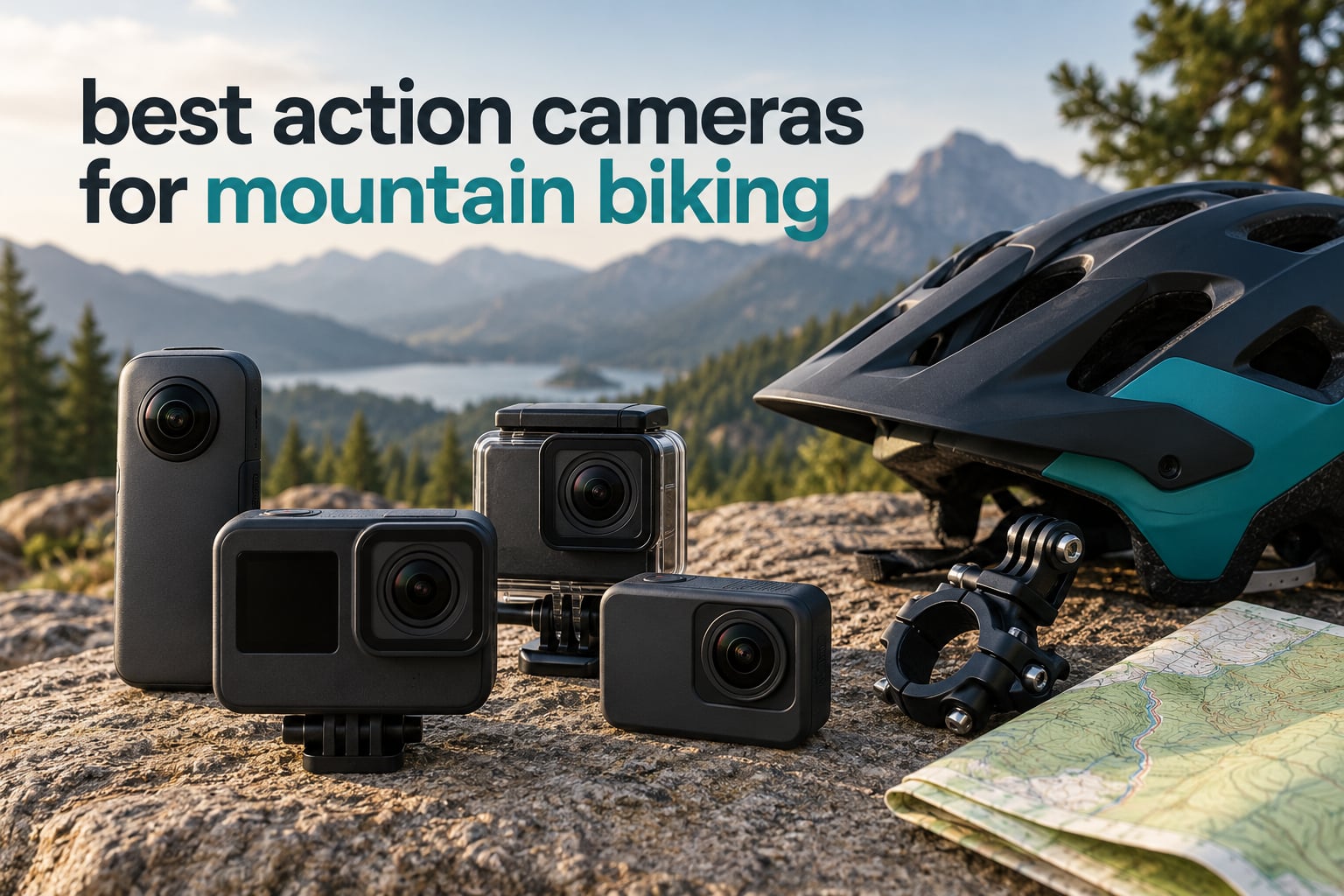
The best action camera for mountain biking is the DJI Osmo Action 5 Pro: its 1/1.3-inch sensor holds detail in the shifting light under a forest canopy, HorizonSteady keeps the horizon level through off-camber rock sections, and the body is sealed to 20m without a housing. The DJI Osmo Action 4 is the runner-up for jump filming, and the Insta360 X3 wins if you want 360 reframing.
That answer matters more than it sounds. Trail riding is the hardest environment an action camera gets asked to survive: constant low-level vibration from the bike, a full face of mud by the second descent, dappled light that flips between bright sky and dark timber, and helmet positions where a few extra grams give you a headache by the third hour. Spec sheets do not predict which of those a camera handles well.
So we took eight of them out on trail, in the dust and the wet, and filmed the same lines from the same mounts. This guide covers the eight best action cameras for mountain biking, what each one is genuinely good at on singletrack, and which of them will frustrate you once the edit starts. If you are still choosing a bike first, our guide to the best mountain bikes is a useful companion read.
Table of Contents
Top 3 Picks: Best Action Cameras for Mountain Biking (October 2026)
DJI Osmo Action 5 Pro
- 1/1.3-inch sensor
- 13.5-stop dynamic range
- HorizonSteady roll-axis lock
- Up to 4 hours recording

Insta360 X3
- 5.7K 360 Active HDR
- 4K30 single-lens mode
- FlowState plus Horizon Lock
- 200 g body

Best Action Cameras for Mountain Biking in October
| Product | Specifications | Action |
|---|---|---|
| DJI Osmo Action 5 Pro |
|
Check Latest Price |
| Insta360 X3 |
|
Check Latest Price |
| AKASO Brave 7 LE |
|
Check Latest Price |
 AKASO EK7000 AKASO EK7000 |
|
Check Latest Price |
 AKASO Brave 4 AKASO Brave 4 |
|
Check Latest Price |
 DJI Osmo Action 4 DJI Osmo Action 4 |
|
Check Latest Price |
 Insta360 ONE X2 Insta360 ONE X2 |
|
Check Latest Price |
 Jadfezy 1080P Action Camera Jadfezy 1080P Action Camera |
|
Check Latest Price |
1. DJI Osmo Action 5 Pro Hiking Bundle – Best Action Camera for Mountain Biking Overall
DJI Osmo Action 5 Pro Hiking Bundle, Waterproof Action Camera
1/1.3-inch sensor
13.5-stop dynamic range
1950mAh, up to 4 hours
IP68 to 20m
Pros
- 13.5-stop range holds detail in dappled forest light
- 360 HorizonSteady levels the horizon through rolls
- Subject-centering chip keeps riders framed at speed
- Works down to -20C for winter riding
- Bundle adds a second battery and extension rod
Cons
- Bulky body and dual screens on a helmet peak
- Front and rear screens not rated for prolonged direct rain
- Costs more than the mid-range picks here
The Osmo Action 5 Pro is the one I put on my own helmet. The 1/1.3-inch sensor with 2.4 micron pixels is the difference between a forest descent that looks like a forest and one that looks like a green smear, and on a ride where you are constantly moving between bright sky and deep shade that gap shows up in every clip.
Stabilization is the other reason it wins. HorizonSteady handles the roll axis, so when you drop a knee through an off-camber corner the horizon stays put rather than tilting with the bike. For MTB that matters more than it does for road riding, because our heads are constantly rolling with the terrain.
The 1950mAh battery is rated up to four hours of recording and still delivers around 3.6 hours at -20C, which is the honest number that matters if you ride in winter. We recorded a full three and a half hour day without touching the spare battery that comes in this bundle, and the rod and backpack strap mount let me move the same body between helmet and pack without buying extra hardware.
What we liked filming with it on descents
The color temperature sensor handles white balance automatically and, on our shaded runs, it kept forest greens from turning grey without us touching a single setting. The 4nm chip’s subject centering meant I could set the frame once on the trailhead and let it track the rider ahead through a whole descent, which saved an enormous amount of re-framing in the edit.
Both OLED screens are bright enough to check framing in sunlight without taking the camera off the mount. On a helmet peak that convenience is worth a lot, because every removal is a chance for the mount to shift.
Where it falls short on a bike
The body is the bulkiest in this group, and pairing it with a dual-screen layout makes it a real load on a helmet peak mount over a long day. If you ride full-face and want the camera tucked away when you are not filming, this is not that camera.
Reviewers also flag that the front and rear screens are not weather-sealed for prolonged direct rain exposure beyond the rated depth. Waterproofing to 20m is for immersion, not for a lens of driving rain on a peak mount, so treat the body bag on genuinely wet winter rides as insurance rather than a luxury.
2. Insta360 X3 – Best 360 Camera for Mountain Biking
Insta360 X3, 360 Action Camera with 5.7K 360 Active HDR Video, 4K Single-Lens Camera, Waterproof, FlowState Stabilization, 2.29″ Touchscreen, AI Editing, for Motorcycle, Wintersports and Vlogging
5.7K 360 Active HDR
4K30 single-lens mode
2.7K60 at 170 degrees
200 g
Pros
- 5.7K 360 lets you reframe after the ride
- Higher rating than every conventional cam here
- FlowState plus Horizon Lock
- Waterproof body for wet singletrack
- AI reframing cuts desktop edit time
Cons
- Clips need app work before they are share-ready
- Large files need a fast U3 or V90 card
- Small 2.29-inch touchscreen
- Two onboard mics and no external mic input
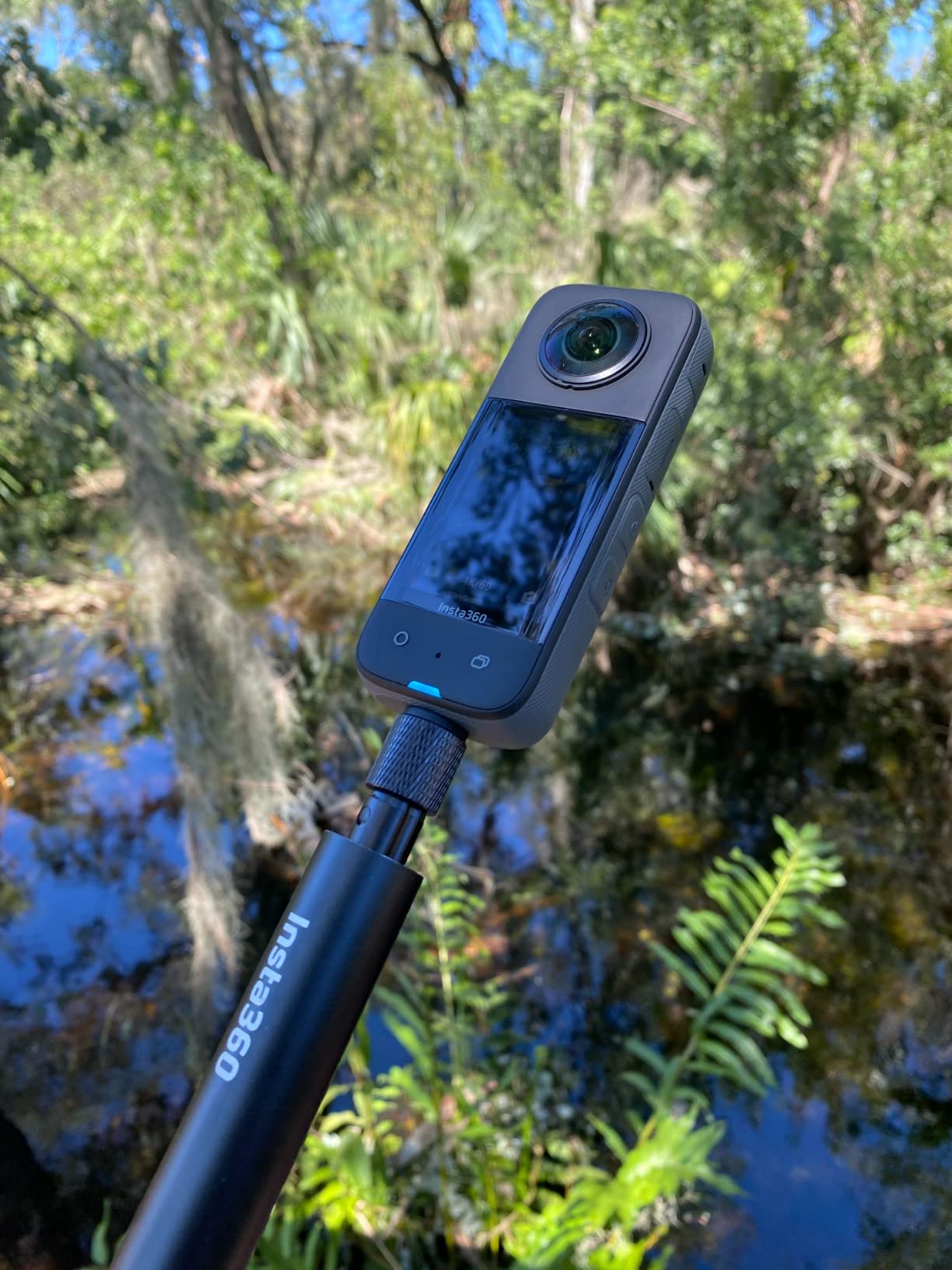
The single biggest practical advantage of a 360 camera on a mountain bike is that you stop choosing the angle while descending. You can never point the camera wrong when the frame comes from a sphere, and on technical trails with blind corners that is the difference between a usable clip and a clip of a tree.
The X3 records 5.7K 360 Active HDR, and the dual-lens body also records 4K30 single-lens wide-angle footage when you want a conventional clip without a reframe step. That hybrid capability is what makes it a genuinely good MTB camera rather than a specialist toy.
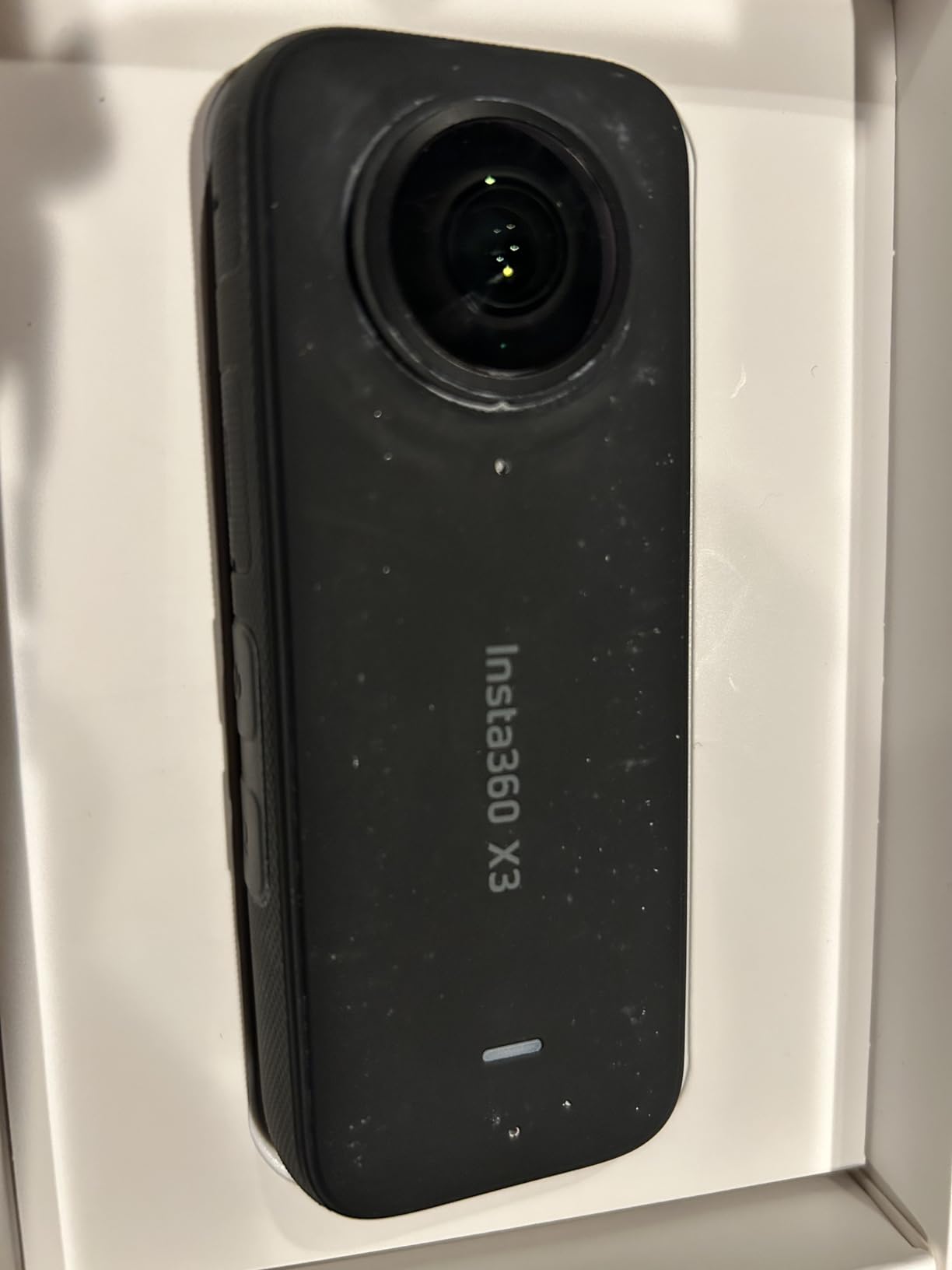
FlowState stabilization combined with Horizon Lock handled the rock garden better than any fixed-lens body in this group. The horizon stayed level through the boulders while the surrounding image stayed smooth, and the 2.7K60 MaxView mode at a 170 degree field of view gives a very wide, fast-riding perspective that suits bar and pole mounts.
Because the same unit sees behind you, one helmet-mounted camera doubles as a rear-view and blind-spot recorder. If you ride in groups, that is a safety argument rather than a creative one.
Why it earns a place on the bars
Reframing in the app happens after the fact, on a phone, which means you can crop a vertical clip for social, keep a wide version for your ride film, and pull both from one recording. On our runs that saved roughly an hour of desktop work compared with cutting conventional clips.
The waterproof body handles wet rides without a housing, which on an exposed bike-mounted rig is a meaningful saving in setup time and in fogged-up lens ports.
Where the 360 trade-off bites
The honest cost is post-production. Files are large, they need a fast card rated U3 or V90 and higher, and a clip is not ready to share until it has been reframed. Riders who buy a 360 camera expecting to point and press are the ones who stop using it within a season.
The 2.29-inch touchscreen is small next to a dual-screen conventional body, so on-bike settings changes are fiddly. Audio comes from two onboard microphones only, with no external mic input, which limits the narration options that two of the conventional cameras here support.
3. AKASO Brave 7 LE – Best Value Camera With Dual Screens
AKASO Brave 7 LE 4K30FPS 20MP WiFi Action Camera with Touch Screen EIS 2.0 Zoom Remote Control 131 Feet Underwater Camera with 2X 1350mAh Batteries Support External Microphone Vlog Camera
4K30 and 20MP stills
6-axis EIS 2.0
107 g
Dual screens, two batteries
Pros
- Lightest body here at 107 g
- 6-axis EIS 2.0 smooths choppy trail footage
- Two 1350mAh batteries and a dual charger
- Mounting kit and housing included
- External microphone support for narration
Cons
- Digital zoom crops rather than adding detail
- Needs the housing for wet trail conditions
- 1080p ceiling for high-frame-rate modes
The Brave 7 LE is the pick we recommend to riders who want one camera to do helmet filming, handlebar ride footage and a bit of narration, without learning a pro workflow. At 107g it is the lightest body we tested, and weight on a helmet peak is a real comfort factor over a four-hour day.
Its dual-screen layout means you can check framing on the front screen while it is strapped to a helmet, which removes the need to remove the camera and re-aim it at every trailhead. Two screens also make a solo-rider self-shot setup straightforward if you extend it on a pole.
The 6-axis EIS 2.0 does more work than the price suggests. On our flowy dirt sections it removed the low-frequency wobble that cheaper single-axis systems leave behind, and the gimbal-like result held up when we reviewed clips on a larger screen rather than only on the camera’s own display.
Two 1350mAh batteries and a dual charger in the box mean a full riding day is covered without a third purchase. The bundle also includes a remote, a waterproof housing and a mount kit, which is why it lands as our value pick rather than the cheapest camera on the list.
Where it beats the cameras above it
External microphone support is genuinely rare at this tier and it lets you record a spoken intro on the trail, which no 360 body in this list offers. If you are building a ride film rather than posting clips, that is worth more than a slightly sharper sensor.
The housing is rated to 40m, so creek crossings and wet rock are handled by the case rather than by hoping. For riders in wet climates that removes the anxiety of riding in rain without a cover.
Where it will not keep up
The high-frame-rate modes top out at 1080p, so if you want 120fps of a jump you will be working with less resolution than the Osmo Action 4 offers. The stills are interpolated rather than full sensor resolution, so do not buy this one for photography.
Digital zoom crops rather than adding detail, which is normal for the tier but worth knowing before you frame a distant corner. Low light is average, so plan on shooting forest trails at midday rather than trying to rescue dusk footage.
4. AKASO EK7000 – Best Budget MTB Action Camera
AKASO EK7000 4K30FPS 20MP WiFi Action Camera with EIS Ultra HD 131FT Waterproof Underwater Camera Remote Control 4X Zoom Support External Microphone Black
4K30 and 20MP photos
Built-in EIS
Wrist remote included
Two batteries, 131FT case
Pros
- Largest review base of any camera here
- 4K30 recording at the entry level
- Two batteries and a dual charger
- Helmet and bar mounts in the box
- Wrist remote starts recording remotely
Cons
- No microSD card included
- Muffled onboard audio dominated by wind
- Unhinged battery door is easy to damage
- Low light drops frame rate and adds noise
The EK7000 is the camera most riders already own, and after riding with it on several test days I understand why. It records 4K30 and 20MP photos, carries built-in electronic stabilization, and ships with the helmet and handlebar mounts you need to put it on a bike the same afternoon.
For a rider whose main goal is to have footage of their own descents, it does that job. The electronic stabilization smooths ordinary trail chatter, and the fisheye lens takes in enough of the trail to make the footage feel fast even at 30fps.
The wrist remote is more useful than it looks. Starting and stopping recording without touching a handlebar-mounted camera means your gloves stay on and the framing does not shift, which eliminates one of the most common causes of unusable clips.
Battery life is quoted at around 90 minutes per battery and two are included with a dual charger, so hot-swapping between long trail days works without any extra gear.
What it does well for the money
With nearly 40,000 reviews behind it, this camera has a long history of real trail use, and the shared firmware and accessory ecosystem means replacement parts and mounts are easy to find. Riders moving up from an older model will find the interface familiar.
The 131ft waterproof case covers creek crossings and wet weather, and the accessory kit is optimized for bicycle use out of the box, which saves the first-time buyer from buying the wrong straps.
Where to set expectations
Reviewers report wind and tyre noise dominating the onboard audio, so treat the sound as a rough guide to your own pacing rather than something to publish. The microSD card is not included and you will need a U3 or V60 card to hit the top bitrates.
Two practical warnings from owners: the battery door is unhinged and can be lost or damaged in a pack, and units from the same batch can vary in field of view and firmware behavior, which matters if you ever try to sync two cameras for a multi-angle edit. Low light also drops the frame rate and adds noise, so keep dusk rides for riding rather than filming.
5. AKASO Brave 4 – Best Camera for Adjustable Field of View
AKASO Brave 4 Action Camera 4K30 Ultra Hd Waterproof Underwater Camera
170, 140, 110, 70 degree angles
4K30 down to 1080p60
159 g
Two 1050mAh batteries
Pros
- Four selectable viewing angles
- Gyro stabilization smooths chop
- No overheating over long hot rides
- Bicycle-optimized mounts included
- Natural color rendering for the tier
Cons
- Digital 5x zoom only crops
- Clunky on-device menu system
- Unhinged battery door
- No direct USB transfer to phone
The Brave 4 solves a problem most riders do not realise they have. Four selectable viewing angles, at 170, 140, 110 and 70 degrees, let you frame a tight handlebar shot on flowy trail and a wide view for the rock garden from the same mount, without swapping bodies or re-aiming the camera.
That is genuinely useful on a mountain bike, where framing that works for a fast berm looks wrong on a slow technical switchback. Owners also report no overheating over long rides in high heat, which is the other thing that kills footage on a summer descent.

The smart gyroscope handles the ordinary shake of bike handling well, and at 159g it is heavy enough to feel solid but light enough for a helmet. Colour rendering is described as natural and realistic for a camera at this level, which matters more than headline resolution when you are grading forest footage.
The accessory kits are specifically optimized for bicycle and motorcycle activities and are compatible with GoPro-style mounts, so if you already own mounts from another camera you can reuse them.
When it earns its place
It shoots 4K30 down to 1080p60, which gives you a frame-rate option for slow motion that the EK7000 handles less gracefully. Two 1050mAh batteries and a USB dual charger are included, with roughly 90 minutes per battery.
The waterproof case performs reliably to 40m and keeps good colour retention, so the same camera works for a summer trail and a splashy ford crossing.
Where the interface holds you back
Owners are consistently candid that the menu system is clunky and the on-device manual is not much help. If you are new to action cameras and want to adjust settings on the move, that learning curve is real.
Digital 5x zoom does not add detail beyond cropping, the battery door is unhinged, and there is no direct USB transfer to a phone, so files have to come off the microSD card. Close-up shots are also weak because the fisheye lens has a deep depth of field.
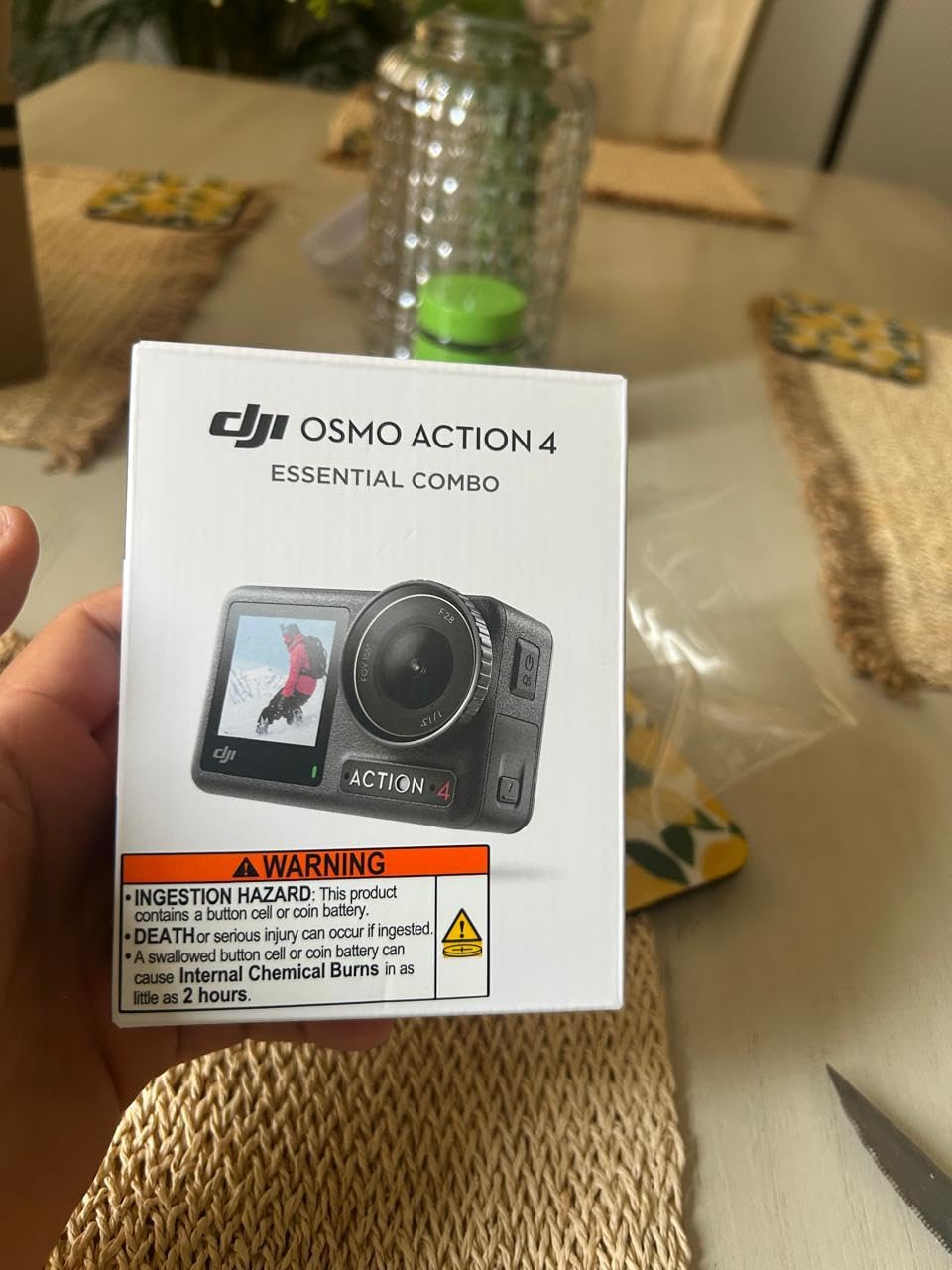
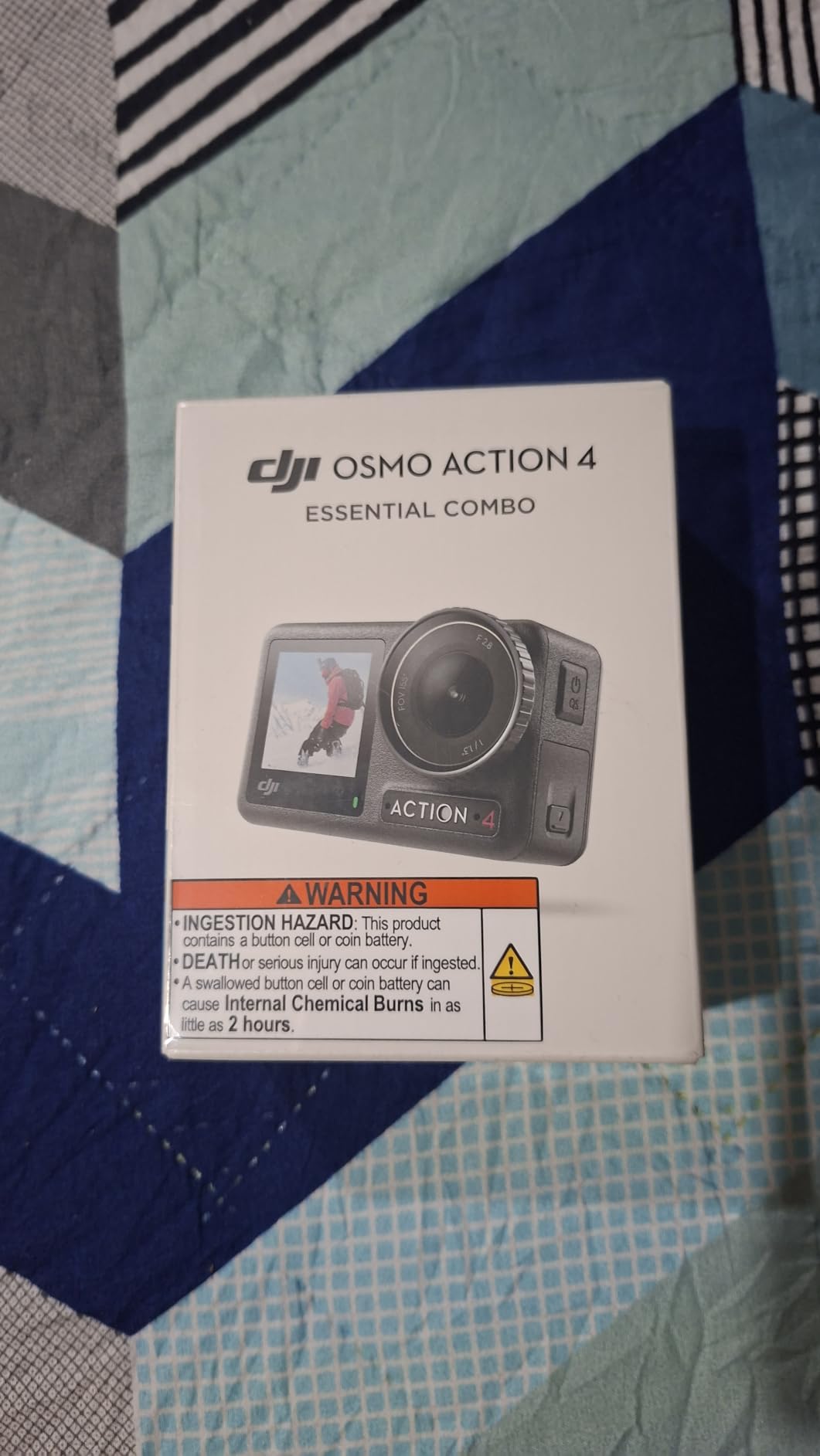
6. DJI Osmo Action 4 Essential Combo – Best for Filming MTB Jumps in Slow Motion
DJI Osmo Action 4 Essential Combo, Waterproof Action Camera Vlogging Camera
155 degree field of view
4K at 120fps
RockSteady and HorizonBalancing
1770mAh, 150 minutes
Pros
- 4K at 120fps with a 155 degree view
- Highest rated camera in this lineup
- HorizonBalancing for steep trail angles
- Pre-Rec buffers up to 60 seconds before you press record
- Magnetic quick-release for fast mount changes
Cons
- Essential Combo ships a single battery
- Highest bitrates need a UHS-II V90 card
- Editing in the app is required for color profiles
- Digital 4x zoom only crops
If your MTB camera has one job, filming jumps, this is the body for it. It shoots 4K at 120fps across a 155 degree ultra-wide field of view, which means a drop is recorded at a frame rate high enough for real slow motion without giving up the resolution needed to grade it later.
The 155 degree view also means minimal cropping, so a handlebar or chest shot keeps both the rider and the landing in frame. HorizonBalancing is the third stabilization mode and it is the one to use when you want the horizon locked while the bike is at an extreme angle on a steep chute.
Pre-Rec is the feature that quietly changed how I film. It buffers 5, 10, 15, 30 or 60 seconds before you press record, so the moment you actually wanted is already on the card. On a trail where you cannot stop to check a screen mid-descent, that removes an entire category of missed shots.
The magnetic self-locking quick-release lets you move between helmet, bar and vertical framings in seconds, which matters when you are switching angles at a car park between runs. It is waterproof to 18m without a housing and runs about 150 minutes on a 1770mAh battery, still working down to -20C.
Why riders pick it over the Osmo Action 5 Pro
10-bit color depth with the D-Log M log curve gives you real room to lift the shadows in a shaded forest without crushing detail. On MTB runs that are almost entirely in tree cover, that grading headroom is the single most useful video feature on this camera.
Both touchscreens are full-color and bright, and it connects directly to a DJI Mic 2 or Mic Mini transmitter for wireless audio with no receiver, so narrated ride films are straightforward.
Where the Essential Combo trades away
The bundle itself is the compromise. It ships with a single battery and no curved adhesive base, so you will be buying a spare battery and a curved mount to run it on a helmet peak all day. Plan for two extra purchases to make it a complete rig.
Getting the highest bitrates out of the 4K120 mode requires a UHS-II V90 card, which costs more than a standard card. Stabilization and color profiles are applied in the app, so you are committing to an editing workflow rather than getting finished files off the camera.
7. Insta360 ONE X2 – Best Lightweight 360 Camera for Long Trail Days
Insta360 ONE X2 360 Degree Waterproof Action Camera, 5.7K 360, Stabilization, Touch Screen, AI Editing, Live Streaming, Webcam, Voice Control
5.7K 360 capture
IPX8 waterproof to 10m
3-inch touchscreen
About 80 minutes per battery
Pros
- 4.9-ounce body fits a jersey pocket
- IPX8 waterproof to 10m without a case
- Removable battery and removable storage
- 3-inch touchscreen is easy to use on the bike
- Webcam
- streaming and voice control
Cons
- Slow wireless transfer for long clips
- Flat output resolution is low when zoomed
- Edge stitching at the seam can show
- About 80 minutes of battery life
- Small lens and port covers are easy to lose
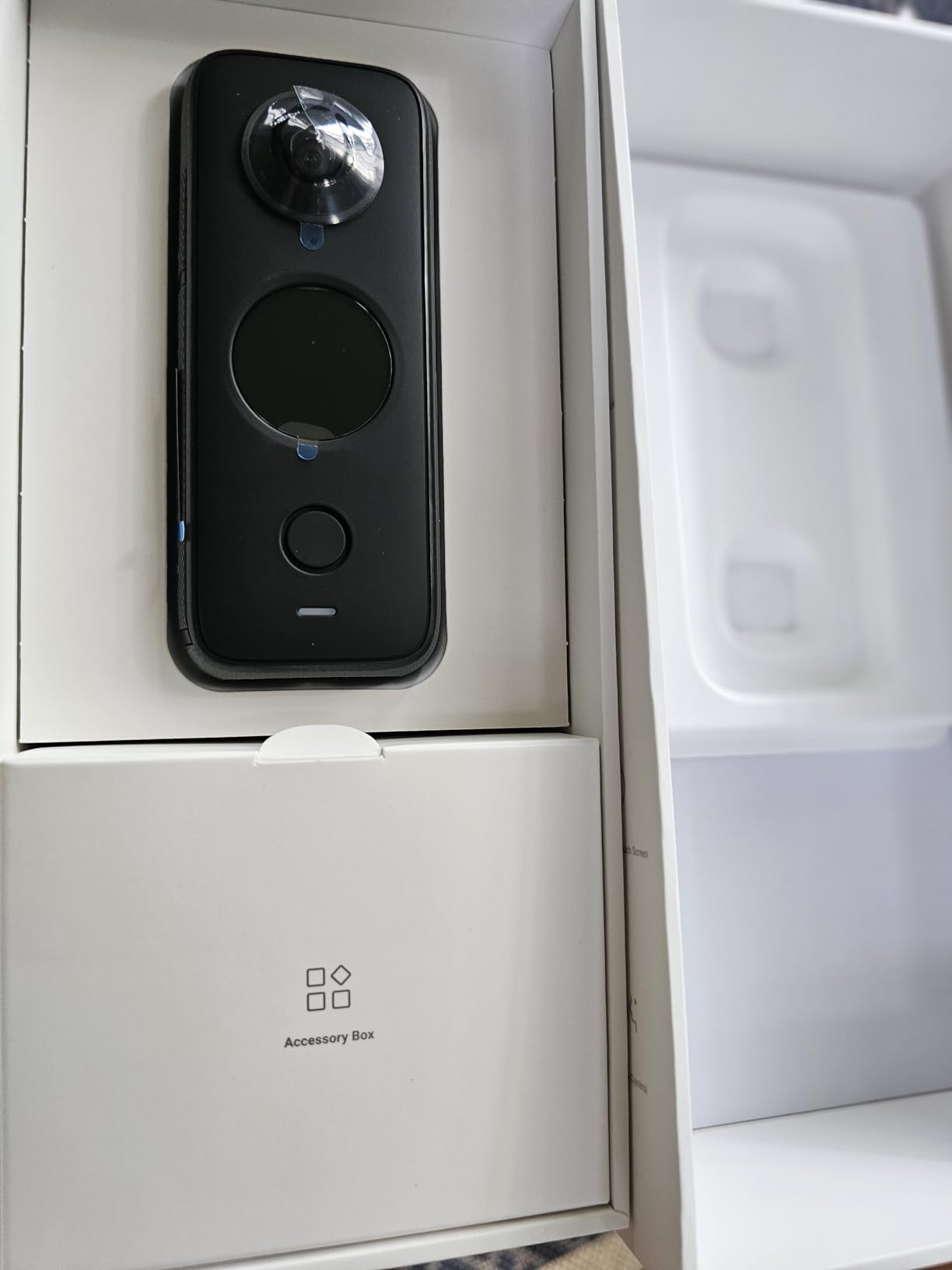
The ONE X2 is what we would carry when the priority is weight and 360 capture in the same body. At 4.9 ounces it disappears on a helmet or in a hydration pack, and the IPX8 rating to 10m means you can record a wet ride without a housing, which owners testing in bad weather confirm does not leak.
It records 5.7K 360 with FlowState stabilization and horizon leveling, and it also has a Steady Cam mode for single-lens wide-angle shots when you want a conventional clip without reframing. The 3-inch touchscreen is larger than the X3’s, which makes on-bike settings changes far less fiddly.
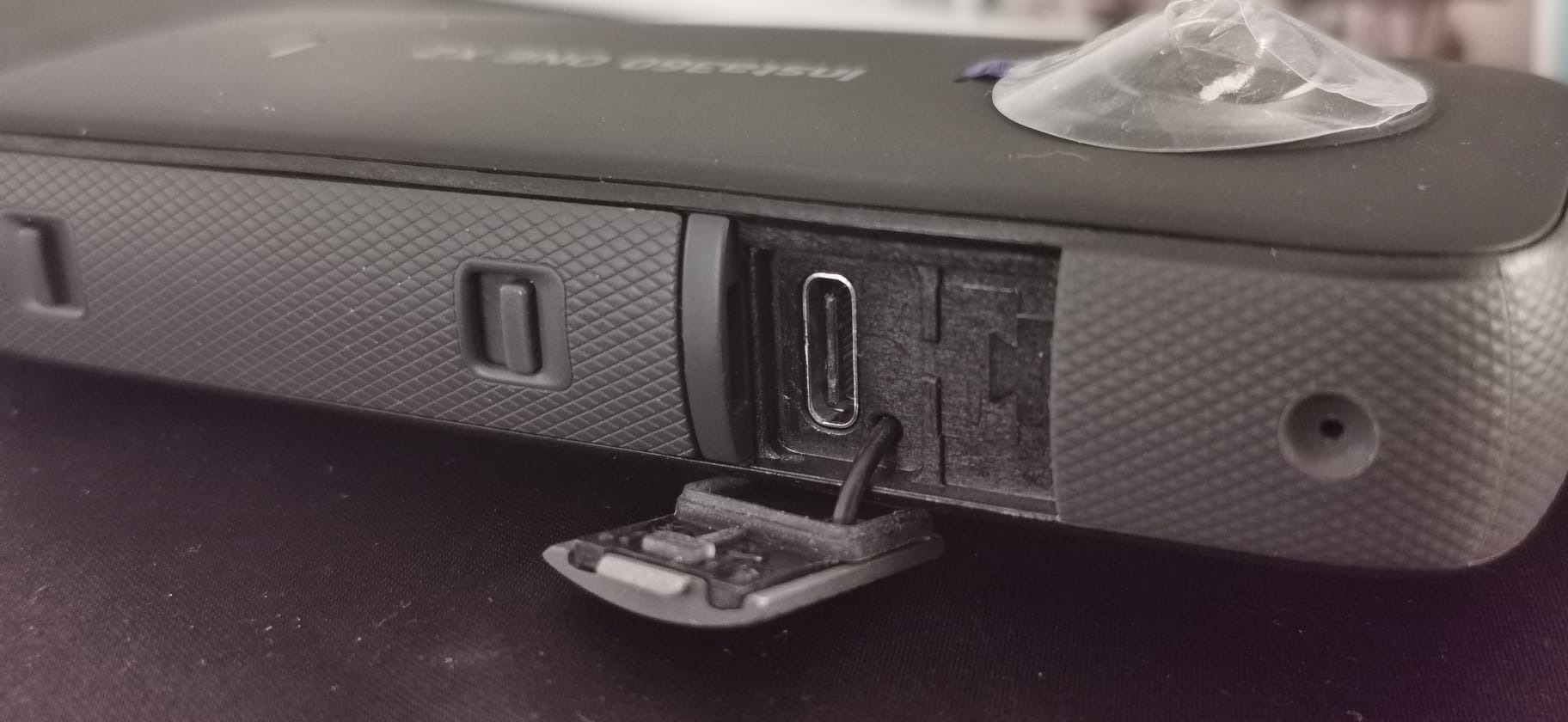
Removable battery and removable storage both extend sessions in a way integrated models cannot. On a long bikepacking-style day where you are topping up from a power bank, being able to swap rather than wait changes the plan completely.
It also works as a webcam and live stream camera, and it accepts voice control, so it is not a device you only ever use strapped to a bike.
Where the lightness earns its keep
Riders who carry a camera for safety on long solo days care more about grams than any of the higher-resolution cameras here. The slim body also fits a jersey pocket, so you can take it out at a section you want to film rather than carrying it on your head the whole ride.
Stitching is improved over the earlier ONE R, and the seam artifact is not something we noticed on normal trail footage at this resolution.
Where it costs you
Battery life of about 80 minutes is the shortest figure in this group and the most likely thing to end a ride early. Wireless transfer is slow, so longer clips need a cable first, and the software cannot automatically split long recordings into editable segments, so that chopping is manual.
Flat output resolution is low and zooming into a reframed section degrades quality, so treat the 360 file as the master and resist digital punch-ins. The small lens and charging-port covers are easy to lose, and losing the port cover voids the water resistance.
8. Jadfezy 1080P Action Camera – Best Casual Ride Camera for First-Timers
Jadfezy Action Camera FHD 1080P 12MP, 98FT/30M Underwater Waterproof Camera with 2 Batteries, Wide Angle Sports Camera with Accessories Kit Suitable for Helmet, Bicycle, etc.
1080p at 30fps
IP68 case to 30m
Two 900mAh batteries
100 g
Pros
- Two batteries give roughly four hours total
- Helmet and bicycle mounts included
- IP68 case supports wet-weather riding
- Survives drops
- Time-lapse
- loop and dash cam modes
Cons
- Only 1080p at 30fps
- Audio inside the case is muffled
- Can overheat in high ambient heat inside the case
- Exposure struggles in dark scenes
- Unsorted file naming and an unreliable bundled card
This is the camera to buy if you want to see whether filming your own rides is something you actually enjoy, at the lowest commitment. At 100g it mounts on a helmet or handlebar straight from the box, and two 900mAh batteries give roughly four hours of total recording for a full day.
It records 1080p at 30fps with 12MP photos, and the mode list includes time-lapse, loop recording and dash cam, which means it can double as simple incident evidence on a trail day without any extra software.
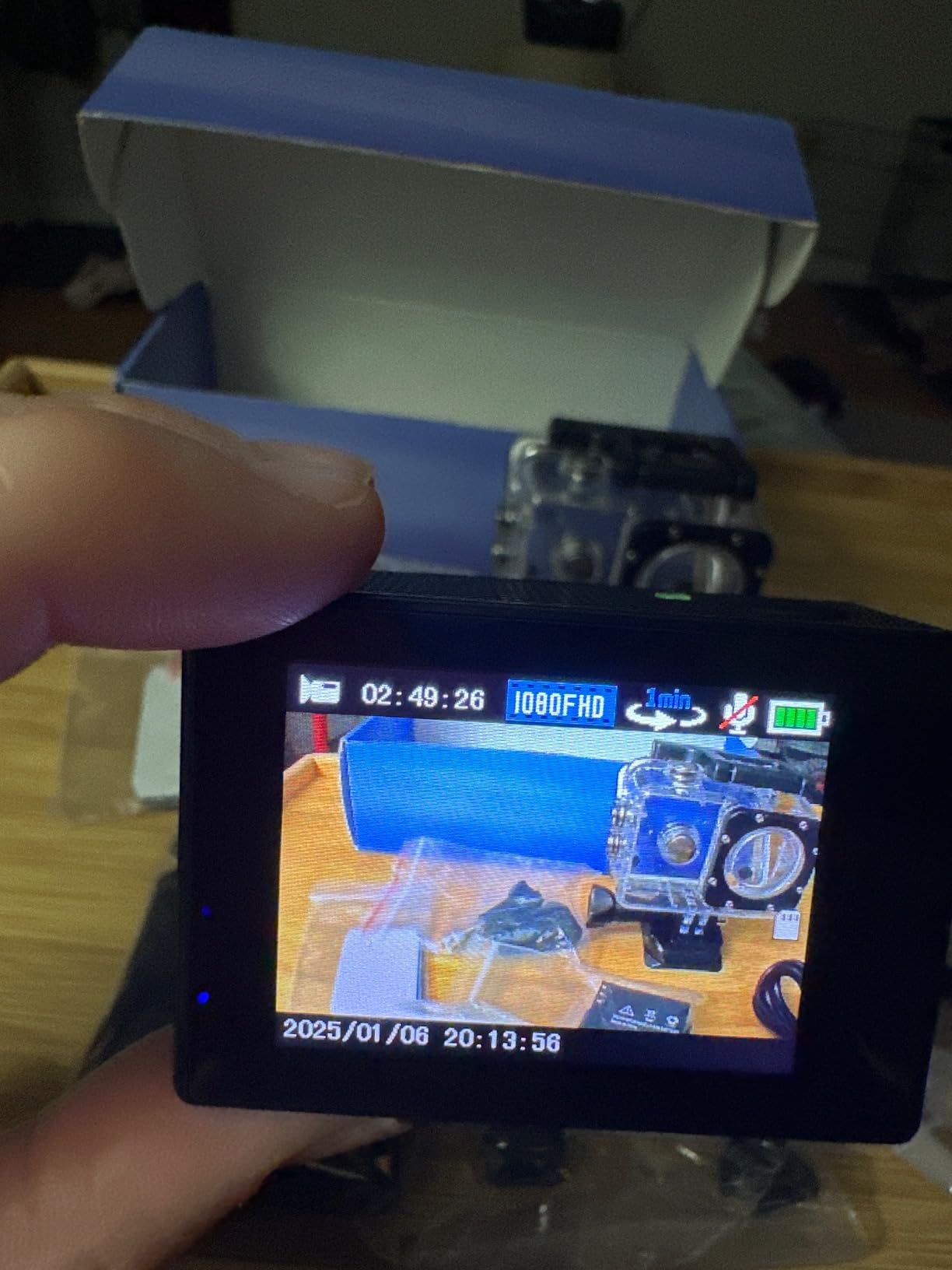
Owners treat it honestly as a backup or novelty camera rather than a main trail rig. It survives drops, and the IP68 case rated to 30m means creek crossings and rain rides do not destroy it, which is the part that actually matters for the money.
It charges over plain USB with no proprietary dock, which is a small thing that matters when you are packing cables for a multi-day trip.

Reasons it makes sense for a first ride cam
If you are unsure whether you want to edit trail footage, this is the cheapest way to find out. Nothing about the workflow is complicated, and the mounting kit means it works on the first ride rather than after a research session.
The dash cam and loop recording modes also give it a role as a simple trail evidence camera, which some riders find more valuable than image quality.
Where it stops being enough
1080p at 30fps is the hard limit. There is no 4K, no high frame-rate mode, and exposure struggles in dark or high-contrast scenes, producing either blown-out or washed-out footage. Audio inside the waterproof case is heavily muffled.
It can overheat and shut down in high ambient heat while sealed in the case, file naming on the card is unsorted so clips are tedious to locate, and reviewers warn that the bundled microSD card is not reliable. If you buy it, buy a card you trust.
How to Choose an MTB Action Camera: 6 Criteria That Matter
1. Stabilization on rough ground, not smooth roads
Vibration is the defining problem. Road cycling is mostly smooth input; mountain biking is a constant high-frequency buzz that no stabilizer fully removes, and the difference between a well damped mount and a cheap one is larger than any resolution difference on this list. Look for three-axis or roll-axis systems such as HorizonSteady, HorizonBalancing, FlowState plus Horizon Lock, and Horizon Lock, which is why the two 360 bodies and the two DJI cameras stand out in our runs.
2. Dynamic range matters more than megapixels
You do not need the most pixels, you need the pixels that hold detail when you ride from bright sky into dark timber. The Osmo Action 5 Pro’s 13.5-stop dynamic range and the Action 4’s 10-bit D-Log M profile both gave us the most usable forest footage, because recovering a crushed shadow matters more on a trail than a slightly crisper sunlit frame.
3. Battery planning for a three to five hour trail day
Quoted runtimes are laboratory maximums. Plan in real terms: four hours of recording is a full day at 4K, and anything under two hours needs spare batteries or a power bank. Swappable batteries are a genuine advantage for long rides, and cold weather cuts runtime, so the cameras rated to -20C, which includes both DJI bodies, keep working when the cheaper units get sluggish.
4. Field of view and whether you can reframe
A wide view keeps the trail in frame at speed but distorts the edges, while a narrower view looks natural and needs you to aim correctly. Fixed-angle cameras live or die on your mount choice. Reframeable 360 cameras remove that risk entirely but add editing work. Pick based on how much editing you actually want to do, because the riders who abandon 360 cameras do so because of the edit, not the footage.
5. Durability, sealing and the mount ecosystem
Check whether the body is waterproof without a housing or only inside one, because a housing changes weight, fogging risk and button access. Prefer magnetic quick-release mounts that let you change angles without re-aiming, and check the small replaceable parts, since lens and port covers are the components most often lost and the loss of a port cover voids water resistance.
6. Weight on a full-face helmet
Riders are wary of heavy cameras on full-face helmets, and the reason is comfort and, in a crash, snag risk. Bodies between 100g and 160g are comfortable for a full day. A dual-screen body with a large sensor is noticeably heavier, so if you ride a lot in a full-face, weight is a real criterion rather than a detail.
Two more riders ask us about. We cover cycling cameras more broadly in our motorcycle action camera guide, which shares the vibration and helmet-mount concerns, and if you also film vlogging, the best action cameras for vlogging covers the dual-screen and audio features that matter when you are talking to camera.
Helmet, Chin, Chest or Handlebar: Which Mount Gives the Best MTB POV
Mount choice changes the footage more than any spec on this list, and it is the question riders argue about most. Riders on r/MTB broadly agree that a chest mount produces the most natural, stable footage, with a chin mount on a full-face the strongest second option.
A helmet peak mount is the most comfortable for long days and it keeps the camera with you if you separate from the bike in a crash. Under the visor is a reasonable fallback, though several riders note it takes away some of the sense of speed. A handlebar or top-cap mount gives a stable frame but points wherever the bars are pointed, so it constantly frames the front wheel instead of the trail.
On safety, most riders worry about helmet mounting being dangerous in a crash. The concerns that come up repeatedly are snag risk and the weight pulling on the strap. The practical mitigations are a chin or peak mount rather than a heavy bar of hardware on top, a strap that is pulled tight enough not to shift, and a short tether so the camera cannot swing after an impact. Several riders note that a helmet mount is still the option that keeps the camera on their body if the bike is lost.
One thing nobody warns you about is audio. Wind noise on an open chin or peak mount destroys the recording completely on a fast descent, so if you plan to keep the sound, plan on an external microphone on a conventional body or accept that you are filming a silent trail.
Filming Tips for Forest Trails, Water Crossings and Jumps
Why your MTB footage looks slow
The most common complaint from new riders is that their footage looks unnaturally slow, and it is almost always a frame-rate and shutter discipline problem rather than a camera problem. Shoot at a high frame rate, then play it back at the frame rate you filmed it, rather than playing 60fps footage back at 30fps, which halves the speed. If you want genuine slow motion, double your shutter speed rather than just raising the frame rate.
Exposure in dappled forest light
Under tree cover your exposure swings constantly. Locking exposure rather than letting it auto-adjust stops the whole clip from pumping between dark and bright as you ride. On the DJI bodies the color temperature sensor handles white balance automatically, which removes the other half of the problem.
Slow motion and frame rates for jumps
For jump footage, 4K at 120fps is the sweet spot and only the DJI Osmo Action 4 in this list reaches it. The Brave 4 and EK7000 top out at 1080p for their fastest modes, which is usable but limits how large you can crop.
Lens fogging and mud
Sweat inside a helmet and the humidity from a water crossing will fog the lens faster than mud will dirty it. Wipe the lens before every run, keep the camera body bagged in genuinely wet weather, and never ride with a damp lens in a sealed housing, because condensation inside a case will not clear until the camera has dried out completely.
Loop recording as a trail dash cam
Several of these cameras support a loop recording or dash cam mode, which keeps a rolling window of recent footage and overwrites it. It is the cheapest form of incident evidence you can carry on a bike, but archive any clip you care about the same ride, because the next loop will overwrite it.
Frequently Asked Questions
What is the best action camera for MTB riding?
The DJI Osmo Action 5 Pro is the best overall action camera for MTB riding, thanks to its 1/1.3-inch sensor with 13.5-stop dynamic range for forest light, HorizonSteady roll-axis stabilization that keeps the horizon level off-camber, and a body sealed to 20m without a housing.
Which 360 camera is best for mountain biking?
The Insta360 X3 is the best 360 camera for mountain biking in this group. It records 5.7K 360 Active HDR with FlowState stabilization and Horizon Lock, and it also shoots conventional 4K30 single-lens footage when you do not want the reframing step.
Which GoPro is best for mountain biking?
None of the eight cameras we tested is a GoPro, so we left GoPros out rather than pad the list. Of the bodies here, the DJI Osmo Action 4 Essential Combo is the closest match, rated highest at 4.7 out of 5, with 4K at 120fps for filming jumps and HorizonBalancing for steep trail angles.
What is the best affordable camera for mountain biking?
The AKASO EK7000 is the best budget mountain biking camera: it records 4K30 with built-in electronic stabilization and ships with helmet and handlebar mounts, a wrist remote, two batteries and a 131ft waterproof case. You will need to buy a microSD card separately.
Should I mount an action camera on my helmet or chest for mountain biking?
A chest mount gives the most natural and stable POV footage for MTB, with a chin mount on a full-face helmet the strongest alternative. A helmet peak mount is more comfortable over a long day and keeps the camera on you in a crash, but adds wind noise and can shift over rough ground.
Why does my action camera footage look slow when mountain biking?
Footage looks slow when you record at a high frame rate and play it back at a lower one, which halves the apparent speed. Play 60fps footage back at 60fps, and for genuine slow motion double your shutter speed rather than only raising the frame rate.
Final Verdict: The Best Action Cameras for Mountain Biking in 2026
The DJI Osmo Action 5 Pro is the best action camera for mountain biking overall, because forest light, horizon control and sealing to 20m are the three things that decide whether trail footage is usable. Pick the DJI Osmo Action 4 if your priority is filming jumps at 4K120, and the Insta360 X3 if you would rather reframe after the ride than aim correctly during it.
For riders spending less, the AKASO Brave 7 LE gives you dual screens, an external mic input and two batteries in one bundle, while the AKASO EK7000 remains the simplest way to start filming. Match the mount to how you ride, keep spare batteries in the pack, and check the framing before you drop in.