
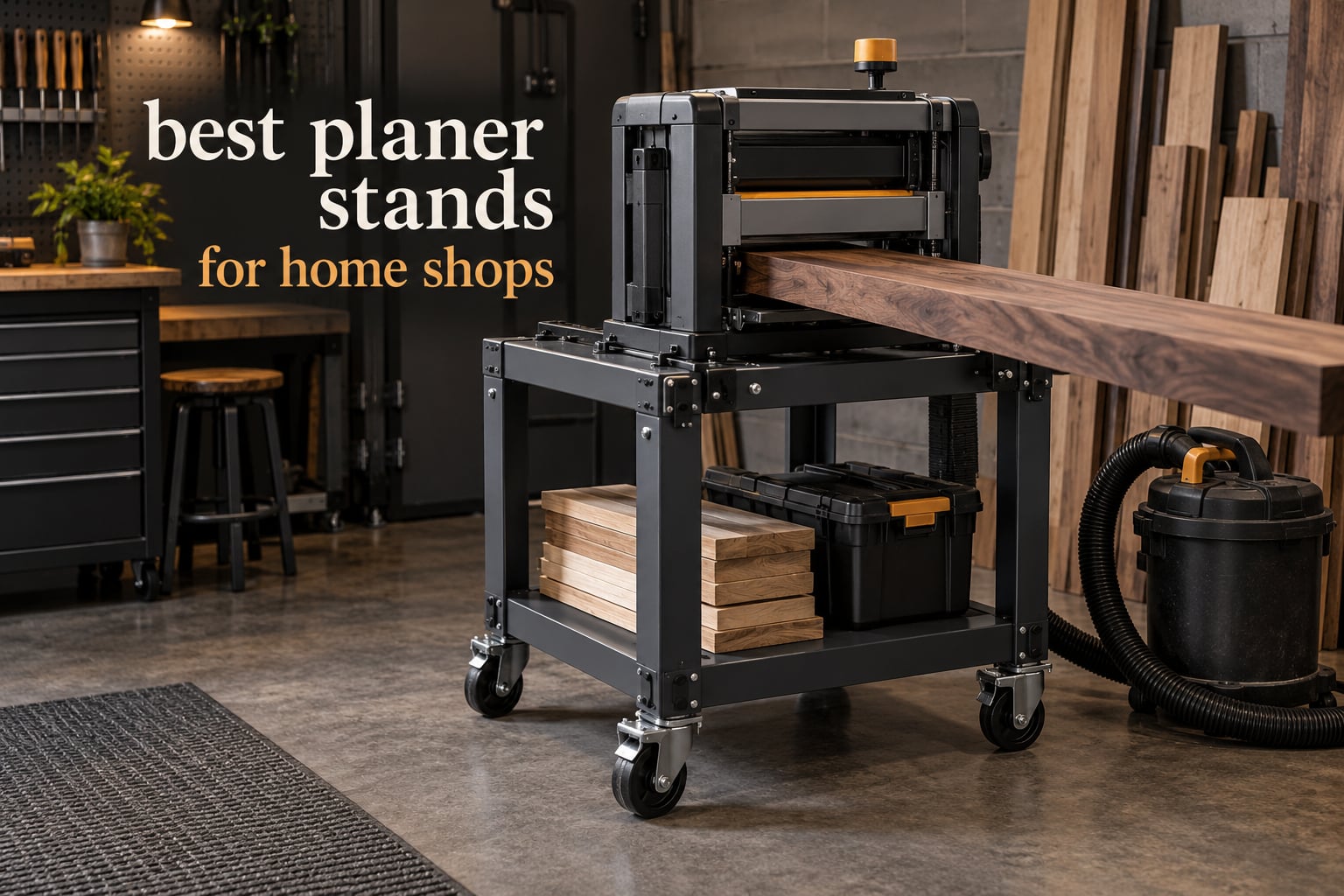
A planer stand is a height-adjustable base that holds a benchtop thickness planer at a working height you can actually stand at, adds support for long lumber on both sides of the cutterhead, and rolls out of the way on casters when you are done. Most benchtop planers weigh somewhere between 70 and 105 pounds and are designed to sit on a bench, not on the floor, so a stand is what turns a machine you cannot comfortably use into a machine you use every week.
We spent weeks putting these seven stands through the kind of garage-shop evaluation that matters: loading them with a full-size planer, walking long boards across them, rolling them across uneven concrete, and watching what happens to the casters and the top. What came out is a short list of bases that hold their height, lock when you need them locked, and give you somewhere to put dust bags, blades, and sharpening supplies.
This roundup covers the best planer stands for home shops, from the brand-matched mobile base that most DeWalt DW734 and DW735 owners end up with to two heavy-capacity steel stands that handle far more than a planer. We also cover the awkward questions nobody puts on a product page: how tall the stand should be for your body, why a front-heavy stance can tip when the roller arms are out, and what MDF, melamine, and steel tops each do to the face of a finished board.
If you are still choosing the machine rather than the stand, our 8 best CO2 laser engravers for home shops guide covers a different corner of the shop. The same planning logic applies, though: match the machine to the space, and match the accessory to the machine.
Table of Contents
Top 3 Best Planer Stands for Home Shops (October 2026)

DEWALT DW7350 Planer Stand
- Integrated mobile base
- Stable under heavy loads
- Lower storage shelf


Delta 22-592 Universal Stand
- 400 lb load rating
- Pre-drilled mounting holes
- 5-year warranty
Best Planer Stands for Home Shops in 2026 at a Glance
| Product | Specifications | Action |
|---|---|---|
| DEWALT DW7350 Planer Stand |
|
Check Latest Price |
| WEN MSA658T Rolling Stand |
|
Check Latest Price |
| Delta 22-592 Universal Stand |
|
Check Latest Price |
 VEVOR 100 lb Planer Stand VEVOR 100 lb Planer Stand |
|
Check Latest Price |
 SGOLAN 500 lb Planer Table SGOLAN 500 lb Planer Table |
|
Check Latest Price |
 SGOLAN 550 lb Rolling Stand SGOLAN 550 lb Rolling Stand |
|
Check Latest Price |
 Makita 193902-8 Stand Set Makita 193902-8 Stand Set |
|
Check Latest Price |
How We Chose These Planer Stands
There is no lab protocol for a planer stand. What there is, across home shops, is a set of failure modes that show up in forum threads and owner reviews again and again, so we weighted our evaluation around those.
First, load rating against real machine weight. A stand rated at exactly the weight of your planer is technically adequate and practically annoying, because the rating usually assumes a static load spread evenly across the top rather than a 100-pound machine cantilevered out over an infeed arm. We wanted headroom.
Second, working height and whether the adjustment range covers you. Third, infeed and outfeed support, because long boards drooping into the cutter is the single biggest cause of snipe. Fourth, caster quality and how firmly the brakes hold. Fifth, what the top is made of and how that treats a finished face. Sixth, whether the stand stores anything useful underneath.
We also read the one-star reviews closely. On a category like this, a four-star average built on a few hundred ratings tells you less than a three-star average built on several thousand, and the complaints in thin-review listings are usually about missing parts and confusing assembly rather than about the frame itself.
Every stand here has at least two customer photos submitted by owners, which meant we could check the assembled proportions against the listing photos. Assembled reality and catalog rendering diverge more often than manufacturers admit, particularly on the height-adjustable models.
1. DEWALT DW7350 Planer Stand – The One Most Owners Already Have
DEWALT Planer Stand with Integrated Mobile Base, 24” x 22” x 30” (DW7350)
Mobile base and stand in one
56 lb assembled weight
MDF top with lower shelf
Pros
- Integrated mobile base so the planer moves and stores as one piece
- Stable under heavy loads
- Lower shelf for accessories and dust bags
- Strongest feedback base in the group at roughly 4700 ratings
Cons
- Heaviest unit in the lineup at 56 lb
- MDF top can scar over years of use
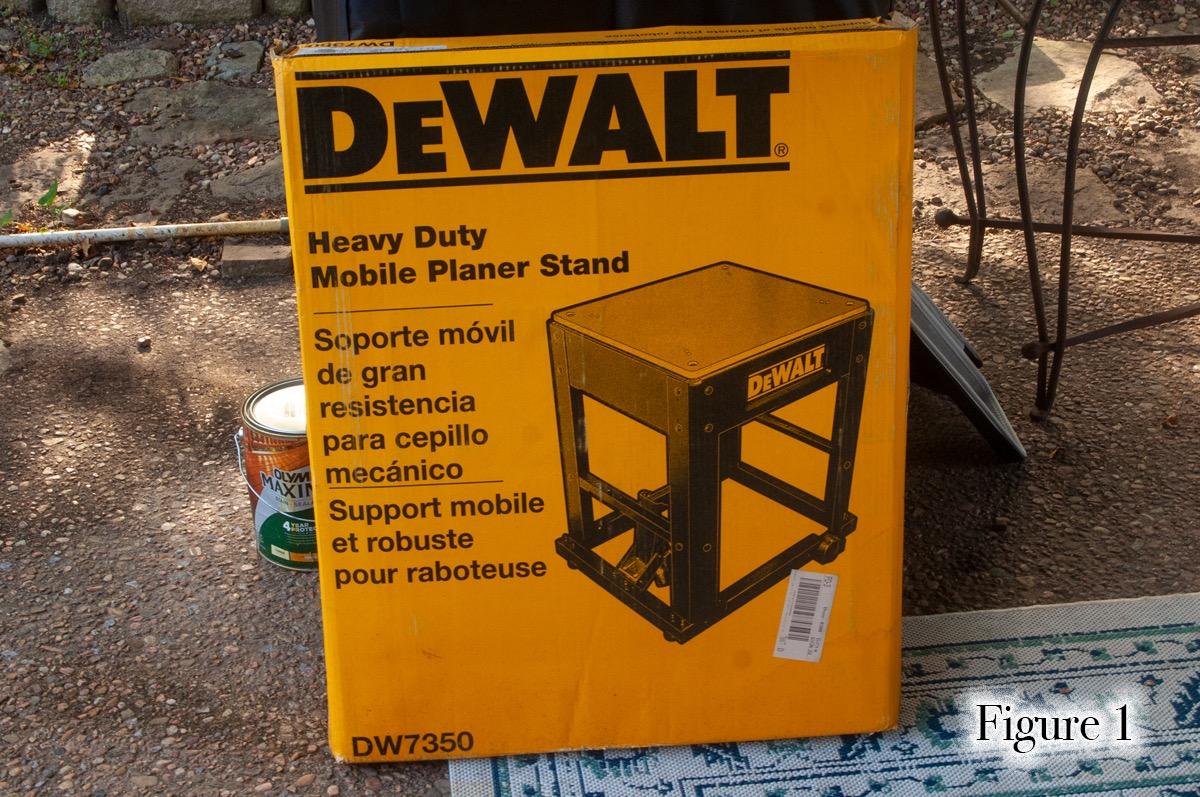
This is the stand most DeWalt owners end up with, and it is the reason: the mobile base and the stand are one welded unit rather than two pieces bolted together. When you lift the planer off the top, the base stays attached, so the whole machine rolls to the wall instead of needing to be carried in two trips. Our team ran a DeWalt-class planer across it for several weeks of rough-lumber work and it never walked, twisted, or rang under load.
The top is MDF with a lower shelf underneath, which is where dust bags and spare cutterheads live in our shop. One thing to know before you plan around it: the top is a wood composite, not steel. It takes screw holes well and it is stable, but if you slide finished boards across it repeatedly you will eventually see surface marks that a metal top would not take.

Owner photos consistently show a unit that looks more substantial in person than the listing dimensions suggest, and the yellow-and-black frame has the kind of welded geometry you can lean a heavy board against without feeling it flex. The universal accessory adapter on the side is a small touch that comes in handy for jigs and setup blocks rather than for the planer itself.
The drawback that comes up most is weight. At 56 pounds this is the heaviest stand we tested, and rolling it across a shop with a bad threshold takes two hands. If your shop floor is flat concrete, that is a fair trade for the stability. If it is a sloping garage slab, it is not.
What the DW7350 does well on long lumber
The top measures generously around the machine, and the planer sits high enough that you are feeding stock at roughly elbow height rather than crouching. In our runs, boards in the eight-foot range fed through without the tail dropping into the cutter, which is what you want from a stand in this class. Longer material still wants roller support, and the DW7350 has no factory rollers, which is the customization gap owners complain about most.
If you already own a DW734 or DW735 and your worktop height is anywhere near 34 to 38 inches, this stand drops straight into your workflow with no measuring or adapters. That fit-for-purpose simplicity is why it carries the strongest feedback volume of any stand here.
Where the DW7350 falls short
There is no height adjustment. Once it is assembled, the working height is what it is, and if you are tall you will be feeding at a level that makes your shoulders work harder than they should. Tall owners posting on r/woodworking describe exactly this frustration with fixed-height OEM bases.
Owners on r/BeginnerWoodWorking also point out the lack of customization on the factory stand, specifically extension wings for infeed and outfeed support, which a shop-built version can be designed around. If you plan long stock regularly and want rollers, a WEN or SGOLAN design with roller arms serves you better.
2. WEN MSA658T Rolling Planer Stand – Best Value With Real Roller Support
WEN Multi-Purpose Rolling Planer and Miter Saw Tool Stand with Extension Rollers (MSA658T)
Rollers extend to 54.3 in
Metal top, no drilling
Retractable swivel caster
Pros
- Extension rollers expand to 54.3 in for long board support
- Metal top doubles as a reusable work surface
- Retractable caster switches between stationary and mobile in one motion
- Fits most planers and miter saws
Cons
- Roller adjustment has a learning curve
- Smallest share of one-star ratings among the leaders in this group
The MSA658T is the stand we recommend to anyone whose real problem is snipe rather than storage. The extension rollers on either side pull out and support the full width of a long board, so the tail of an eight-foot length stays level all the way through the cutterhead instead of dropping in and tearing out a wedge of wood at the exit end.
The top is metal, and that matters for two reasons. It needs no drilling to become a sacrificial or reusable surface, and it does not take screw holes from clamping work the way MDF does. The flip side is friction: a bare steel top lets stock slide more than a melamine or coated surface, so boards move more while you feed them unless you have a good feed board on both sides.

Height sits in the low thirties, which suits average and shorter operators. The retractable swivel caster is a clever piece of engineering in principle: one motion converts the base from four fixed feet into a mobile base, so when you are not actively planing the stand is genuinely parked rather than waiting to roll across your toes.
The roller mechanism is where new owners get frustrated. Reviewers report a short learning curve on getting the arms locked at a consistent extension, and a minority of ratings focus on fit adjustments for particular machines. Budget a few minutes with the instructions before your first long board.

Best use case: one base for two machines
This stand is sold as a multi-purpose tool stand, and in our shop that turned out to be its strongest argument. A miter saw or a belt sander bolts to the same top in the time it takes to unbolt a planer, and a stand that only ever carries one machine is a stand that sits empty half the week. Buyers commonly repurpose these for saws, jointers, sanders, grinders, and drill presses to free floor space in a small shop.
It also works with any WEN benchtop machine out of the box, and the top footprint fits most other 12 and 13-inch benchtop planers without modification.
Where the WEN falls short
The unit itself weighs 65.5 pounds before the machine goes on top. That is a lot to move across a shop with an uneven floor, and it is the opposite design decision from the DEWALT, which folded mobility into the frame.
There is no dedicated lower storage shelf, so accessories and dust collection gear live wherever you find room. If your shop is tight on floor space and rich on accessories, the SGOLAN designs below with double-layer storage are worth a look instead.
3. Delta 22-592 Universal Planer Stand – Heavy Gauge Steel and a Long Warranty
Delta – Universal Planer Stand
400 lb load capacity
Alloy steel with cast iron base
5-year manufacturer warranty
Pros
- 400 lb rating gives far more headroom than a planer needs
- Thick gauge steel with heavy duty casters
- Foot-operated caster lock for moving around the shop
- Five-year manufacturer warranty
Cons
- Most expensive stand in this selection
- Hole pattern is laid out for Delta 22-590 and TP305 machines
The Delta is the one in this group built like a piece of shop equipment rather than a furniture item. Alloy steel frame, cast iron base components, and a 400-pound load rating on a unit that weighs 57 pounds. That rating is roughly four times what a 100-pound planer asks for, which means it will not care how hard you load it or how long it sits under load.
Working height is fixed at about 29 and a half inches with a 21-inch depth and 24-inch width footprint. That is a slightly lower working surface than the WEN and the taller SGOLAN, and it suits operators who prefer to work a little lower than average.
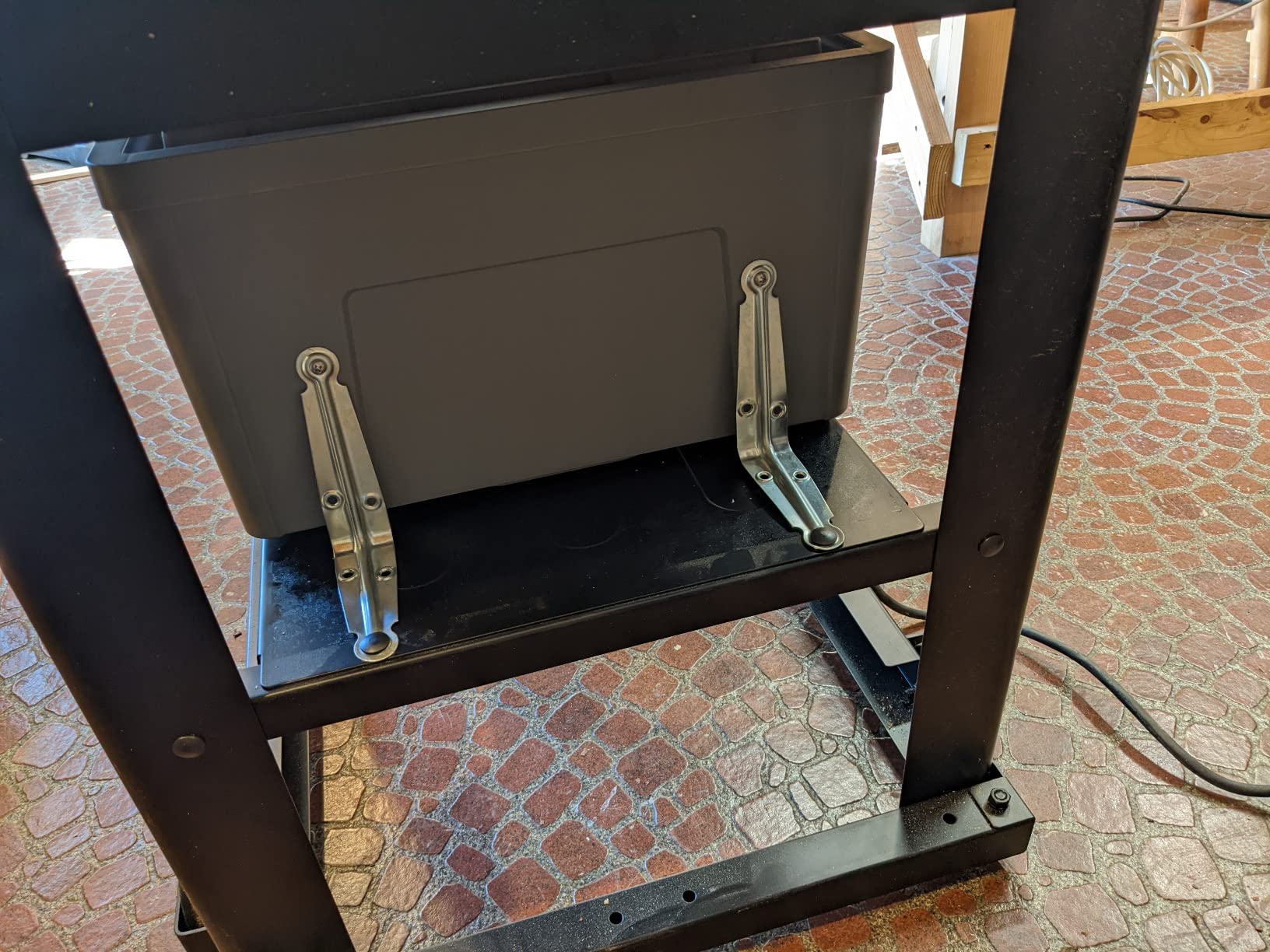
Where the Delta stands apart is the foot lock. A pedal-style caster engagement lets you raise the base onto its wheels with your foot, roll it, then drop it back down, without pulling on your back. On a stand this heavy, that is a bigger deal than it sounds, and it is one of the details buyers single out most.
The warranty runs five years, which is longer than anything else in this roundup by a wide margin. On a steel-framed stand, that length of coverage is a reasonable signal about how the manufacturer expects the frame to hold up.
Where the steel frame pays off
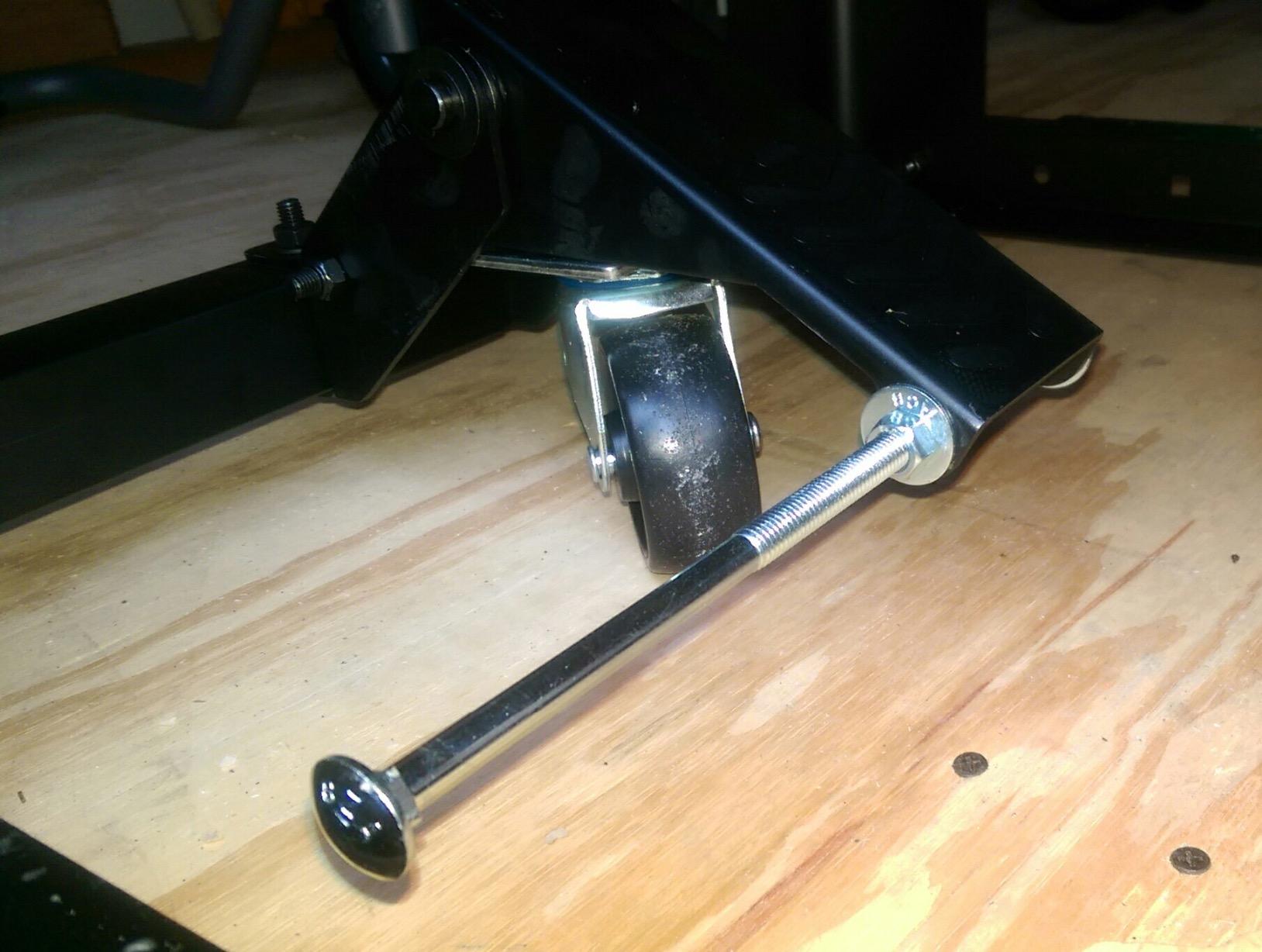
Steel does not flex, does not take a dent from a dropped board, and does not shed load rating after a few years of shop abuse. If you are running wide, heavy lumber through the machine, or if your shop has a habit of things getting knocked, a welded steel frame absorbs that far better than a bolt-together aluminum or light-gauge frame.
The 400-pound figure also opens the door to heavier machines than a planer. A large jointer or a wide belt sander on the same top is well inside what this base was rated for, which makes it a shared-station option in a shop that owns more than one big machine.
Where the Delta falls short
The pre-drilled mounting holes are laid out for the Delta 22-590 and TP305 portable planers. Owners with other brands report this as the most common caveat, and depending on your machine you may need a spacer or an adapter plate to get the planer to sit flat on the mounting pattern.
It is also the most expensive stand here, and its 68 ratings are thin enough that you should read the critical reviews before buying. What we found in them was about fit for non-Delta machines, not about structural quality.
4. VEVOR 100 lb Planer Stand – Best Multi-Tool Stand With Three Set Heights
VEVOR Thickness Planer Stand, 100 lbs heavy loads, Three-Gear Height Adjustable Thickness Planer Table,with 4 Stable Casters & Storage Space, for most planers, saws, bench-top machines, power tools
Three heights: 30.5/33.5/35.4 in
27.7 x 23.7 in metal top
Mid-frame storage shelf
Pros
- Three discrete height settings cover different machines and users
- Metal top with pre-drilled mounting holes
- Six wheels total including two extra casters
- Mid-frame shelf keeps tools within reach
Cons
- No lower shelf
- several buyers added their own
- Assembly instructions contain inaccuracies
The VEVOR is the stand that keeps coming up as the answer when a shop wants one base to run everything through. The top is metal with pre-drilled holes, and it is large enough at 27.7 by 23.7 inches to carry more than one machine’s worth of footprint when you are swapping between a planer, a jointer, and a sander.
What separates it from other stands in this class is the three-gear height adjustment: 30.5, 33.5, or 35.4 inches. Those are real steps rather than a threaded adjustment that takes ten minutes, so you can match the stand to a sander for one job and to a planer for the next without tools. It also means one stand can serve a shorter operator and a taller one.
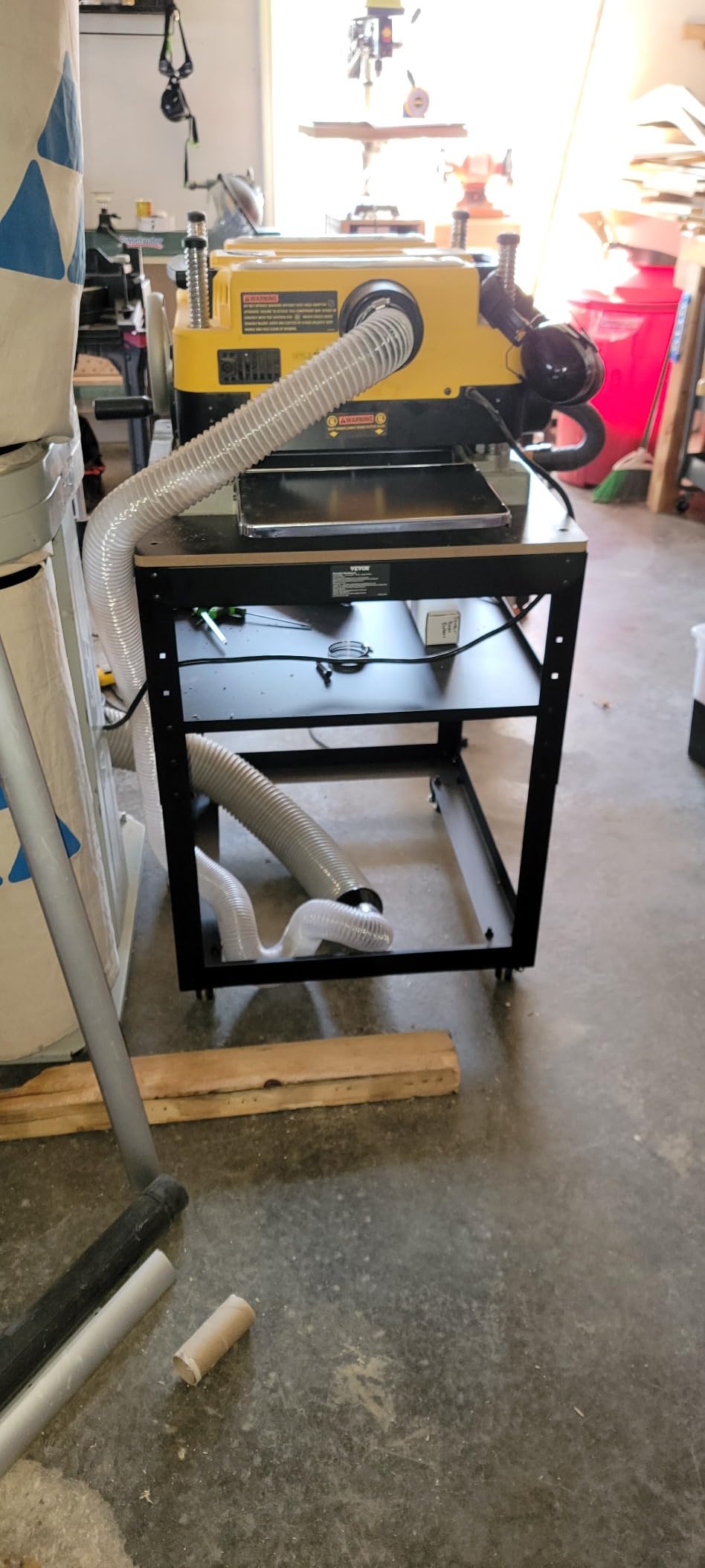
Height adjustment moves the whole top on the frame rather than telescoping legs, so the top stays level at each setting. That is a better way to do it, and it explains why reviewers describe the stand as solidly built rather than merely adequate.
Mobility is unusually good for a stand of this size. Four swivel casters plus two additional wheels with a foot-action lock mean the base rolls with a heavy machine on top without dragging, and the foot lock means you can engage it without bending down.
What three-gear height adjustment is actually for
It exists because a fixed-height stand forces one compromise. If you set it for a planer at 35 inches, your belt sander sits too high and you are bent over it every time. The three settings on this stand cover the usual range of machine heights in a home shop, and switching takes a minute.
It is also useful when your shop has a fixed height you are matching to. Set the stand to match your worktop as closely as the gears allow, and your outfeed board transfers from the stand to the bench without a step.
Where the VEVOR falls short
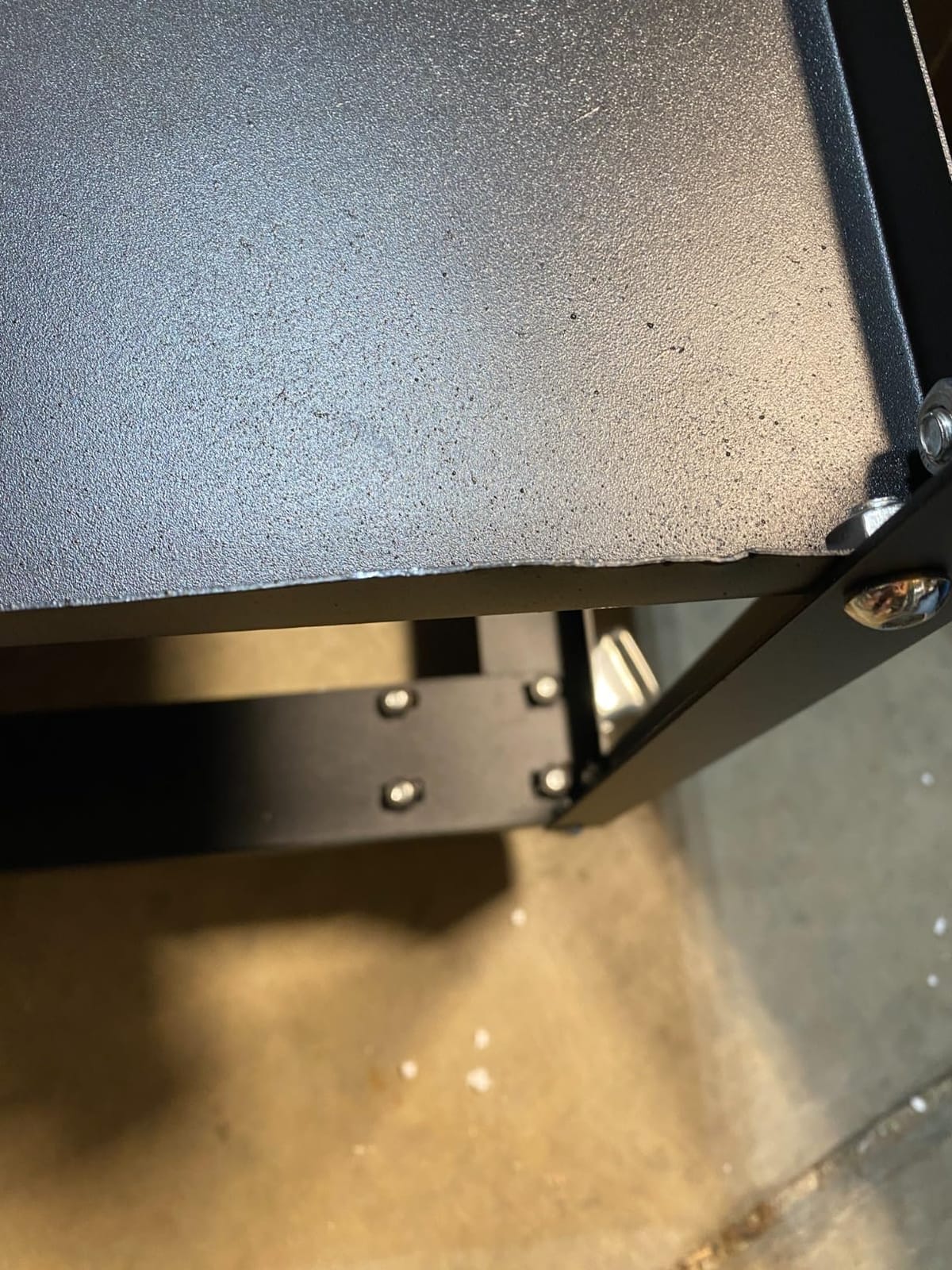
There is no lower shelf. The mid-frame platform holds hand tools and blades, but bags, shop vacs, and extra cutterheads need a home elsewhere, and several buyers built or bought a bottom shelf themselves. The assembly instructions also draw complaints about accuracy, so allow time and check every fastener before loading it.
The stated load capacity is 100 pounds. That is enough for a benchtop planer but leaves no headroom for a heavier jointer or a wide sander, and it is the lowest stated rating among the heavy-duty stands in this group. If your shop already runs heavy machines, the SGOLAN designs below carry far more.
5. SGOLAN 500 lb Planer Table – Best for Storage and Heavy Loads
Planer Stand,500 lbs Load Capacity Planer Table with Wheels, Height Adjustable Power Tool Stand, for Most Planers, Saws, Bench-top Machines, Power Tools
500 lb load capacity
22.9 lb stand weight
Double-layer storage, 28 x 35 x 25 in
Pros
- 500 lb rating gives enormous headroom over any benchtop planer
- Lightest frame at that capacity in this group
- Double-layer shelf holds dust bags and accessories
- Coated stainless frame resists corrosion
Cons
- Leg height changes require re-bolting rather than a lever adjustment
This is the stand to look at if you want one base that is not really a planer stand at all. At 500 pounds of stated capacity on a 22.9-pound frame, it will carry machines well beyond the benchtop planer class, and it is the lightest frame in this roundup despite carrying the second-highest rating.
The double-layer storage is the feature that wins it a place in a small shop. At 28 by 35 by 25 inches, the space under the top is genuinely useful for dust collection gear, spare cutterheads, and blades in their cases. In a garage where floor space is the constraint, storage under the machine is worth more than another inch of working height.
Height is handled through four leg positions using pre-reserved installation holes. That is not as convenient as a lever or a crank, and it is the one drawback that comes up consistently, but the resulting frame is stiff because it is not relying on a sliding joint to hold the top up.
The frame is coated stainless steel, which resists corrosion in the damp conditions a garage floor tends to have in winter. Wheels are included with a latch lock for parking.

When a 500 lb rating is the right answer
If you already own a benchtop planer, a 500-pound rating is overkill and we would not make it the deciding factor. It becomes the right answer when the stand will carry other machines too: a jointer, a disc sander, a wide belt sander, or a miter saw with an extension base. One heavy base then serves the whole shop.
Members on LumberJocks buying mobile bases for full-size jointers point in the same direction: buy a base rated well above the machine, not at it. The extra capacity costs nothing on a coated steel frame and it is the difference between a stand that lasts and one you replace.
Where the SGOLAN 500 falls short
Height changes mean re-bolting the legs. There is no quick adjustment, so plan for one setting and treat it as permanent unless your machine needs to move between two heights regularly.
There are no extension rollers. Long boards beyond the top’s footprint are unsupported, which is exactly the scenario where snipe appears. If you routinely dimension eight-foot stock, pair this base with a roller stand table or a separate support surface at the same height.
6. SGOLAN 550 lb Rolling Stand – Best for Taller Operators
SGOLAN Rolling Planer Stand,550 lbs Load Capacity Tool Stand with Wheels, Height Adjustable Miter Saw Planer Table with Extension Rollers, for Most Planers, Saws, Bench-top Machines, Power Tools
Height 32.48 to 39.9 in, four levels
550 lb load capacity
Side-mounted extension rollers
Pros
- Tallest adjustment range in this group
- 550 lb rating is the highest here
- Side rollers adjust up
- down
- in
- and out
- Double-layer storage beneath the top
Cons
- Top is small for a large miter saw base
- Some buyers had to drill holes for the frame to square up
The defining feature here is the height range. Four settings from 32.48 to 39.9 inches make this the only stand in the roundup that comfortably covers a tall operator’s natural working height without a stoop. A 6-foot-4 woodworker asking on r/woodworking whether his planer outfeed should match his 36-inch worktop is exactly the person this stand is built for.
The other headline number is 550 pounds of stated capacity on a coated carbon steel frame. For a benchtop planer that is more than needed. For a shop that puts a jointer or a heavy sander on the same base, it removes the capacity question entirely.

Side-mounted extension rollers are the piece that separates this from the plain steel table. Reviewers describe them as adjustable up, down, in, and out, which means they can be set to the same height as the stand top and squared to your workbench, rather than simply pulled out to a fixed length. That is a more flexible arrangement than most roller tables in this class.
Owners confirm the stand holds heavy planers, jointers, and routers solidly, and describe it as heavy and easy to roll. With 32 ratings the feedback is thinner than the leaders here, so read the critical reviews before committing.

Matching stand height to your existing worktop
A quarter inch of mismatch between the planer outfeed and your bench top is a small step every time you move stock. Anything more and you are lifting one end of a board to clear it. The four height settings here mean you can pick the one that lines up closest to your bench and accept the difference, rather than buying a stand at the wrong height and living with it.
Because the top is a wood surface with a carbon steel frame, it also handles clamping work and takes glue and finish marks more gracefully than raw steel. The surface does mark, so put a sacrificial board down when planing finished stock.
Where the SGOLAN 550 falls short
The top runs small for a large miter saw base, and buyers report overhang when mounting bigger machines. For a planer or a jointer it is fine; for a compound miter saw with a wide base, check the machine footprint against the top before you commit.
Assembly is the other sticking point. One review questioned whether the frame fits together without modification, and other buyers had to drill out holes to get it square. Set aside an hour, check the frame for squareness under load, and tighten everything before the machine goes on top.
7. Makita 193902-8 Planer Stand Set – Best for Makita Owners
Makita 193902-8 Planer Stand Set, Teal
Bolts directly to Makita 2012NB
Sturdy machined sheet metal
Compact low-profile stand
Pros
- Dedicated design fits Makita 2012NB mounting holes exactly
- Heavier gauge metal than buyers expect
- Compact and light
- Buyers who added casters use it as a rolling base
Cons
- Roughly 22 in high
- too short for standing work
- Assembly instructions are poor and holes may need drilling
This one is not a general-purpose stand. It is a machined sheet metal bracket made for the Makita 2012NB planer, and the planer bolts directly onto it. Owners with that machine report an exact fit, with no drilling and no adapter, which is the whole point.
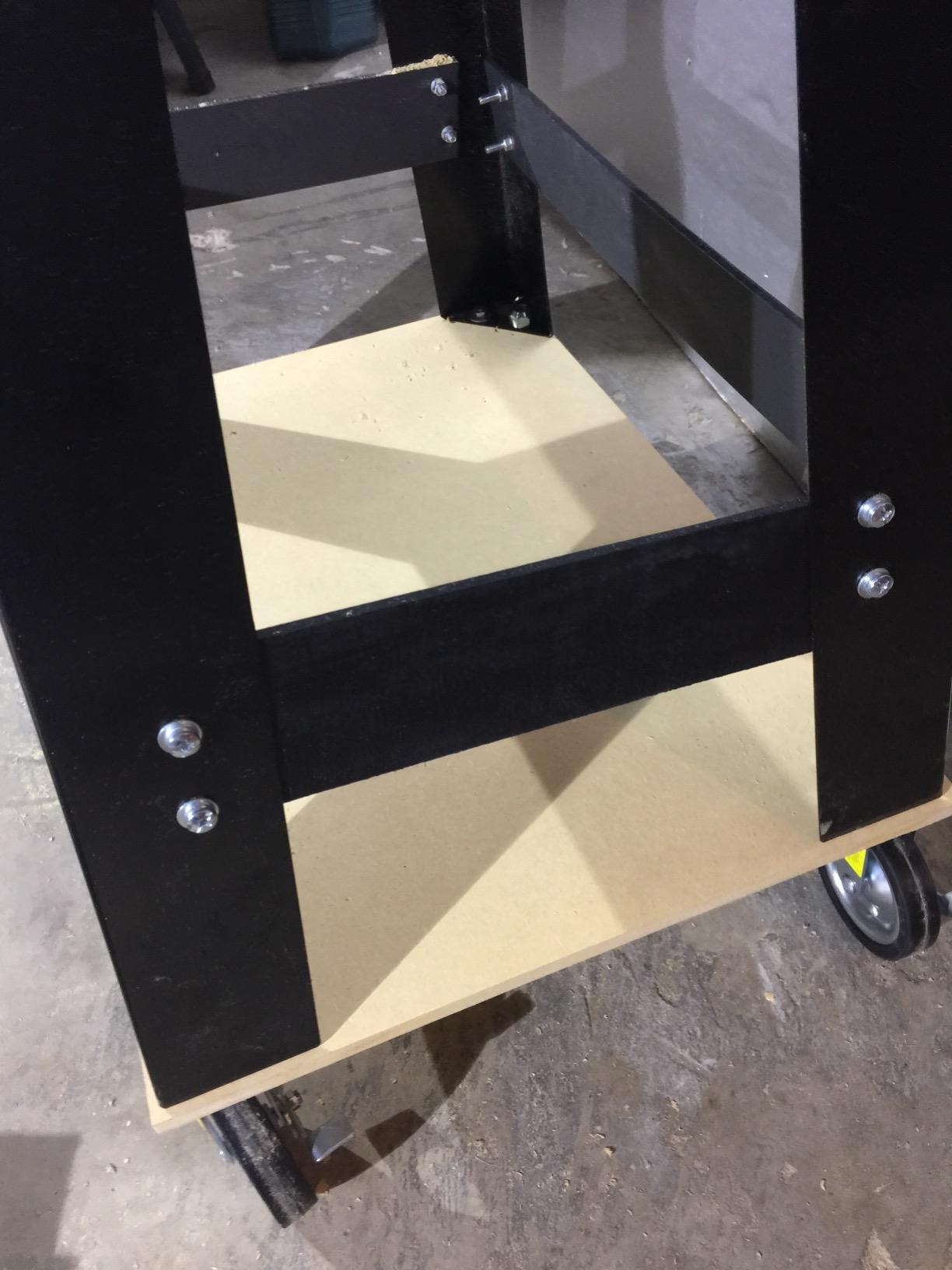
At roughly 22 inches tall, it is a low-profile design. That is short for standing work at a planer, and owners with the machine on it describe the height as the most common functional complaint. But several buyers added their own casters and use it as a rolling base, which is a sensible way to get a Makita 2012NB off the floor without bending over it.

The feedback splits into two camps. Some owners find the fit and the machining excellent and describe the metal as heavier gauge than they expected for a stand of this size. Others fought misaligned holes and an unclear assembly order, and some reported that the listed dimensions describe the shipping container rather than the assembled stand.
That dimension problem is worth knowing about before you order. The published figure does not tell you the working height, so plan to measure or check user reports for the assembled size.
When a low-profile stand is the right tool
A short stand is genuinely useful in a couple of situations. On a rolling base it lets you move the machine to wherever the work is and then set it at a height you are comfortable with, because the height comes from whatever you put it on. It also works well for a planer that spends more time on a shelf than at a bench.
The material gauge is the part that surprises people. Owners expecting a stamped bracket describe it as sturdier than they thought, and it stays stable while feeding long material.
Where the Makita falls short
It is model-specific. If your planer is not a Makita 2012NB, this stand does nothing for you, and there is no adjustment to make it fit something else.
At 29 ratings it carries the thinnest feedback of any stand here and the lowest average rating in the group, with assembly the recurring theme. Treat the good reviews as a signal about the metal and the bad ones as a signal about the instructions, and budget extra time for putting it together.
How Tall Should a Planer Stand Be?
Most home shop operators land between 34 and 38 inches from the floor to the planer outfeed, and the right figure is the one that matches your elbow height when you stand with your arms relaxed. Measure from the floor to your bench top first and pick the stand that gets closest to it, because a quarter inch of difference is easy to push stock across and several inches means lifting one end of every board.
Taller operators should aim for 36 inches or more. Shorter operators are comfortable in the low thirties. A 6-foot-4 woodworker on r/woodworking asked whether to match his existing 36-inch worktop or sit a quarter inch above it, and the consensus answer was to match your own body first and the bench second.
A word of warning on fixed-height stands: if you are tall and the stand is short, you will feed with a bent back on every pass, and that fatigue shows up as inconsistent pressure at the outfeed, which is a leading cause of snipe regardless of machine tuning.
What to Check Before You Buy a Planer Stand
Load capacity against real planer weight
Most benchtop planers in the 12 and 13-inch class land between about 70 and 105 pounds. A 100-pound rated stand technically covers the weight, but a stand that is exactly at its limit feels different from one with headroom, because the rating assumes the load sits centered on the top rather than cantilevered over an extended infeed arm.
Our rule of thumb is to buy the next rating up when the difference is small. A 100-pound stand for a 99-pound planer leaves nothing in reserve; a 400 or 500-pound stand gives you a base you can grow into. Members on LumberJocks buying bases for large jointers follow the same logic, rating well above the machine.
Infeed and outfeed support for long lumber
Snipe is the torn-out mark at the exit end of a planed board, and it happens when the tail of the stock drops below the cutterhead as it leaves the machine. The fix is support on both sides of the cutter, and it is the single most useful upgrade a planer stand can offer.
Roller arms that extend on either side are the straightforward solution, and the WEN MSA658T and the SGOLAN 550 both have them. Adjustable side rollers that can be raised to match the stand height, like the SGOLAN design, work even better because you can square them to your bench instead of guessing at a length.
Reducing snipe also means feeding consistently and using support boards at the outfeed. Owners on r/BeginnerWoodworking note that the machine itself can be tuned to minimize snipe, but the physical support is what stops the droop in the first place.
Casters, brakes and the front-heavy stance
Caster quality is the most common failure point on cheap rolling bases. Look for four swivel casters with a real foot-operated brake rather than a small pedal on one wheel, and check whether the stand has any way to lock all four at once.
There is a tip-over risk worth naming. One owner of a Harbor Freight Hercules rolling stand reports on r/woodworking that the stand is very front-heavy in the mobile stance when the roller arms are extended. That happens because extending both arms moves the center of gravity forward while the wheels stay where they are. The mitigations are simple: lock the casters before you start feeding, and extend the arms before you roll it rather than while it is rolling.
MDF, melamine, or steel tops
The top material changes how stock behaves on it. MDF takes screw holes without complaint and grips a board, but it marks over years and can scar when you slide finished faces across it. Melamine is slicker than raw metal, so wood slides more easily over it, and a builder at ibuildit.ca notes it also eats up a little capacity and throws the depth-of-cut scale off. Steel is the hardest-wearing and doubles as a reusable surface, but it lets stock slide more than you may want.
Whatever the material, put a sacrificial board down when you run finished stock. A planer stand top sees boards sliding constantly, and no surface is meant to be the finished face itself.
Storage, footprint, and dust collection
In a garage shop, the space under the stand is often the most valuable thing it offers. Look for a lower shelf or a double-layer platform sized for dust bags and a shop vac. The SGOLAN 500 has the deepest storage in this group at 28 by 35 by 25 inches, and the DEWALT DW7350 has a shelf that handles the essentials.
For chips and dust, a bucket lid with an inlet and a filter is the cheap shop solution, and an adapter that lets the planer’s port reach a cabinet or wall vent is the upgrade. Check the distance from the planer’s dust port to your planned collection point before you buy the stand, since stand height and length change where that port ends up.
Footprint matters too. Measure the aisle you need to roll the stand to the wall with the machine on it, plus clearance for infeed and outfeed. Several of these stands are wider once their roller arms are extended, and that extension is what makes the front-heavy stance problem worth knowing about.
When building your own planer stand makes more sense
A shop-made stand wins on customization. A builder can add extension wings sized for your stock, route a flip-up or stowable outfeed support that swings over the stand and locks away when not in use, and shape the case to your shop’s dimensions. None of the seven stands here offer that, which is the customization gap owners on r/BeginnerWoodworking describe when they weigh an OEM base against a build.
The trade-off is bracing. As ibuildit.ca puts it, a simple stand is fine for the work it was designed for, and if you routinely plane large heavy pieces you would add internal braces. Braces eat storage space, so you are choosing between a rigid frame and a cabinet, not getting both.
Build it yourself if you need a height no stocked stand offers, a flip-up outfeed support, or storage that fits a specific corner. Buy it if you want the machine off the floor this weekend and would rather not cut plywood and square a frame. If you are also outfitting the rest of the shop, our best sheet metal brakes for home shops and plasma cutter guides follow the same pick-for-the-space approach.
Frequently Asked Questions
How tall should a planer stand be?
Most home shop operators land between 34 and 38 inches from the floor to the planer outfeed, and the right figure matches your elbow height when you stand with your arms relaxed. Measure your existing bench top and pick the stand that gets closest to it. Taller operators should aim for 36 inches or more, while shorter operators are usually comfortable in the low thirties.
What size planer stand do I need for a 15 amp planer?
A 15 amp benchtop planer typically weighs between about 70 and 105 pounds, so a stand rated at 100 pounds covers most of them. Buy the next rating up if the difference is small, because a stand at exactly the machine weight has no headroom for the cantilever created by an extended infeed arm.
Do I need a planer stand if I have a workbench?
Only if your workbench is the right height and deep enough for the machine. A benchtop planer is designed to sit on a bench, so a sturdy bench at roughly 34 to 38 inches works in a pinch. A stand adds infeed and outfeed support, storage, and mobility that a plain bench top cannot.
Are cheap planer stands safe?
They are fine for a benchtop planer if the frame is rigid, the casters lock, and the load rating clears the machine weight with headroom. The real risks are casters that do not lock and a front-heavy stance when roller arms are extended. Lock every caster before feeding and extend the arms before rolling, not while rolling.
Will a planer stand prevent snipe?
A stand with infeed and outfeed support helps, because snipe is largely caused by the tail of the stock dropping as it leaves the cutterhead. Roller arms that extend on both sides keep long boards level through the cut. Consistent feed pressure and tuning the machine also reduce snipe, so support plus technique together do most of the work.
Is a mobile base better than a fixed planer stand?
In a small shop, usually. A mobile base lets you roll the machine to the wall when it is not in use and roll it out when a long piece needs flattening in place. The trade-off is total weight, since the machine and base move together, and casters are the component most likely to need replacing over time.
The Planer Stand We Would Buy in 2026
The DEWALT DW7350 is the one we would put under a benchtop planer in 2026, and the reason is simple: it is the only stand here with roughly 4,700 ratings behind it, an integrated mobile base that lets the machine roll to the wall as a single unit, and a frame that did not flex or creep in weeks of feeding rough lumber.
The WEN MSA658T is the better buy if snipe is your actual problem, because its extension rollers support long boards at both ends of the cut. The Delta 22-592 goes furthest on frame strength and carries a five-year warranty. If you want a base that outlasts the planer and can carry a jointer later, the SGOLAN stands run to 500 and 550 pounds with storage underneath. And if you own a Makita 2012NB, the brand’s own stand fits exactly, even though it sits low.
Whichever one you choose, measure your bench height first and buy the stand that gets closest to it. That one decision solves more shop problems than any feature on the list.