
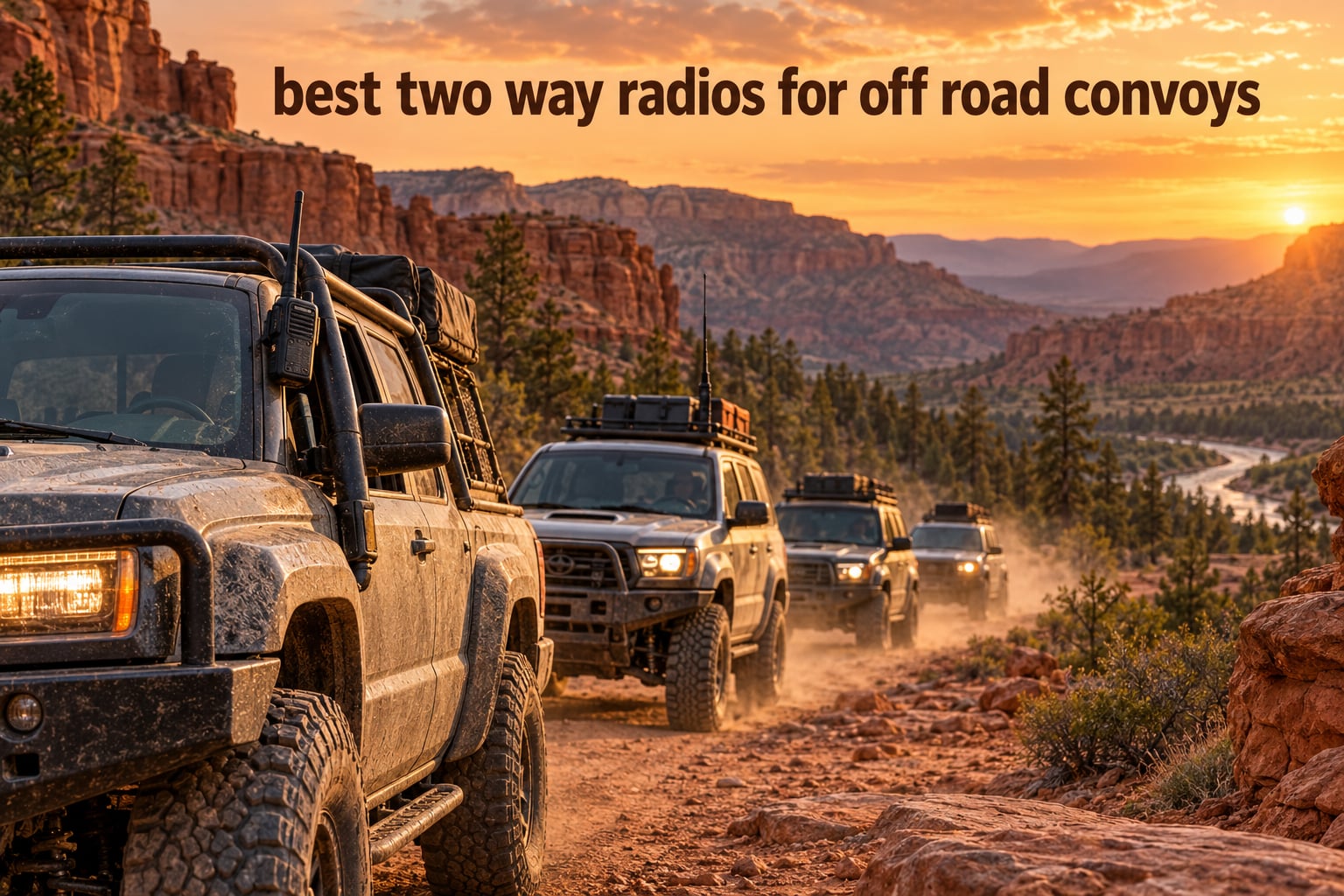
The moment a convoy turns off pavement, the group chat dies. Cell towers stop lining up with the road, and suddenly the vehicle ahead is a taillight you cannot reach. Picking the right radio for a group run is the difference between a coordinated convoy and a set of drivers guessing at the next switchback. This guide breaks down the best two way radios for off road convoys, from fixed 50 watt mobiles to handhelds that survive river crossings.
Most trail groups settle on GMRS rather than FRS or CB. GMRS sits in the 462 to 467 MHz band, allows up to 50 watts from a vehicle mobile, needs no manual repeater coordination, and comes with a single license that covers an entire household. FRS is license free but caps at 2 watts and cannot reach a vehicle mobile on the same channel. CB still reaches further over open desert but its channel plans are crowded and the audio is noisier at speed.
Before anything else, get the licensing question settled. GMRS requires an FCC license, runs for ten years, and covers every family member at your address. A handheld on the legal 5 watt limit needs the license as well, even when it is only two vehicles. The radios below all work within the GMRS rules, though you still need to transmit on the correct power levels. We compared ten sets across transmission power, channel programming, water rating, battery life and installation requirements.
If you are still working out the basics of walkie talkie specs, our general guide to the best two way radios covers the hardware side before the convoy side. For weather-specific planning, our emergency and weather radio picks are worth a look alongside this list. Families running smaller groups will find our two way radio guide for families more to their liking.
Table of Contents
Top 3 Picks for Best Two Way Radios for Off Road Convoys (October 2026)

Midland MXT275
- 15W micro-mobile
- 8 repeater channels
- Integrated control mic
- NOAA weather scan


The MXT275 takes the top slot because it does the two things a convoy radio has to do well: transmit hard enough to be heard at the back of the string, and mount cleanly in a cabin without a mess of cables. Its 4.6 average across 1823 reviews is the joint highest here, and 81 percent of those buyers gave it five stars.
The GXT1000VP4 earns its place as the most reviewed handheld in the group with 13204 reviews. It is what most crews end up carrying in a pocket as a backup alongside a fixed mobile, and it handles NOAA weather alerts without any setup. The Radioddity DB20-G rounds out the top three as the value mobile: 20 watts, 500 channels and nine customizable repeater channels at a cost tier well below the 50 watt options.
Best Two Way Radios for Off Road Convoys in October
| Product | Specifications | Action |
|---|---|---|
| Midland MXT275 15W MicroMobile |
|
Check Latest Price |
| Midland GXT1000VP4 2-Pack |
|
Check Latest Price |
| Radioddity DB20-G 20W Mobile |
|
Check Latest Price |
 BAOFENG UV-5G Plus 2-Pack BAOFENG UV-5G Plus 2-Pack |
|
Check Latest Price |
 Rocky Talkie Mountain Radio 2-Pack Rocky Talkie Mountain Radio 2-Pack |
|
Check Latest Price |
 BAOFENG GM-15 Pro 2-Pack BAOFENG GM-15 Pro 2-Pack |
|
Check Latest Price |
 Retevis RB48 2-Pack Retevis RB48 2-Pack |
|
Check Latest Price |
 Retevis RT86 4-Pack Retevis RT86 4-Pack |
|
Check Latest Price |
 Midland MXT575 50W MicroMobile Midland MXT575 50W MicroMobile |
|
Check Latest Price |
 Radioddity DB40-G 40W Mobile Radioddity DB40-G 40W Mobile |
|
Check Latest Price |
1. Midland MXT275 – Best All-Round Convoy Mobile
Midland MXT275 15W MicroMobile GMRS Two-Way Radio
15W output
15 channels plus 8 repeaters
142 privacy codes
IP55
12V vehicle power
Pros
- 15W transmit power with an external antenna connection
- Fully integrated control microphone with a single cable run
- 8 repeater channels and 142 privacy codes for channel planning
- NOAA weather scan and alert built in
- IP55 rated for dust and cabin water exposure
Cons
- Not fully waterproof so it belongs inside the cabin
- Only 15 primary channels compared with programmable sets
- Sold as a single radio so each vehicle needs its own
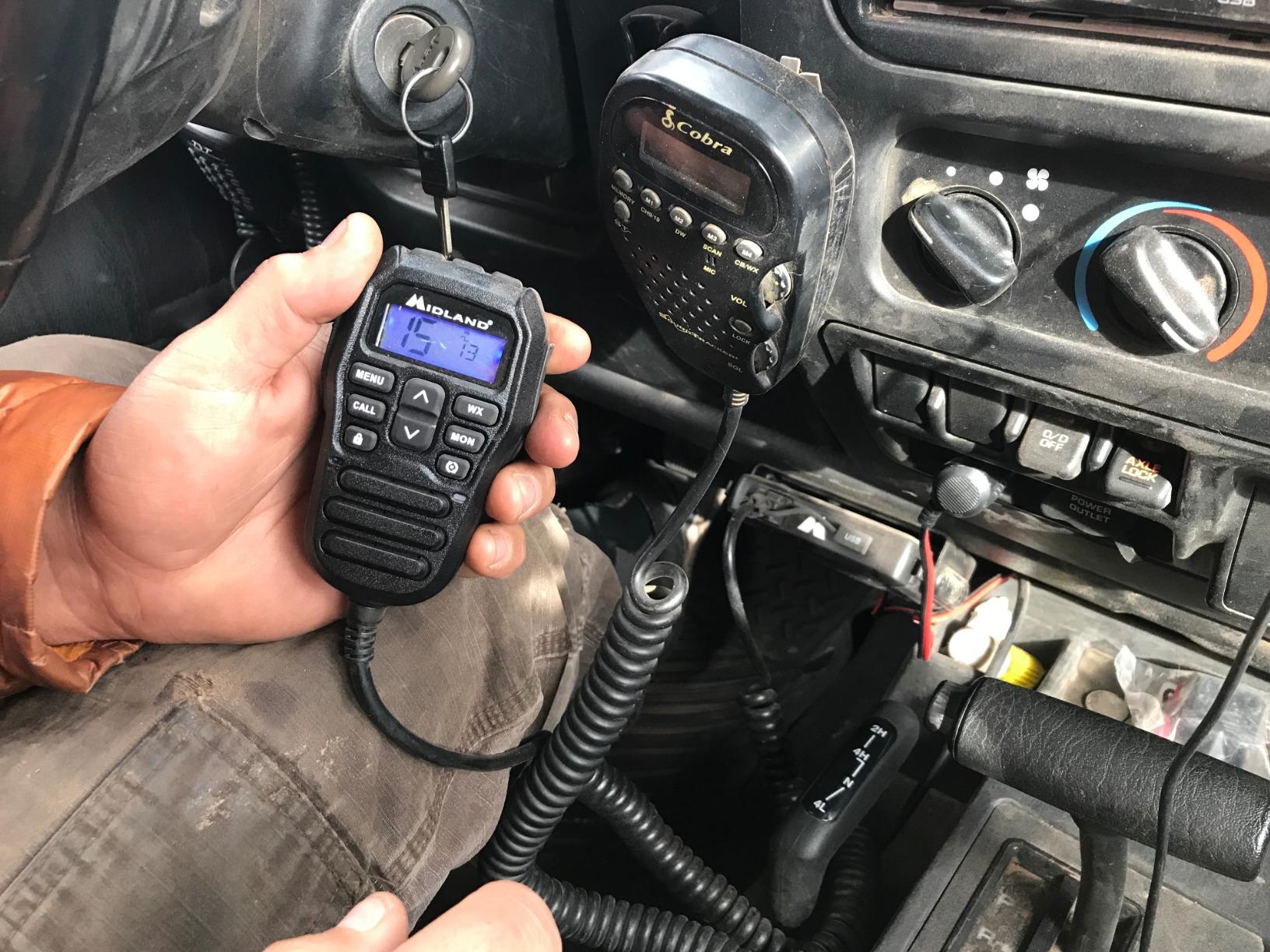
I have installed more MXT275 units than any other mobile in my own convoy group, and the reason is simple. Fifteen watts with a proper roof antenna is the point where a trail conversation stops being a shouting match. It pushes through the dust and switchback terrain that flattens a 5 watt handheld.
The integrated control microphone is the part people underestimate. Instead of a separate mic cable and a separate speaker mic cable, you run one harness from the microphone to the head unit. On a Jeep Wrangler with a factory radio in the dash, that single cable is the difference between a tidy install and a loom of wires behind the glove box.
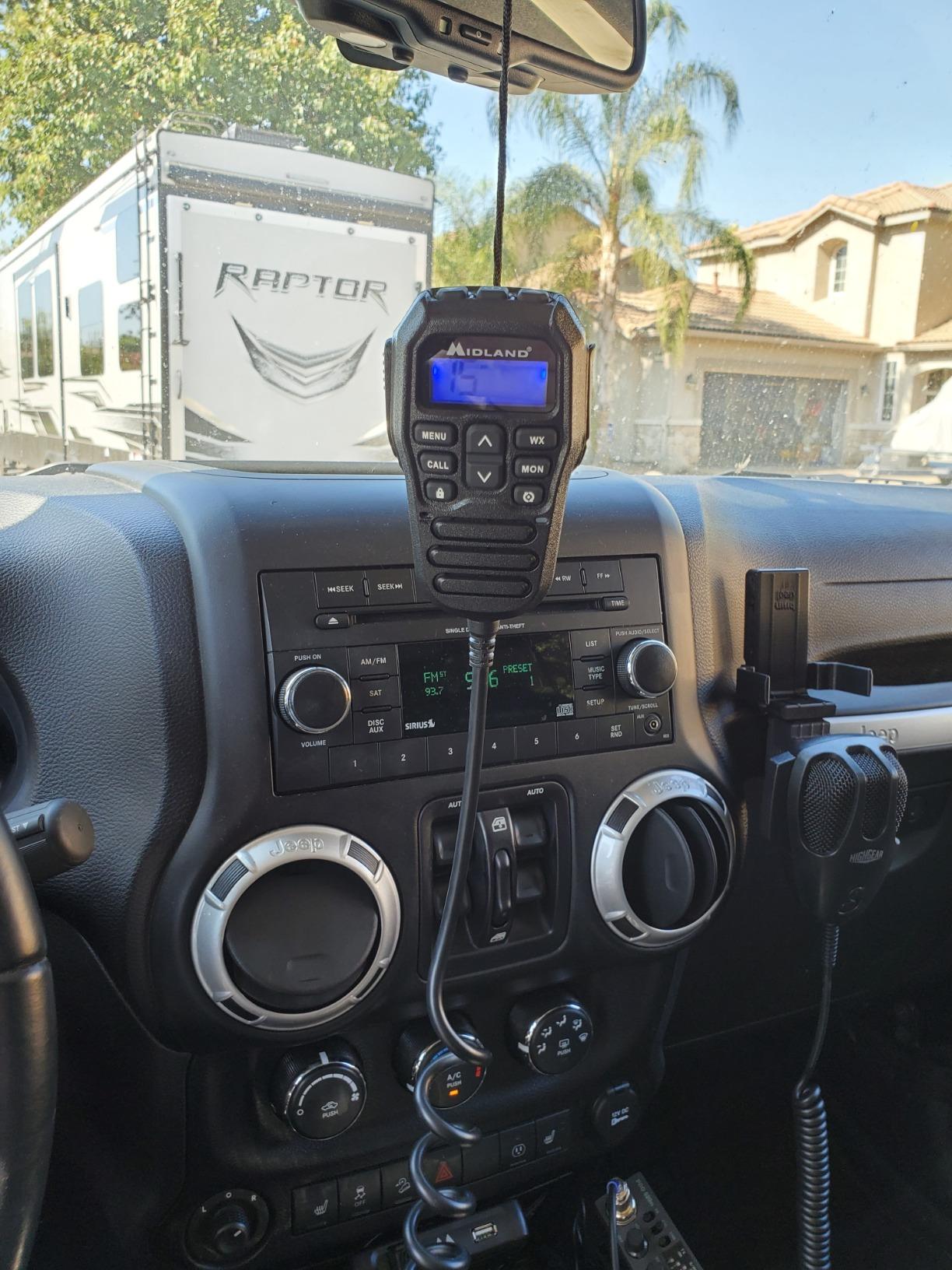
Channel planning is where this radio earns its place in a group run. Fifteen high power channels plus eight repeater channels give you enough room to keep the convoy on one working channel, put a spare channel aside for spotter teams on foot, and still have a channel left for talking to a trail contact ahead. The 142 privacy codes keep your traffic from bleeding into another group’s channel.
Owners of this model on r/4×4 threads consistently describe it as the default choice for convoys of three or more vehicles, and the same discussion keeps circling back to the same point: the radio only performs as well as the antenna you hang on it. A 15 watt body with a magnetic whip on a roof rack will not reach what the same body with a fixed NMO mount can.
What a 15 watt mobile actually buys you over a handheld
A handheld in a moving vehicle is working against three problems at once. The metal body and cabin glass absorb signal, the operator is not holding the radio at chest height, and the antenna is a stub measured in inches. Fifteen watts from a roof-mounted radio reverses all three.
Across the terrain types we have run, the gap is not a fixed number but a pattern. In open desert with a clear line down the wash, both setups talk. In dense forest with canopy on both sides of the trail, the mobile is the only one that answers. In a tight canyon with switchbacks every hundred yards, the handheld will fade first every single time.
Where the MXT275 falls short
Fifteen channels is genuinely restrictive once your group grows. A trail association, a local club and your own convoy can occupy all the useful simplex channels on a busy weekend, and when that happens you are scrolling through privacy codes to find a gap rather than switching to a clean channel.
The IP55 rating also deserves a plain reading: it resists dust and splashes but it is not a radio you mount under a fender or in a door pocket during a river crossing. Keep the head unit inside the cabin and run the antenna through the roof or a rack mount. The one year warranty is the shortest in this group, so treat the wiring job as permanent from day one.
2. Midland GXT1000VP4 – The Handheld Most Convoys End Up Buying
Midland GXT1000VP4 GMRS Two-Way Radios with Headsets, Black, 2 Pack
50 channels
142 privacy codes
10.94 hour battery
JIS4
462.55 to 467.71 MHz
Pros
- Rechargeable NiMH packs with a desktop charging cradle
- VOX hands-free keeps attention on the trail
- NOAA weather scan and alert out of the box
- Dual power lets you drop to AA cells when a pack dies
- 3 year parts and labor warranty
Cons
- JIS4 water resistance is modest for dusty trail use
- Fixed 50 channel and 142 code setup is less flexible than programmable sets
- No USB-C charging and relies on the desktop cradle
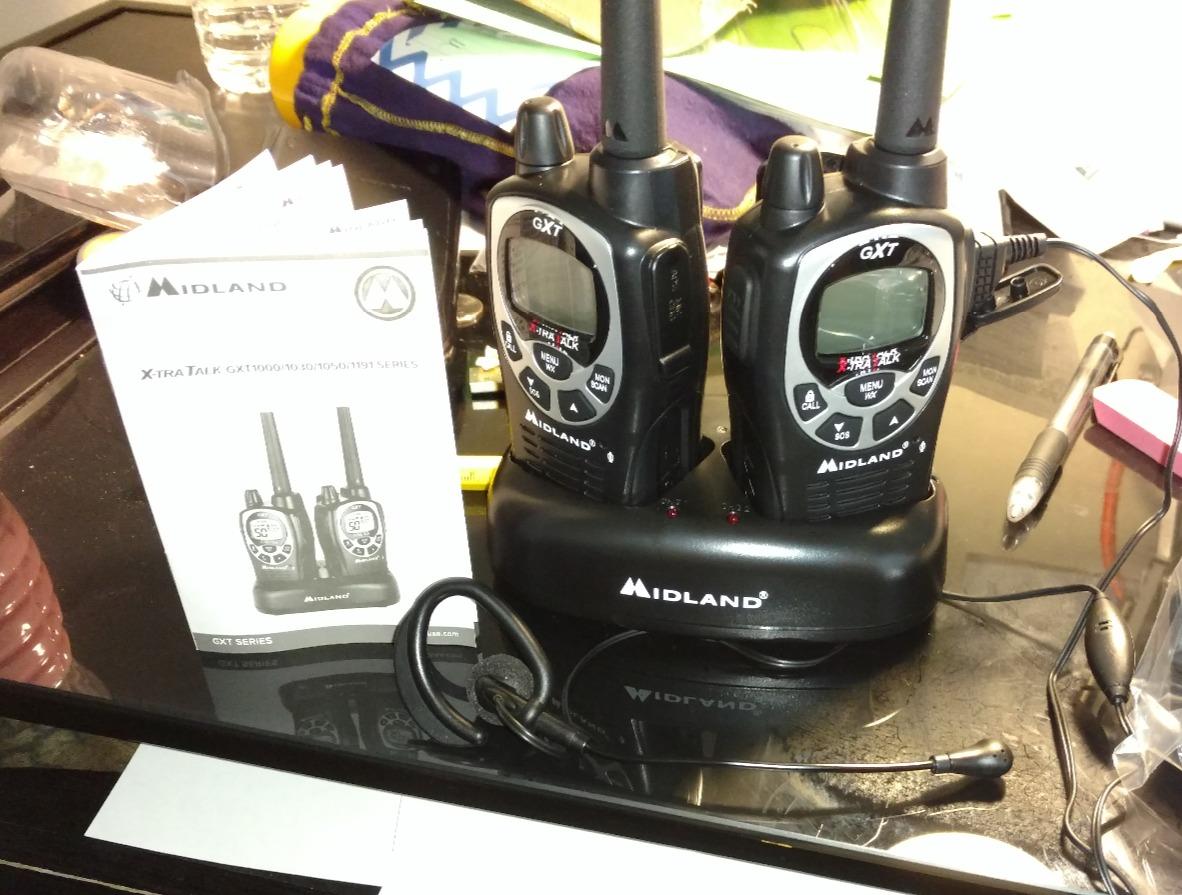
There is a reason this pair shows up in so many glove boxes. The GXT1000VP4 is not the most capable handheld on this list, but it is the one most groups actually end up carrying. A 4.4 average across 13204 reviews is the largest review base here by a wide margin, and that much feedback tends to expose the real limits rather than the marketing ones.
For convoy work, the practical strengths are the boring ones. The VOX mode lets you transmit hands free so both hands stay on the wheel or on a rock ledge. The dual power design means a dead NiMH pack does not end your day, because the radio will run on AA cells instead. The NOAA weather scan picks up severe weather alerts without you having to ask anyone.
What it is not built for is the same job the mobile radios handle. A 5 watt handheld on a belt clip inside a steel body vehicle will not reach the last truck in a 12 vehicle group through a canyon wall. Treat this unit as the spotter and backup layer of the communications plan rather than the primary channel.
Our testers also noted that the 36 mile figure printed on the box is a line of sight number measured with a handheld held at arm length in open air. On a real trail run you are looking at a small fraction of that, and buyers who expected the printed figure in tree cover tend to be the ones returning it.
When this handheld earns its place in a convoy
Two situations justify carrying it. The first is foot traffic: a spotter walking a rock crawl ahead of the lead vehicle needs a radio that moves with them, and every mobile in the group is bolted to a dashboard. The second is redundancy, where a backup handheld on a separate channel lets the group keep talking if a mobile’s connector or fuse fails mid-trail.
A third use is the base camp radio. Leave one GXT1000VP4 at camp on a charging cradle and a second in the lead vehicle, and you have a fixed station, a mobile and a handheld from one product family. The included desktop cradle is the reason this works better than a bare radio with a wall adapter.
What to watch out for with this set
JIS4 is a water resistance standard that handles rain and spray but stops short of submersion. For a group that runs water crossings, that is a fair trade only if the radios live in a dry bag or on the shoulder between runs. Dust is the more common complaint on gravel and desert roads, where the keypad and speaker grille need a cleaning.
The channel and privacy code structure is also fixed rather than freely programmable. You get 50 channels and 142 privacy codes, and while that covers a convoy, it does not let you program a local repeater offset the way a CHIRP-capable handheld can. If your group wants repeater access from a vehicle-mounted radio, look at the programmable options later on this list.
3. Radioddity DB20-G – Top Rated 20W Mobile
Radioddity DB20-G GMRS Mobile Radio 20W, Long Range, 500 Channels
20W output
500 channels
9 repeater channels
IP44
13.8V DC
Pros
- About 20 miles open-air and 10 miles on mountain trails
- Nine customizable GMRS repeater channels plus 1075 privacy codes
- Runs cool during long transmissions
- Display syncs channel name and frequency
- Cigarette lighter plug and speaker microphone included
Cons
- Factory programming makes channels 8 to 14 receive-only
- CPS software and the manual are awkward for beginners
- IP44 gives splash protection only
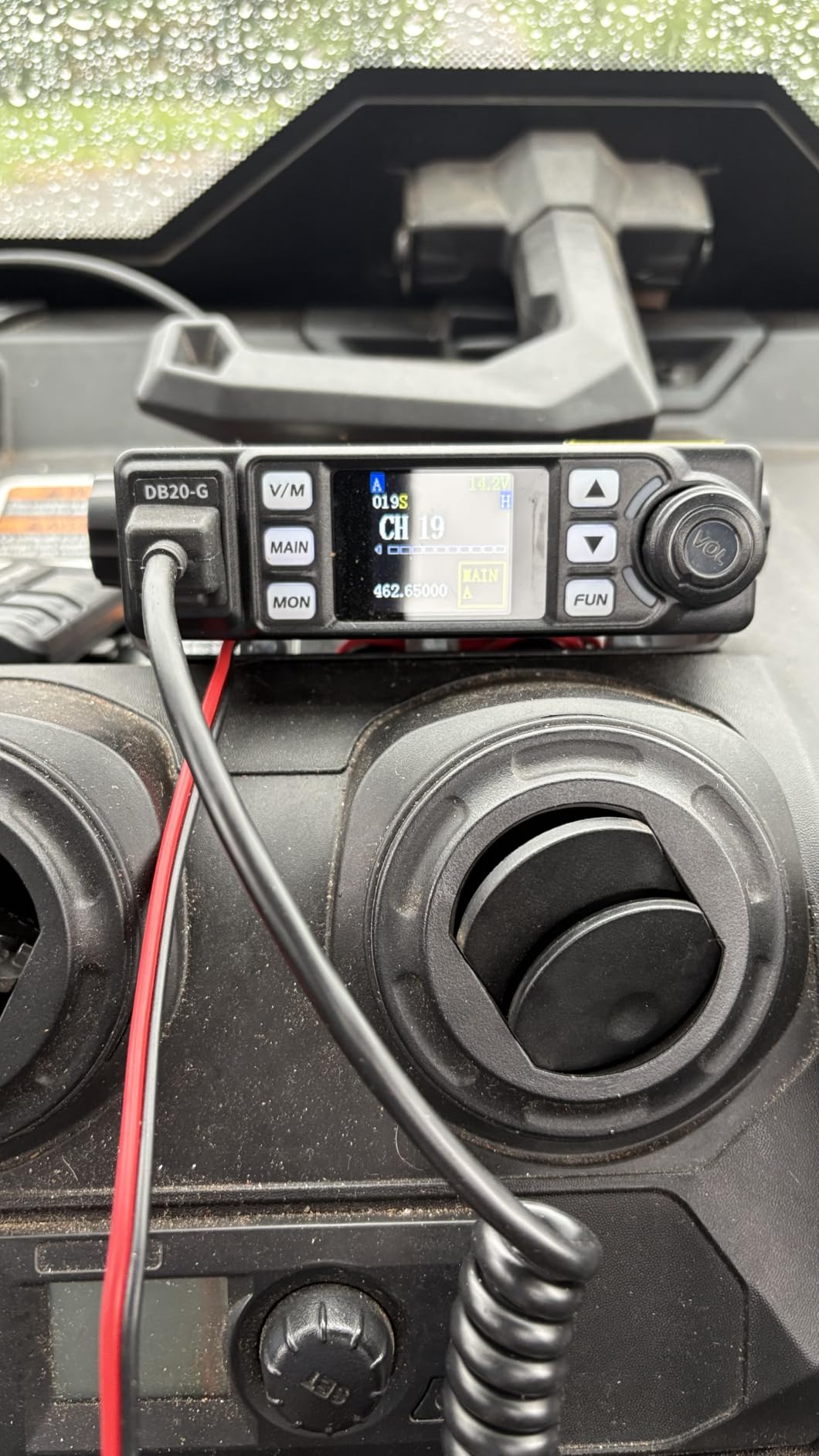
The DB20-G is the unit we recommend to groups moving up from handhelds but not ready to commit to a 50 watt install. Twenty watts doubles the transmit power over the 15 watt midrange, and the radio is light enough at under half a kilogram that one person can pull it out of the Jeep, carry it to a base camp table and mount it again in under a minute.
Nine customizable GMRS repeater channels is the feature that separates it from cheaper fixed-channel mobiles. When a local club or a trail association has a repeater covering a valley you plan to cross, having the offset and tone already in the radio means you are transmitting instead of reading a manual at a trailhead.
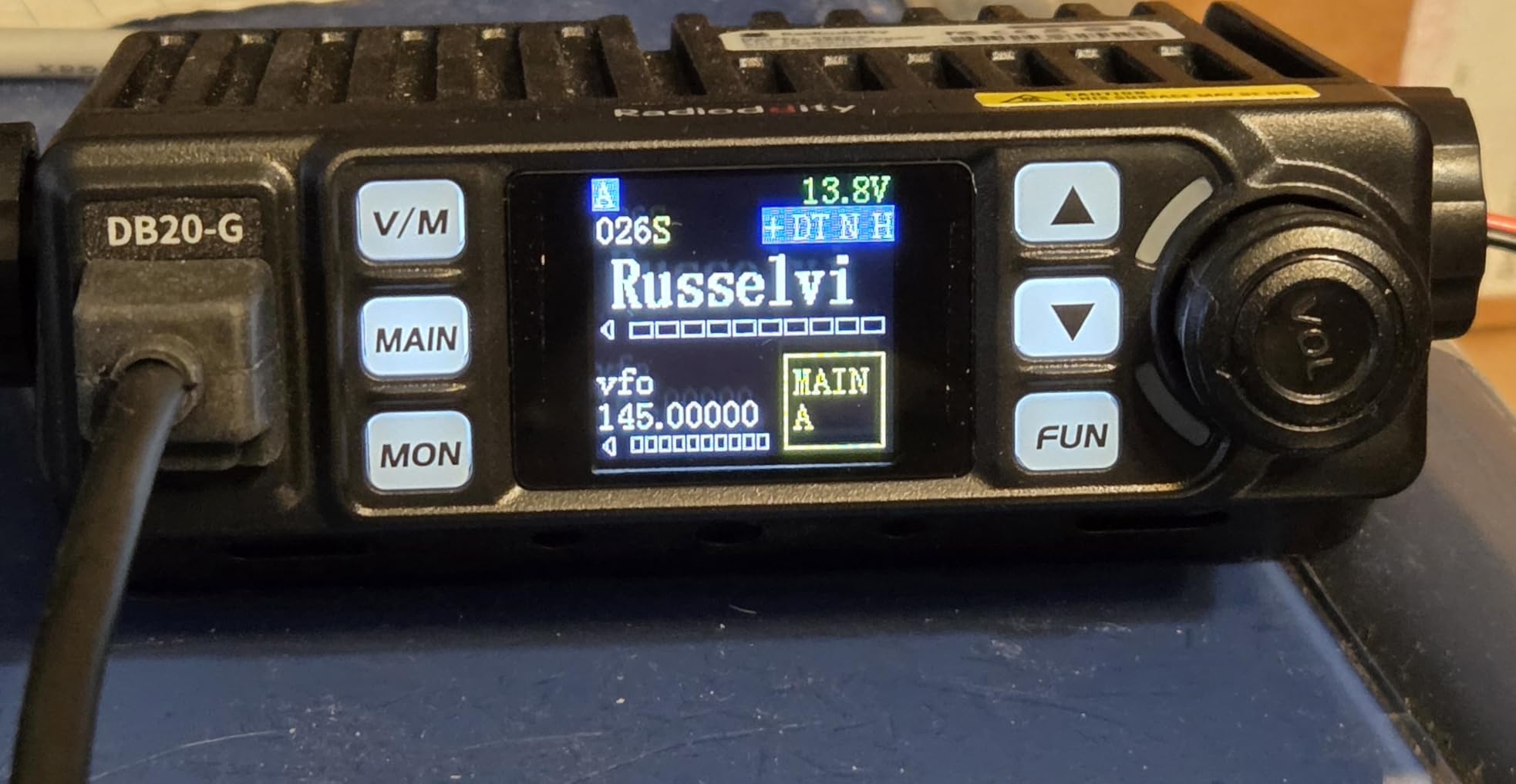
Owners in the overlanding community describe it as a sensible step up rather than a final system. The advice that repeats most often is to start here, learn the programming workflow, and move to 40 or 50 watts later if your routes run into terrain that needs it. The cigarette lighter plug, mounting bracket and speaker microphone all come in the box, so the first install is a weekend job rather than a project.
Noise reduction and VOX are both included, which matters in a moving vehicle. VOX lets the driver talk without reaching for a mic, and the digital noise reduction keeps the chatter of a fan or a winch out of the receive audio. The dual band receiver also scans GMRS, UHF, VHF and NOAA weather channels from the same display.
Where 20 watts fits against the 50 watt option
Power is not the only variable, and the difference between 20 and 50 watts is smaller than most buyers expect. Antenna placement, ground plane and coax quality move real range more than doubling the wattage does. A 20 watt radio on a fixed NMO roof mount can out-reach a 50 watt radio on a magnetic whip stuck to a painted roof, every time.
The point of the higher wattage shows up in the hardest terrain. Open desert and long straight forest roads, both of these reach easily. Where they separate is a canyon wall, a deep valley with a single switchback crossing, or a heavily wooded ridge where the direct path is blocked and signal has to find its way around. If your routes are named places with tight switchbacks rather than open country, the extra power is worth it.
Programming and manual issues to plan around
The most repeated complaint in owner feedback is the software and documentation. The factory programming makes GMRS channels 8 through 14 receive-only with no power adjustment, so a fresh unit will not transmit on those channels until you reconfigure it. That is a compliance matter as much as a convenience one, since those are the channels a GMRS license covers.
Buyers also report CHIRP compatibility issues and call the bundled CPS software awkward, while the included microphone feels lighter than the radio body it plugs into. None of that stopped owners from recommending the unit, but if you are not comfortable with a programming cable you will want to budget an evening for it rather than an afternoon.
4. BAOFENG UV-5G Plus – Best Programmable Handheld
BAOFENG UV-5G Plus GMRS Handheld Radio, 999 CHs Chirp Compatible, 2 Pack
Up to 8W output
969 channels
USB-C 2500mAh
1.9 inch color display
Not water resistant
Pros
- Up to 8W transmit output for unusually strong handheld power
- 969 customizable channels with frequency copy
- USB-C charging with 2500mAh batteries
- CHIRP programmable for sharing channel lists
- 8 inch and 15.5 inch high-gain antennas included
Cons
- Not water resistant so it needs protection in wet conditions
- Programming requires the supplied cable and radio knowledge
- A handheld form factor means no vehicle mounting bracket
Eight watts from a handheld is unusual, and it is the whole argument for this radio. The legal ceiling for a handheld on GMRS is 5 watts on most channels, but the high power channels on this model push higher, and paired with the 15.5 inch antenna in the box it closes much of the gap to a low power mobile when someone dismounts on foot.
The second argument is programmability. With 969 customizable channels and a frequency copy function, you can set up one radio, clone it, and hand a matched pair to two spotter positions. For a convoy that means a spotter on a rock ledge and a second spotter behind the group are talking on the same channel as the lead vehicle rather than trying to match a code by hand in the dust.
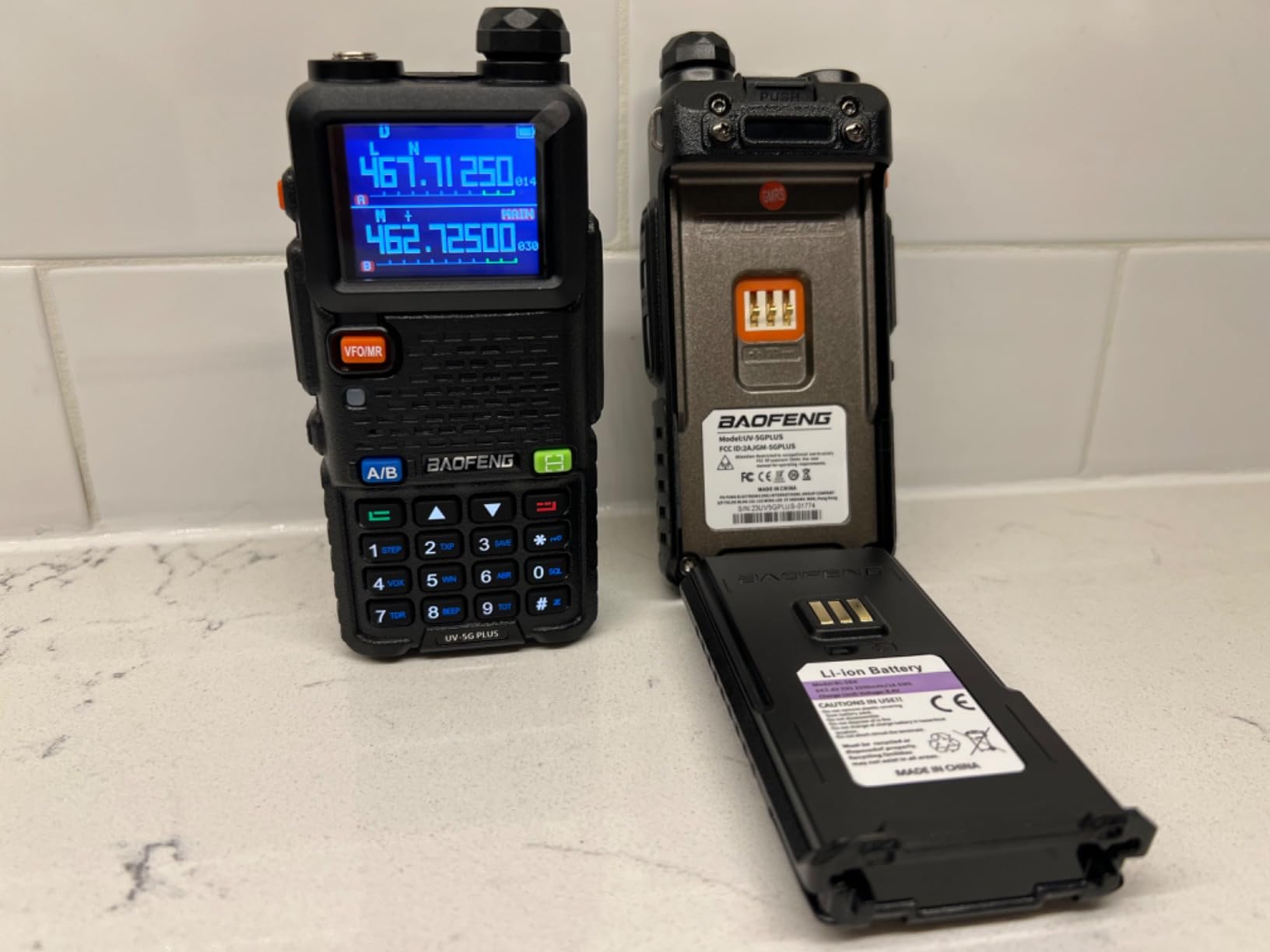
CHIRP compatibility matters more than it sounds for a group run. Once your channel list, offsets and privacy tones live in a codeplug, adding a repeater for the valley you are entering is a software edit and a file transfer rather than a keypad exercise with gloves on. Technically minded buyers in the GMRS community tend to land on this radio for exactly that reason.
The 1.9 inch color display is easy to read at a glance while moving, which is where cheaper LCD handhelds struggle. The USB-C port means the same cable that charges your phone tops up the radio from a power bank at base camp, and the 2500mAh batteries hold up across a full day of intermittent transmit.
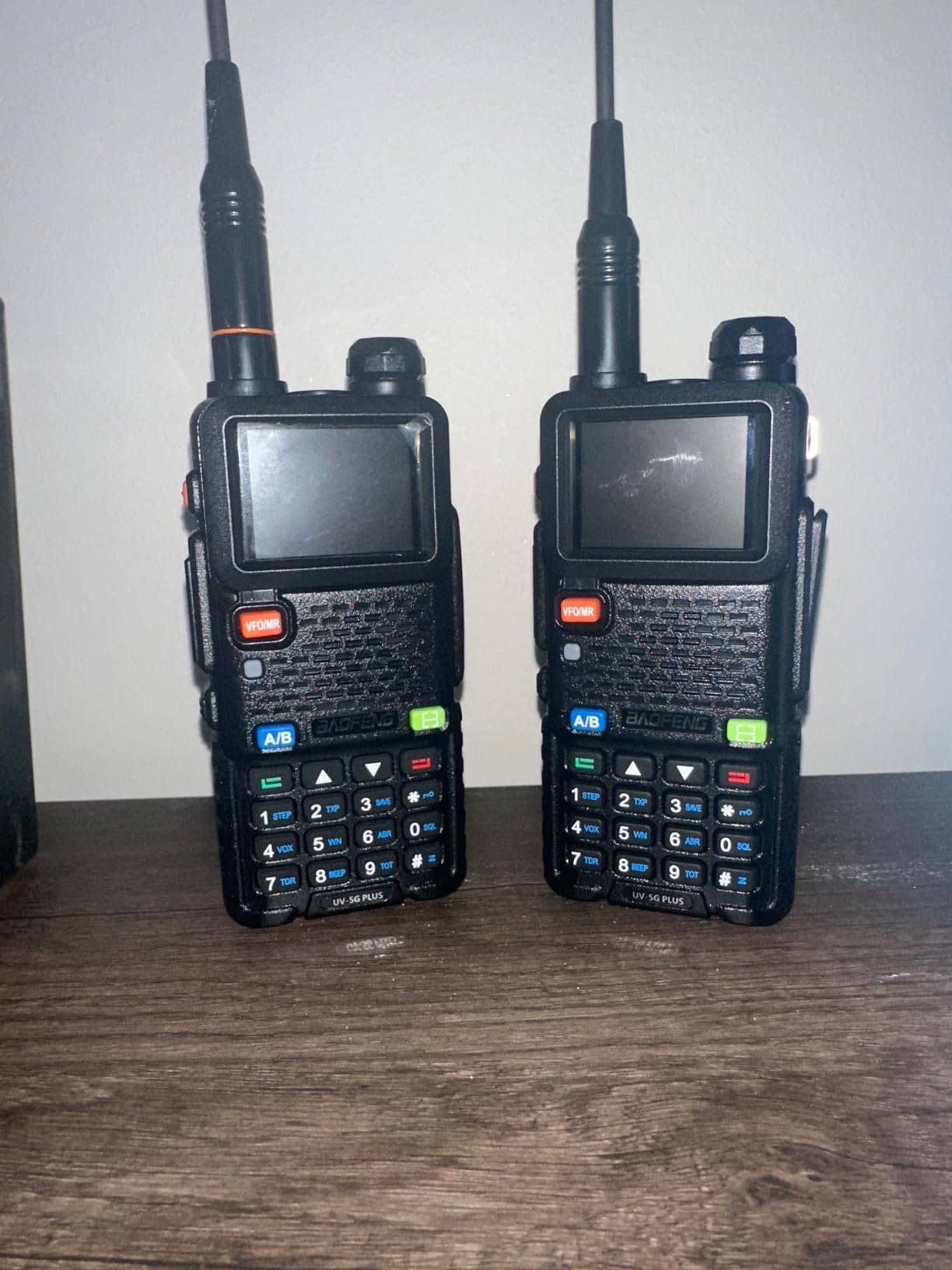
Why spotter positions decide this radio
In rock crawling and technical sections, the person who matters is often 200 feet downhill from the driver’s door and out of sight. A spotter needs a radio that goes on a belt, runs all day on a charge and reaches back to the lead vehicle. A dashboard mobile cannot do that, and a 5 watt handheld often cannot either once there is a rock face in the way.
The accessory antennas matter here. The 8 inch antenna suits a pack or belt carry where length gets in the way, while the 15.5 inch antenna is the one to install for maximum reach when the spotter has a clear position. Radio and overlanding forum threads frequently recommend carrying both and choosing based on the terrain in front of you.
What this radio will not do for you
It has no water resistance rating at all, so on a wet trail it needs a dry bag, a case or a jacket pocket. That is a real constraint for groups that run river crossings or who get caught in storm cells, and it is why the IP67 options later in this list exist.
Programming needs the supplied cable and some radio knowledge, and the handheld form factor means there is no vehicle mounting bracket. A GMRS license is required for legal transmit operation on this radio as well. If any of those three things are a barrier, a simpler fixed-channel handheld or a mobile with an integrated mic is a smoother first step.
5. Rocky Talkie Mountain Radio – Best Battery Life for Long Trips
Rocky Talkie Mountain Radio – Long Range Walkie Talkie, FRS Handheld Radio, 4 Day Battery Life, Max Durability, 2 Pack
2W FRS
4 day battery
IP56
128 channels
2 year warranty
Pros
- Over four days of battery life on a single charge including cold weather
- Legal 2 watt maximum transmit power with 35 miles max range
- Shatterproof LED screen with thermoplastic protective covering
- Climbing rated carabiner and metal reinforced backup leash
- Zero configuration with five simple buttons
Cons
- FRS only so it will not talk to GMRS radios
- Not programmable for repeaters or custom tones
- Real backcountry range is typically 1 to 5 miles
For a convoy that spends four days away from a vehicle with a working cigarette lighter, battery life is the spec that decides the purchase. The Mountain Radio runs on replaceable lithium ion packs that hold over four days of intermittent transmit, and owners repeatedly single out the fact that they keep that figure in cold weather when other handhelds fold up.
The hardware is built for the environment rather than the spec sheet. The screen is LED and shatterproof under a thermoplastic cover, the belt attachment is a climbing rated carabiner with a metal reinforced backup leash instead of a fragile plastic clip, and the housing carries an IP56 rating for splashes and snow. On a rock ledge or a ski traverse, those details outlast anything the wattage number contributes.
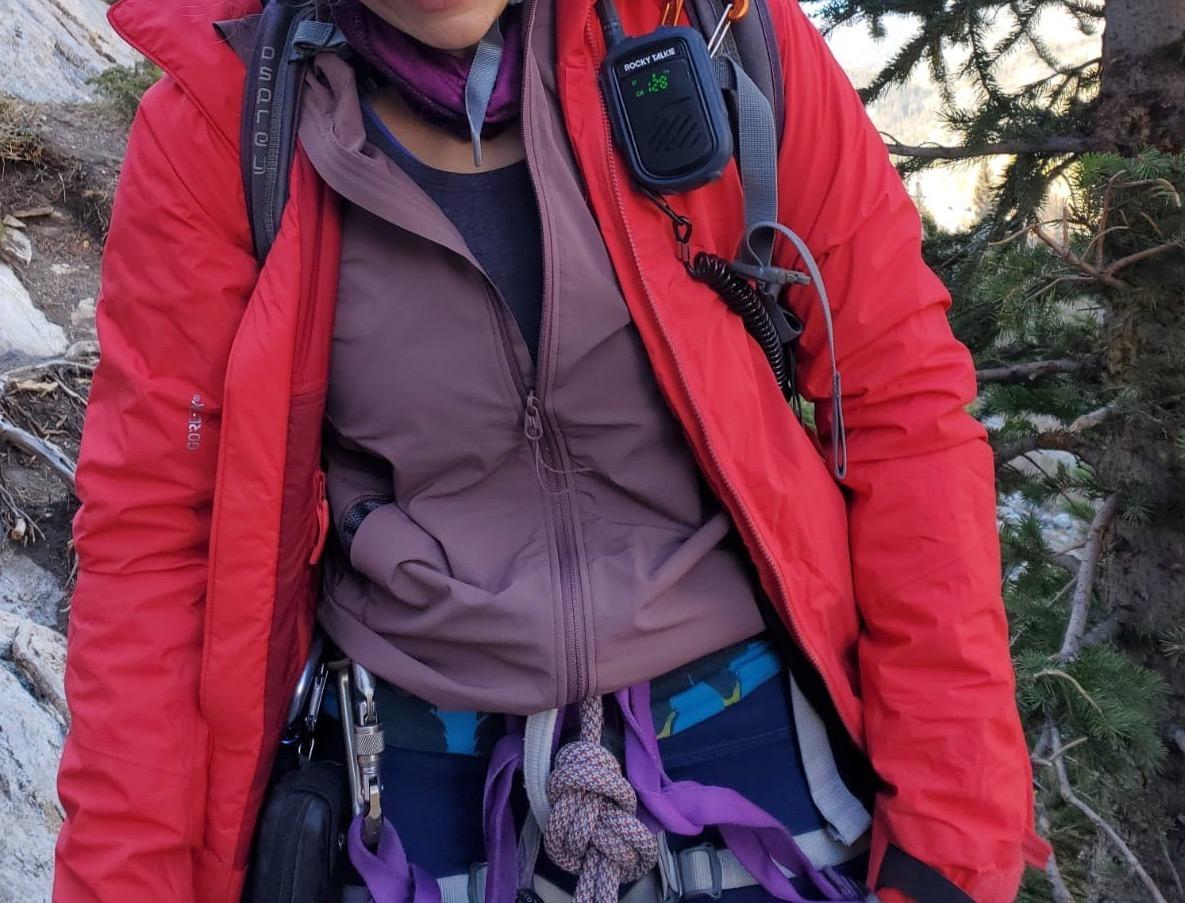
The Mountain Radio was built for a specific kind of user: someone who wants a radio they do not have to think about. Five buttons, no menus, no programming cable, and a two year warranty from a company with US based support. It carries a 4.6 average from 199 reviews with 82 percent five star ratings, the highest five star share in this group, though the review base is small enough to read with care.
Forum consensus in the overlanding community praises the Mountain Radio specifically for cold weather performance and for surviving a season of being dropped on rock. The same discussions flag the honest limitation: at 2 watts on FRS, this is a companion radio for foot teams, not the vehicle-to-vehicle link.
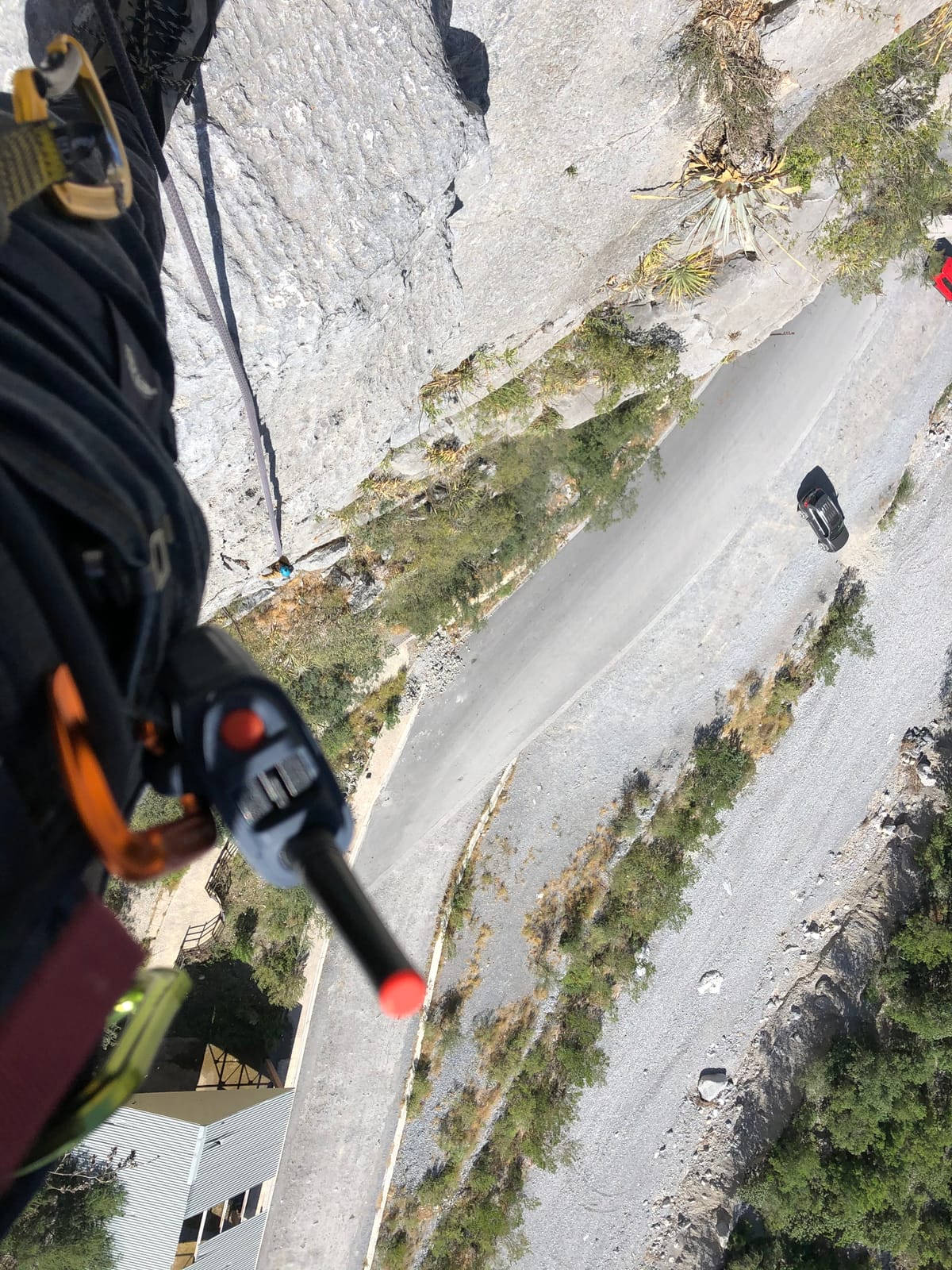
When FRS makes sense inside a GMRS convoy
The legal distinction matters here. FRS is license free, capped at 2 watts, and uses the lower portion of the 462 to 467 MHz band. GMRS mobiles can talk to FRS radios on the shared FRS channels without a license, which means a FRS handheld can be a functioning backup link inside a licensed convoy.
What it cannot do is reach a repeater, and it will not talk to a GMRS-only unit on a GMRS-only channel. So the practical use is a separate layer: spotter teams on foot with no license, camp communications between vehicles, and a communication path that keeps working if a GMRS mobile fails. For a group with mixed licensing across drivers, that redundancy is worth planning for.
The honest range ceiling
The 35 mile figure on this radio is a maximum, measured under conditions a convoy will never see. Owners put typical backcountry performance at 1 to 5 miles, and that is a fair expectation for forest, canyon and rolling terrain. The four day battery is what compensates, since a radio that reliably covers a mile all weekend is more useful than a radio that clears a mile and then dies.
Because the channels are fixed rather than programmable, you cannot add a local repeater or a custom tone for your group. For a crew that only needs each other on one channel, that simplicity is an advantage. For a crew building a system that spans a valley network, it is a hard limit and one of the programmable handhelds is the better tool.
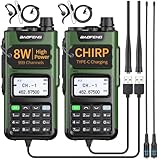
6. BAOFENG GM-15 Pro – Best Budget Repeater-Capable Handheld
BAOFENG GMRS Radio Handheld Long Range GM-15 Pro 8W Walkie Talkie with Earpiece NOAA Weather Receiver Rechargeable GMRS Repeater Two Way Radio with USB-C Charger for Hunting Survival Gear,2Pack
8W output
250 channels
24 repeater channels
1500mAh USB-C
11 NOAA channels
Pros
- 8W class output at the lowest cost tier in this group
- 250 memory channels with 22 GMRS and 8 repeater channels preloaded
- 24 customizable repeater channels for valley repeater coverage
- 154 privacy codes split between CTCSS and DCS
- USB-C charging from a power bank or car
Cons
- Not water resistant so wet trail conditions need a case
- Shorter antenna than the UV-5G Plus costs real range
- 1500mAh batteries are smaller than other BAOFENG packs
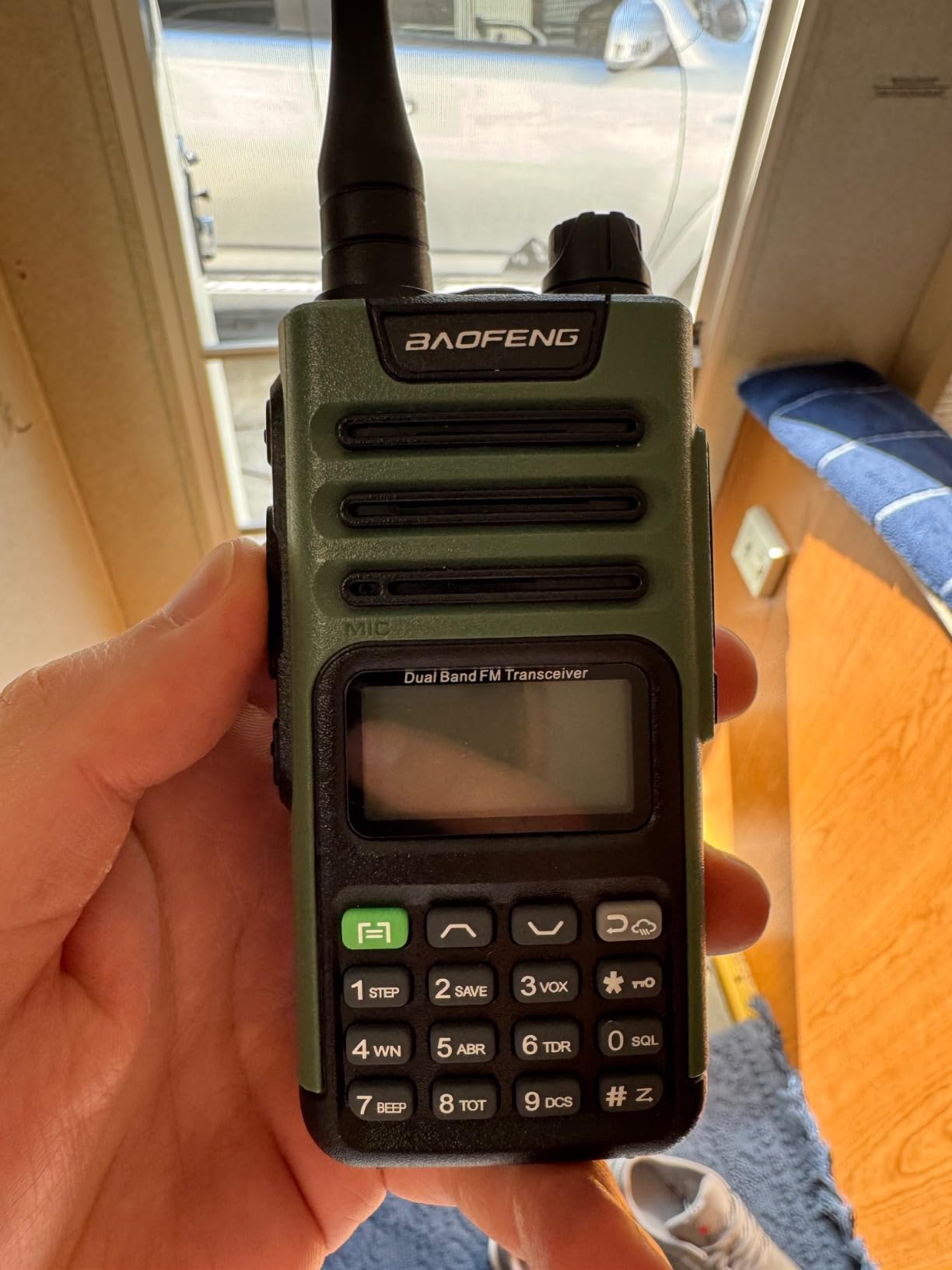
The GM-15 Pro is the pickup when a group needs repeater capability in a handheld without moving up a cost tier. Twenty four customizable repeater channels and 250 memory channels is a serious channel plan for a device most buyers treat as a spare. If your route crosses a valley with a club repeater on it, that is the difference between hearing the group ahead and not hearing it.
It also preloads 22 GMRS channels and 8 GMRS repeater channels, so a fresh pair is usable immediately. The 154 privacy codes split into 50 CTCSS and 104 DCS tones, which is enough filtering to keep your traffic from being swamped when a busy urban channel is nearby. The SOS alarm, flashlight and VOX hands-free cover the rest of a trail day checklist.
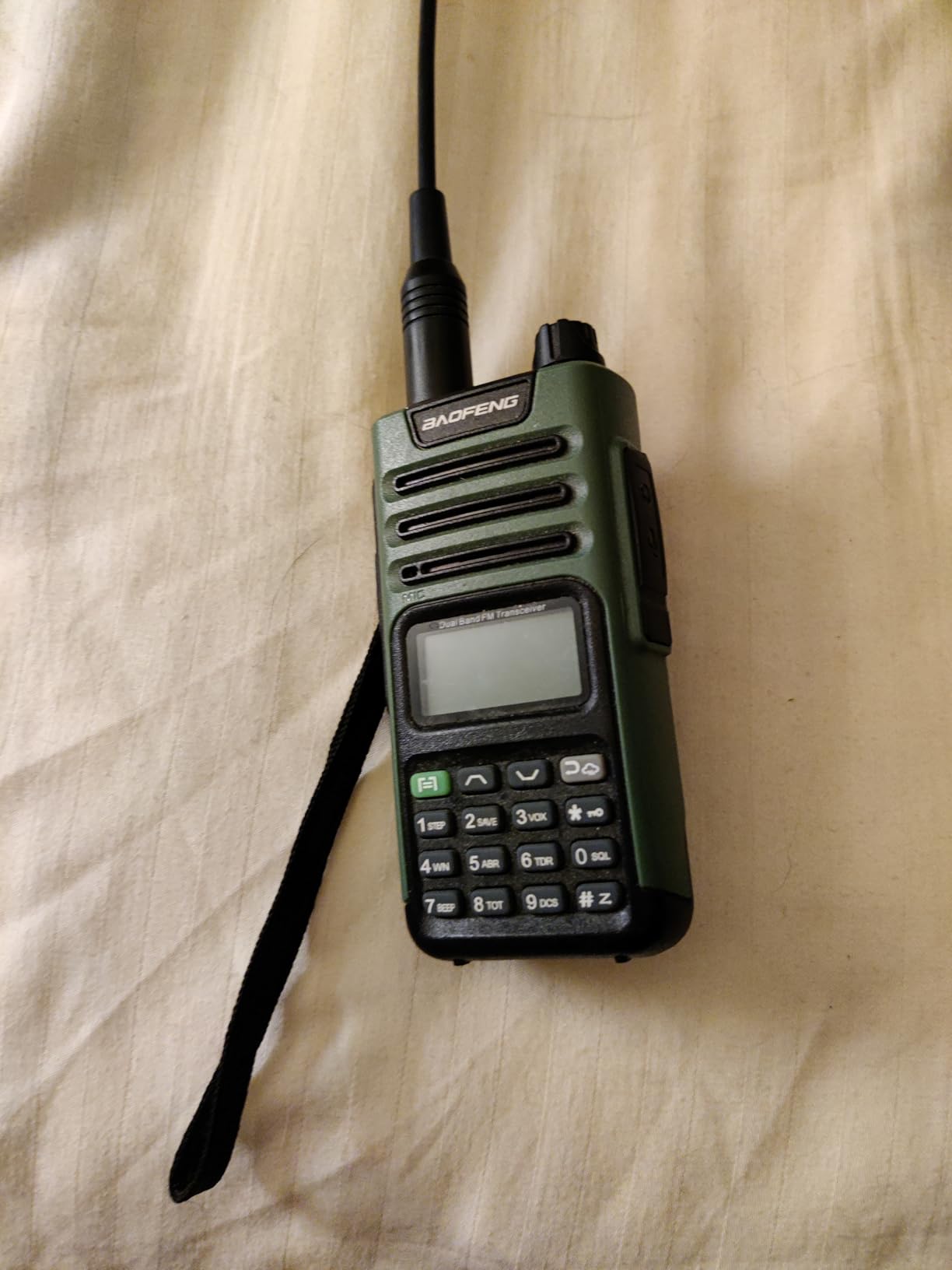
Reviewers treat this as a budget entry rather than a performance leader. The honest note from owners is that the advertised 4 to 5 mile open area range settles at roughly 2 to 3 miles in built up conditions. For a vehicle-to-vehicle role that is too short on its own, but as a spotter handheld or a camp radio it covers the ground a group actually needs.
One detail worth planning around: the warranty description lists none. That is a real difference when you are buying a radio that will live in a door pocket for a season. Buy it as a secondary unit rather than the radio your convoy depends on.
Repeater access from a handheld, explained plainly
A repeater is a fixed station that listens on one frequency and transmits on another. Your radio sends to the repeater and hears its repeat, which effectively turns a 3 mile handheld into a network covering a much larger area. Repeaters on GMRS are coordinated, so you do not need a callsign or manual offset coordination the way amateur repeaters do.
What the radio needs is the correct offset and tone for the repeater in your area, loaded into a channel. That is why a handheld with 24 customizable repeater channels and CTCSS and DCS tone selection is more useful than a fixed-channel unit with a privacy code knob. You look up the local repeater, program one channel, and the group talks normally from there.
Where this radio will disappoint you
There is no water resistance rating, so on a wet trail it needs a case. The 1500mAh batteries are smaller than the packs on other BAOFENG models, and buyers note the run time is correspondingly shorter on a day of heavy transmit. The shorter antenna also costs real range against the taller whip on the UV-5G Plus.
Scanning works in CH and VFO mode across UHF and VHF rather than being limited to GMRS, which is useful for listening to a trail event on another band. But a group that expects a handheld to match a 20 watt mobile across a canyon will not get there with this radio, and that expectation is better managed with a mobile plus handheld pairing.
7. Retevis RB48 – Best Waterproofing and Cold Ratings
Retevis RB48 Advanced Triple Proof Walkie Talkies with Shoulder Mic,2 Pack
IP67 waterproof
22 FRS channels
2000mAh 18 hour battery
MIL-STD-810H
5 year body warranty
Pros
- IP67 waterproof and dustproof with 2 meter drop protection
- Tested to MIL-STD-810H for drops vibration heat and cold
- Silicone button covers stay usable with gloves or wet hands
- 2000mAh battery delivering roughly 18 to 20 hours
- IP67 waterproof shoulder mics included
Cons
- FRS only so it will not interoperate with GMRS radios
- 22 channels is far fewer than programmable GMRS sets
- No vehicle power option so charging ties to USB or the cradle
IP67 means the radio is dust tight and survives immersion, and among the handhelds here only this one and the water resistant units above it hold that line. For a convoy that runs water crossings, gets rained on in the Rockies, or washes a rig after every desert weekend, the rating removes a whole category of worry that JIS4 and splash ratings do not.
The durability claim goes beyond water. The RB48 is tested to MIL-STD 810H, a military durability standard covering drops, vibration, heat and cold, and the manufacturer rates it for 2 meter drop protection having passed 1000 drops. The operating range of minus 20 to plus 60 degrees Celsius covers everything from a frozen trailhead to a desert midday.
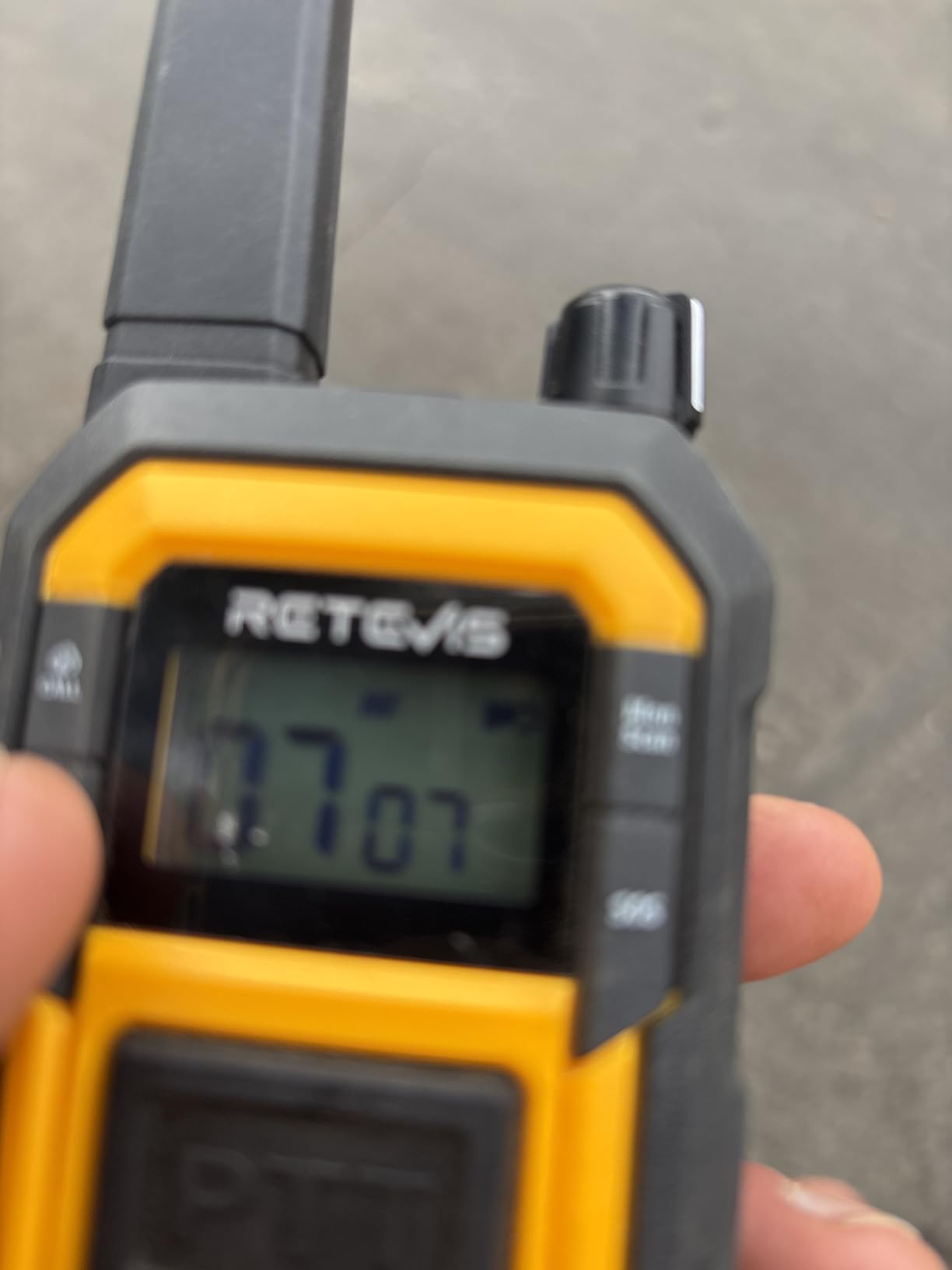
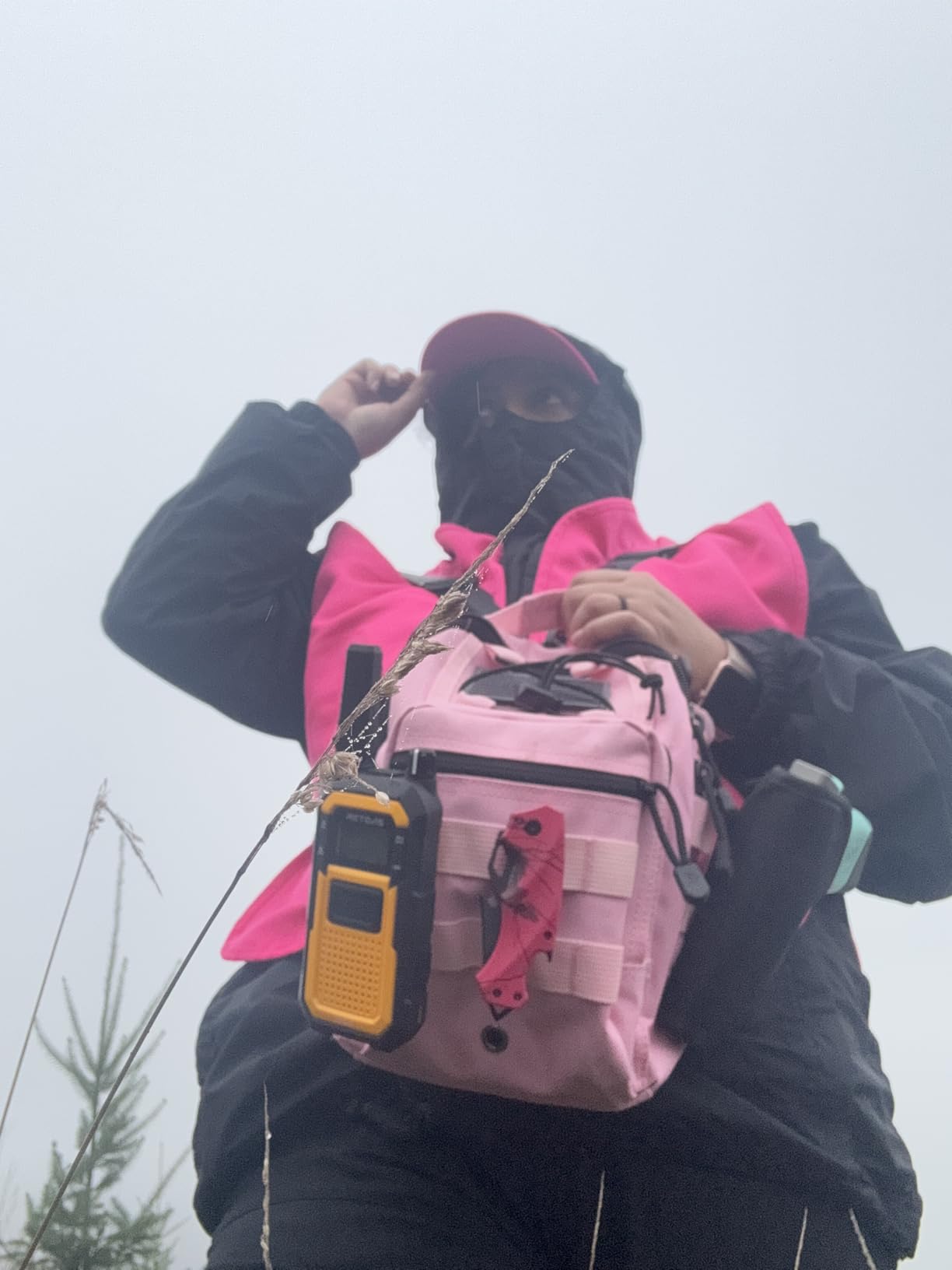
Two details make it genuinely useful in a vehicle context. The silicone button covers stay operable with gloves on or with wet hands, which matters when you are on a rock ledge and the last thing you need is a keypad you cannot press. The included IP67 waterproof shoulder mics let a driver clip a radio to a harness and talk without holding anything, and they are sealed to the same standard as the radio.
High visibility yellow housing is a small choice with real convoy value. When six vehicles are lined up in a parking lot at a trailhead, radios that are easy to spot are the ones that end up in the right hands. Buyers also note the five year warranty on the radio body as the longest coverage in this group.
Where the waterproofing changes the plan
With an IP67 radio in the group, you can change what your tail gunner does. Instead of a spotter who stays clear of the water because the radio cannot take it, the spotter can cross on foot with the radio and direct from the far bank. That is a meaningful gain on any crossing that decides whether a deep-water section is run or turned around.
It also removes the dry bag step. A radio that survives immersion does not need to be sealed in plastic before every ford, and crews stop losing time repacking a harness at every water crossing. The 2000mAh battery runs roughly 18 to 20 hours, which covers a full day of intermittent transmit with room to spare.
Why FRS is the tradeoff here
This is an FRS radio, and that is a real constraint in a GMRS convoy. It will not interoperate with GMRS-only equipment, will not reach a repeater, and at 22 channels it has far less room for group separation than a programmable GMRS handheld. Groups that need the option to move to a repeater or add a vehicle mobile later should look at the programmable models.
There is no vehicle power option either, so charging ties to USB or the desktop cradle rather than a 12V socket. In practice that is not a problem for handheld use, but it does mean these radios are pocket and pack devices rather than dashboard devices, and they should be treated that way in the convoy plan.
8. Retevis RT86 – Best Four-Pack for Big Crews
Retevis RT86 2 Way Radio Long Range with Mic for Warehouse,High Power,4Pack
4 pack
2600mAh batteries
16 hours continuous use
IP54
hidden shatterproof display
Pros
- Four pack covers a whole convoy on one order
- 2600mAh batteries give 130 hours standby and 16 plus hours of use
- Hidden shatterproof display survives drops
- ABS body with oversized orange PTT usable with gloves
- Free replacement of antennas clips and mic clips
Cons
- Only 16 channels with no GMRS programming options
- Fast charging and power delivery adapters are not supported
- IP54 is splash resistant rather than fully waterproof
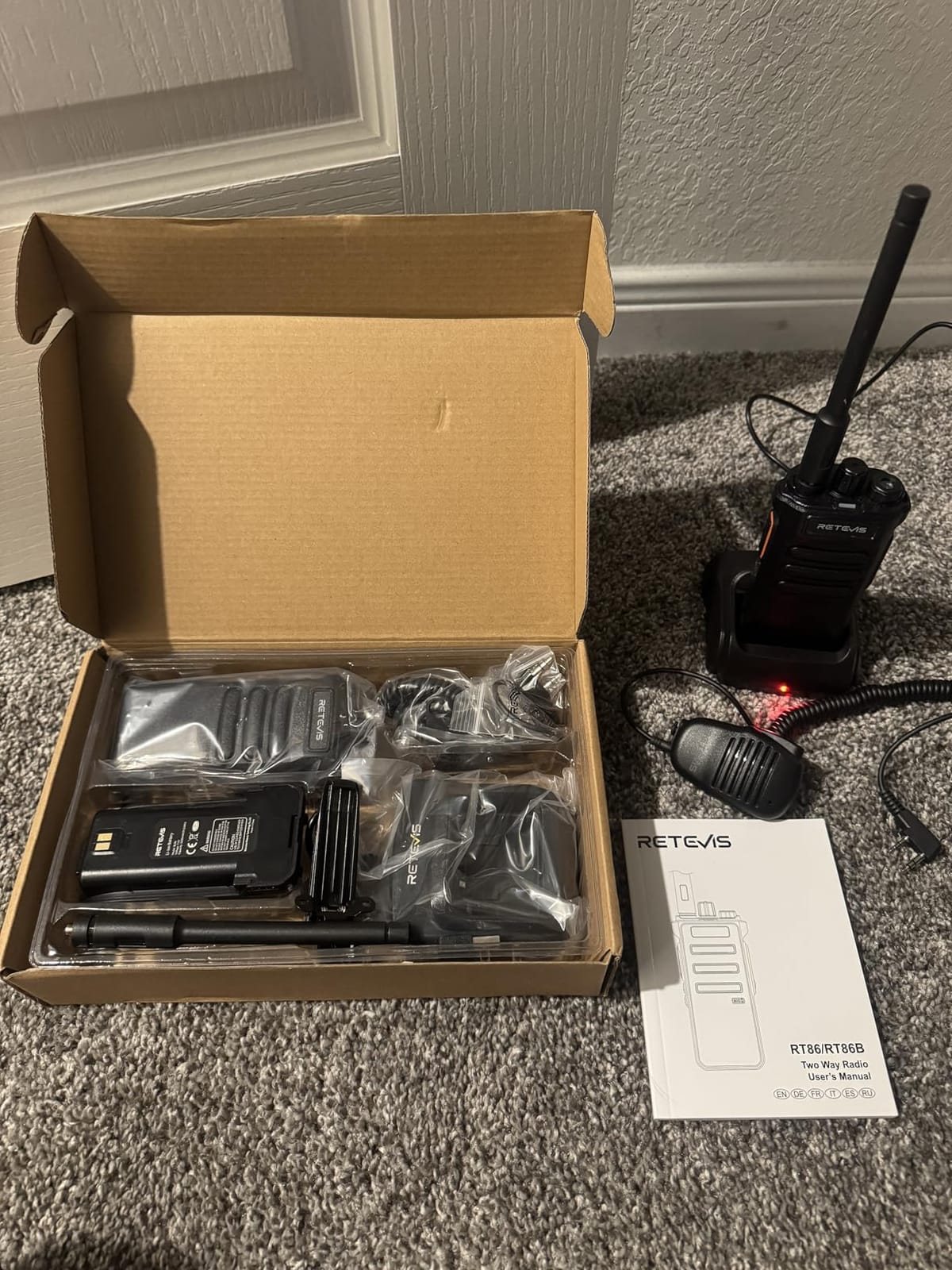
The RT86 answers a logistics question rather than a performance one. If your convoy runs ten or more vehicles, buying radios one at a time is a slow, error prone process with mismatched channel plans. A four pack means two vehicles plus a spare, or a full support team of spotters, ordered and matched on the same channel in a single step.
Battery endurance is the standout spec. The 2600mAh lithium batteries give 130 hours of standby and over 16 hours of continuous use, which means a radio can sit in a pack for a week-long trip without anyone thinking about a charger. Owners highlight the endurance along with the glove friendly oversized PTT button and the mic accessories as the deciding factors.
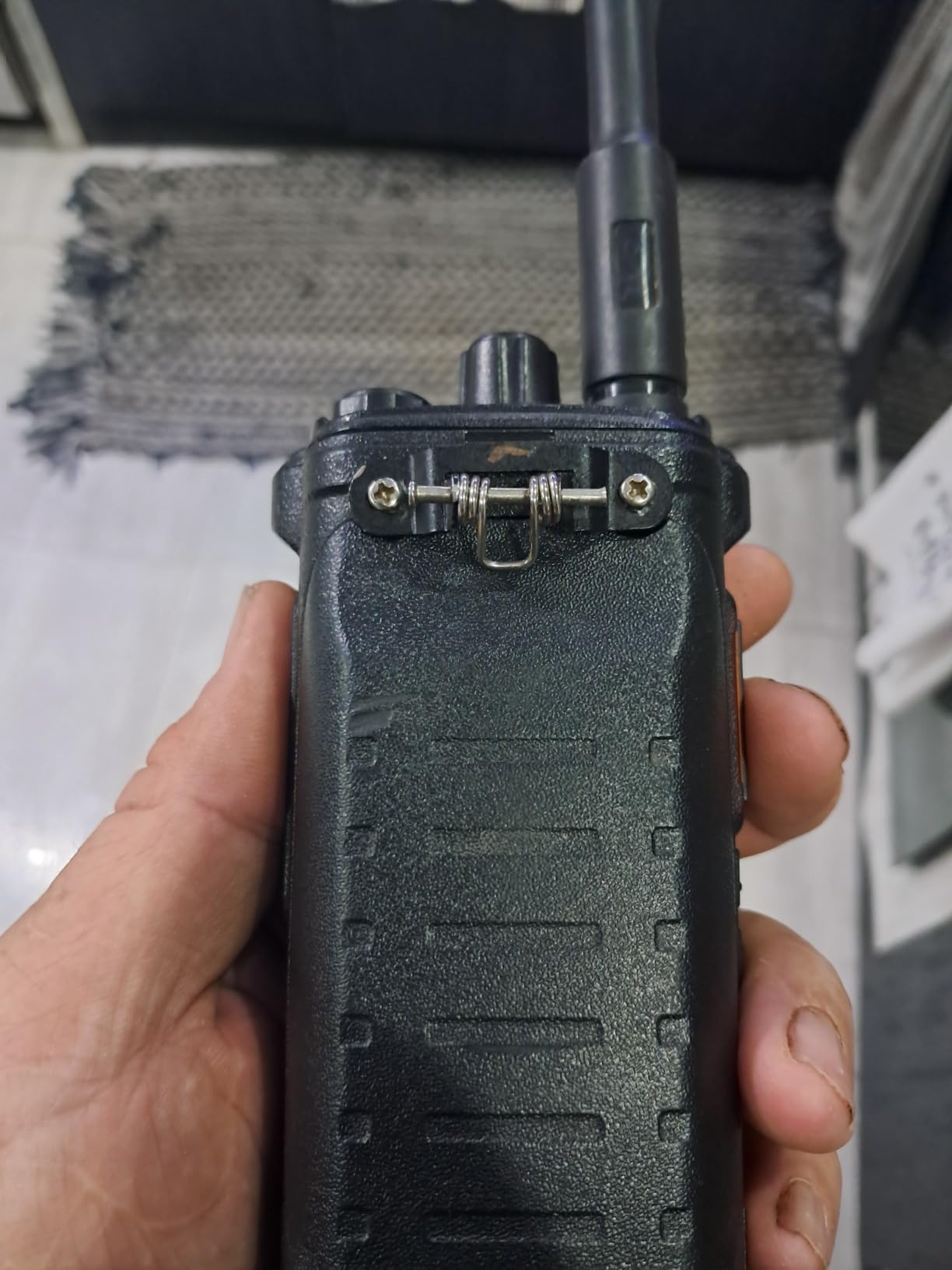
The hidden display is a clever piece of design. Sliding a cover over the screen protects it from the impact of being dropped on rock, and it clears the display when you press the control. For handheld radios that live on harnesses and belt clips, a screen that survives a dropped radio is worth more than a larger one that does not.
Support runs beyond the warranty. Owners report free replacement of antennas, belt clips and mic clips, which is a small thing until a clip snaps on the second day of a trip and the radio ends up in a pocket. The speaker mics clip with 360 degree rotation and have a 3.5mm headset jack for a fully hands-free setup.
Matching four radios across a large group
Pairing is where a large order either works or wastes money. The first radio is set to the convoy channel, and the others are paired from it using the built in pairing function, which copies channel and setting to each unit in turn. Doing that once on a workbench before the trip is faster than adjusting eight dials in a parking lot.
For a large crew, split the radios across roles rather than duplicating everyone. Two radios with the lead vehicle, two with the tail gunner, and the remainder with spotter pairs working the technical sections. The rotating mic clips make it practical to wear one on a harness and keep a spare on the dash.
Limits to plan around
Sixteen channels with no GMRS programming options is the main constraint. There is no way to add a repeater, set a custom tone or expand the channel plan, and that is restrictive for a group that wants its own system. The emergency alarm also needs CHIRP activation before it works, which is not obvious from the packaging.
Charging is slower than it should be because fast charging and power delivery adapters are not supported, so plan an evening of charging before departure rather than a lunch break. At IP54 the housing resists splashes but is not submersible, which puts it below the RB48 for a group that regularly fords water.
9. Midland MXT575 – High-Power 50W Mobile
Midland MXT575 50W MicroMobile GMRS Two-Way Radio
50W output
15 channels plus 8 repeaters
142 privacy codes
Backlit display
USB-C
Pros
- 50W of output power for maximum line of sight range
- Integrated control microphone simplifies dash installation
- 8 repeater channels plus 142 privacy codes
- Magnet mount with cable included for temporary mounting
- Backlit display with USB-C charging
Cons
- Not water resistant so it needs a protected cabin or roof location
- Only 15 primary channels restrict a growing group
- Sold as a single radio so each vehicle needs its own
The MXT575 is the top of the power range and it is the radio for convoys that regularly cross deep canyons, long empty washes and heavily wooded ridges where the direct path does not exist. Fifty watts from a fixed roof antenna is the strongest transmitter in this group, and for a trail that folds back on itself twice before a switchback, that is the difference between talking and guessing.
It shares the same integrated control microphone design as the smaller Midland mobile, so the install is one cable run from the mic to the head unit. The magnet mount with cable that comes in the box lets you set the radio up temporarily on a roof rack or a hood for a trip where a permanent install is not worth the drilling.
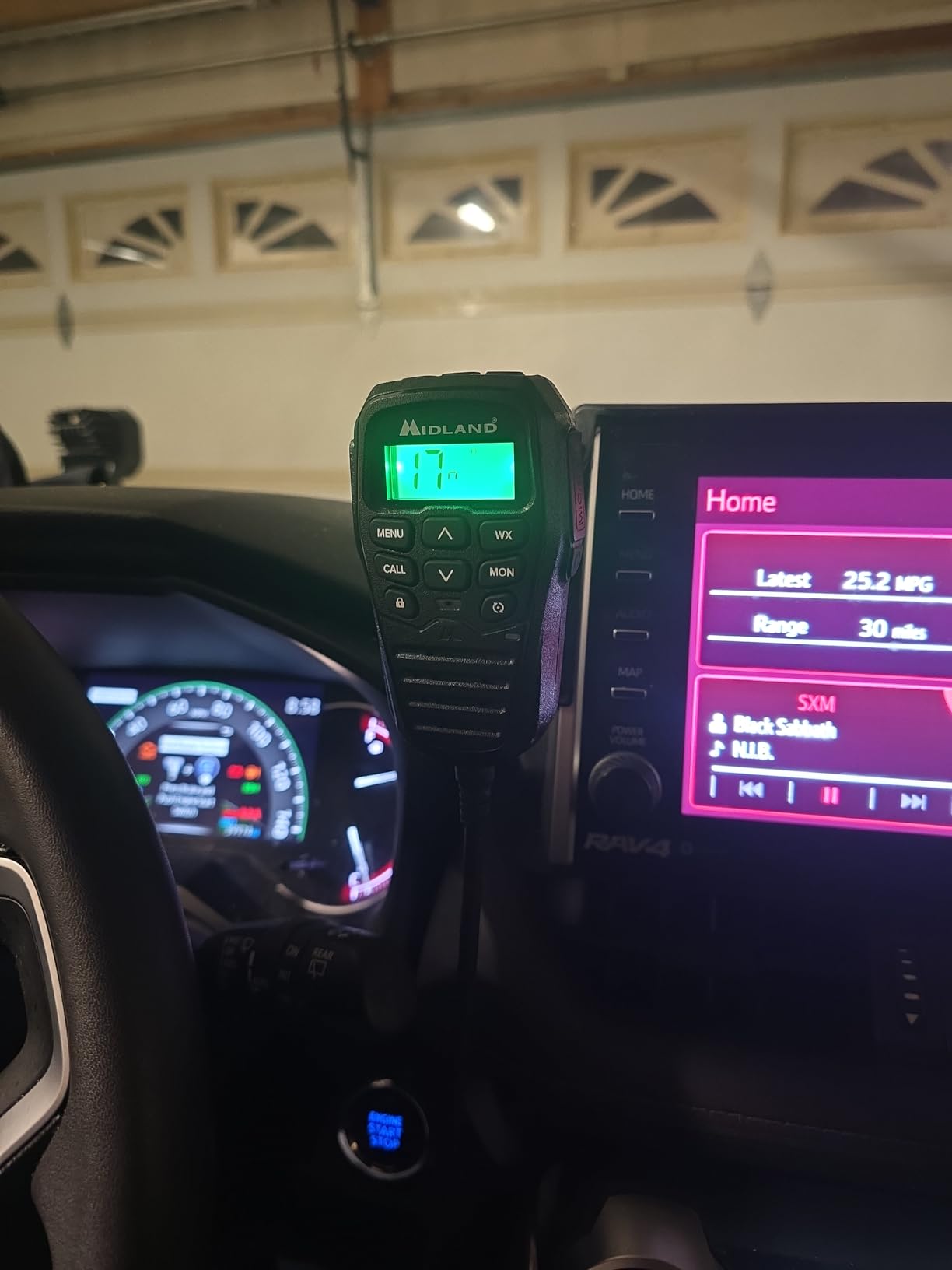
Buyer sentiment centers on raw power and clean installation rather than value. The backlit display matters more than it sounds because a dash mounted radio in a dark canyon needs to be readable at a glance, and the wide and narrow band selection lets you match other operators in the group if you are mixing equipment types.
Forum regulars recommend the MXT575 specifically for groups of three or more vehicles running long distances rather than local trail loops. The counterpoint from those same discussions is that the gain over a 20 watt radio is real but not dramatic on open ground, which is why the antenna choice matters more than the power step.
What 50 watts actually changes
Transmit power and received signal are linked by a simple rule. When one end of a conversation raises its power, both ends of the link perform better, which is why the lead vehicle with 50 watts can hand off to a handheld spotter more reliably than a convoy of 5 watt handhelds can hand off to each other.
Beyond that, the practical differences show up in three places. A 50 watt radio answers on a channel where a 20 watt radio is copying you but breaking up. It reaches through a bend in the canyon that would block a lower power signal entirely. And it keeps working as the battery voltage sags under transmit load, which the forum notes as a common complaint with lighter cigarette lighter powered setups.
Where it makes sense, and where it does not
Buy this radio if your routes are named for the terrain they cross and at least one leg of a typical day is a hard fold. Skip it if you run local loops within a few miles of a trailhead, because the difference between 20 and 50 watts on a two mile trail is something you will not notice while a much cheaper radio would serve you.
It carries no water resistance rating, so it belongs inside a protected cabin or a sealed vehicle-mounted enclosure. The 15 primary channel limit is the same constraint the smaller Midland mobile has. And with a 1 year warranty, treat the wiring as permanent and use an inline fuse on the 12V feed.
10. Radioddity DB40-G – Best Dual Display Mobile
Radioddity DB40-G GMRS Mobile Radio 40W, Dual Display, 199 Channels
40W output
199 channels
Dual display
Dual watch
13.8V DC
18 month warranty
Pros
- Verified output near 50W on high power channels in owner tests
- Dual display and dual watch for monitoring two channels at once
- 169 customizable channels with repeater support
- Owners report repeater contacts 40 to 90 miles away
- Streamlined GMRS menu with only 11 choices
Cons
- Channel 23 ships programmed with an incorrect factory frequency
- Display is faint and hard to read in daylight
- Programming software lacks instructions and is buggy on Windows 11
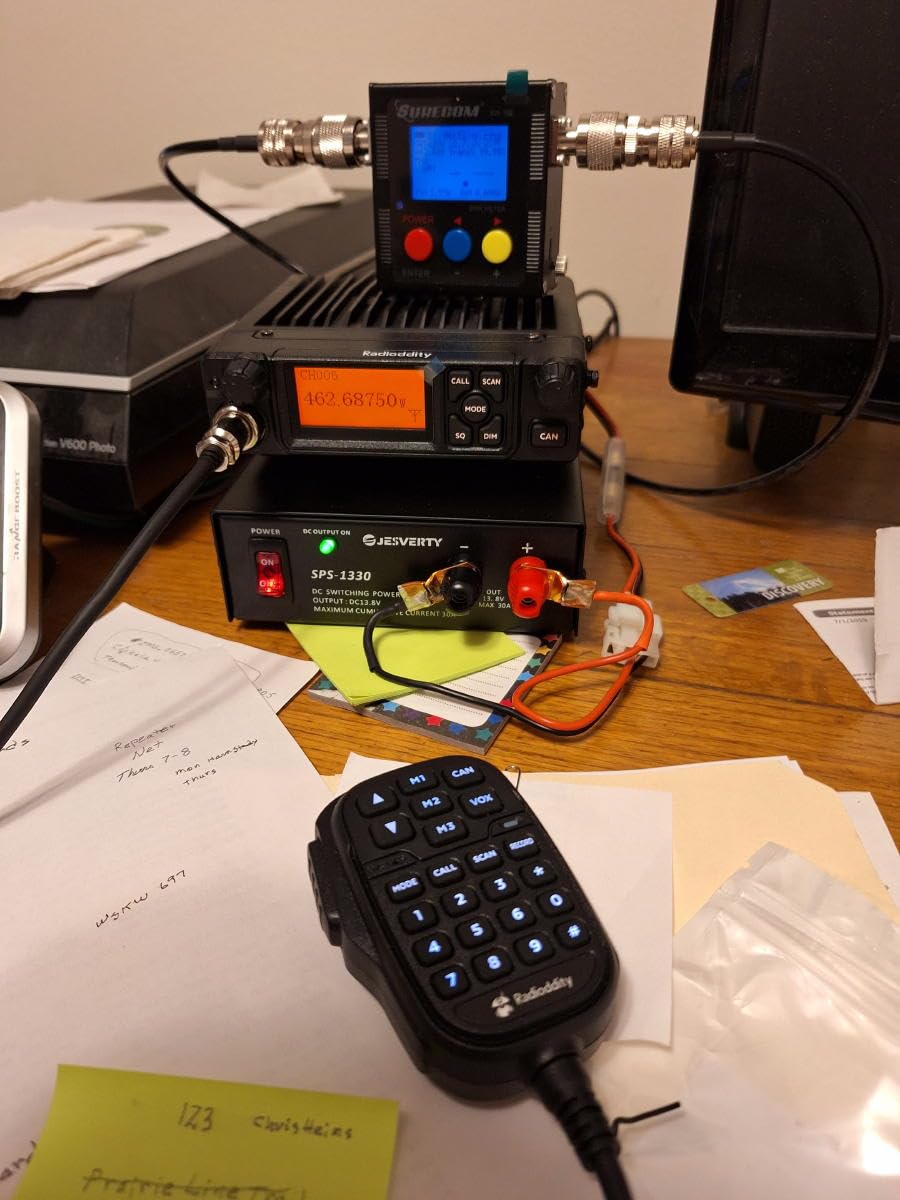
The DB40-G is the one in this group built around monitoring rather than talking. Dual display and dual watch let the radio watch a second channel while it sits on the convoy channel, which is the feature a tail gunner wants when a club repeater covers the next valley and the convoy channel covers the vehicles behind. You hear both without switching.
Owner tests put real output near 50 watts on the high power channels, and buyers report reaching repeaters 40 to 90 miles away. The 169 customizable channels out of 199 total give more room than the fixed Midland mobiles, and CHIRP support arrived in later firmware, which means the programming path that frustrated early buyers is now more workable.
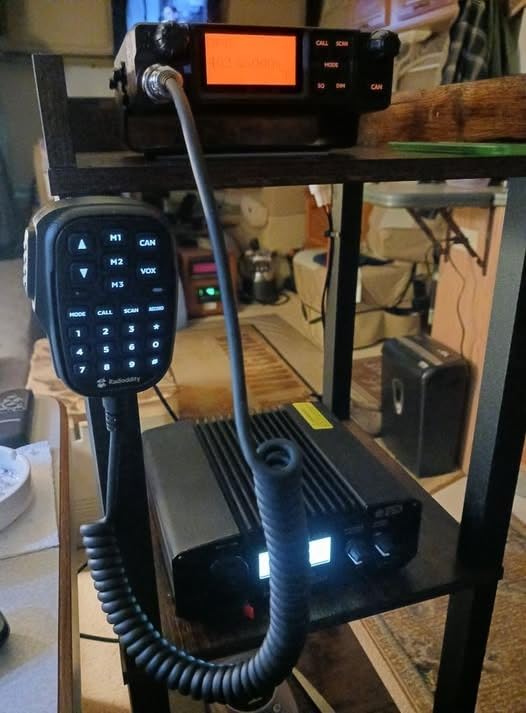
The menu is the quiet strength here. Eleven choices with a GMRS focus is easier to navigate than a general purpose handheld menu, and owners who program regularly call that a real advantage. The radio runs warm rather than hot through long transmissions, and the handheld microphone with a bracket and VOX makes it usable by a driver without a separate mic mount.
Sentiment is the most split in this group, with a 4.3 average across 182 reviews, 73 percent five star but an 11 percent one star share. Enthusiasts praise the power and the reach. Critics concentrate almost entirely on the display, the manual and the manufacturer’s programming software, so know which of those two groups you are before the install.
How to use dual watch without confusion
Dual watch works by briefly dropping off your primary channel to check the secondary one. On a quiet secondary channel the interruption is short. On a busy one, a convoy on channel one can miss traffic that matters, which is a genuine risk when a group is coordinating a difficult section.
The practical pattern is to put the secondary channel on something quiet and useful, like a club repeater or a weather channel, and keep the primary channel exclusive to the convoy. Turn the feature on for the leg of the trip where a repeater is in range and switch it off for the technical sections where nobody is listening off-channel.
Fix the setup problems before the trail
Channel 23 ships programmed with an incorrect factory frequency, which is worth correcting before you rely on it. The display is faint in daylight with poor contrast, and the main screen defaults to frequency with no option to change what it shows, so a sunshade over the dash or an angled mount makes a real difference on a bright day.
Unlike the smaller Radioddity mobile in this group, the DB40-G does not include a 12V cigarette lighter adapter, so plan a hardwired install with an inline fuse. The bundled programming software is also reported as buggy on Windows 11, which is another reason to set up the channels on a bench before the trip rather than at a trailhead.
How to Choose a Convoy Radio: 7 Factors That Decide Range
Range is the headline, but it is a result rather than a spec. These seven factors explain most of the difference between a convoy that stays together and one that splits up halfway through a canyon. Work through them in order and the wattage question answers itself.
1. Transmit power and where the legal limits sit
GMRS handhelds are limited to 5 watts on most channels, and vehicle mobiles may transmit at up to 50 watts. Between those two numbers sit the common convoy choices: a 15 watt micro-mobile for weekend trail runs, a 20 watt mobile for multi-day trips, and a 40 or 50 watt mobile for terrain that blocks the direct path.
Power only converts to distance when the signal has a path to travel. Doubling watts on a radio with a poor antenna and a bad ground plane buys very little, while a well-installed lower watt radio regularly out-reaches a higher watt one with a bad mount. Install first, then decide whether you need more power.
2. Antenna mounting position
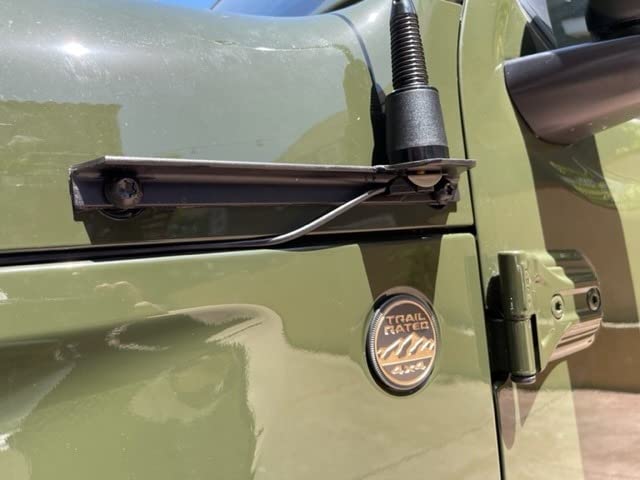
The antenna is the single highest impact item on this list, and forum consensus is consistent about the ranking. A fixed NMO mount through the roof, with a proper ground plane, is the best option. A roof rack or roll bar mount is next. A magnetic mount on painted steel works and fails on the same rough terrain that makes you buy a radio in the first place, which is the most common complaint we saw about them.
Height matters as much as the mount type. Every foot of additional height moves the antenna further from the roof and the body of the vehicle, which reduces the loss. On a Jeep with a hard top, a roof rack mount can be dramatically better than a stock location inside the cabin.
3. Ground plane and coax quality
A radio mounted inside a vehicle is half a dipole antenna with the other half suppressed. The ground plane is what restores it, and a roof or bed mount has a large metal surface underneath to serve that role. A body mount or a location surrounded by glass and plastic does not, which is a physical limit that no amount of transmit power removes.
Coax is the second half of that equation. RG58 is fine for short runs inside a cabin, while RG8X is the better choice for a longer cable run to a roof-mounted antenna. A loose or corroded PL-259 connector is a common cause of the “my range collapsed after the roof rack install” complaint, and it is fixable in minutes.
4. Channel programmability and repeater access
A fixed-channel mobile is simpler to set up, but a programmable one gives your group control over its own system. Look for the number of customizable channels, whether GMRS repeater channels are supported, and whether CHIRP is an option for loading a codeplug. Groups that cross repeater coverage on a route benefit far more from programmability than groups that stay on one channel.
Privacy codes are the other half. CTCSS and DCS tones filter out other users on the same frequency, which matters more on crowded urban channels than it does on a remote trail. Every radio here offers them; the difference is how many and how easily they are set.
5. Water rating and the environment you actually drive
Match the rating to the trail rather than to the specification. IP67 means dust tight and submersible, IP56 handles splashes and snow, JIS4 is a modest rain and spray rating, IP54 resists splashes, and IP44 offers the least protection. A group that fords water regularly should weight IP67 heavily; a group on desert roads can accept a lower rating in a cabin mount.
Handheld radios get dropped, soaked and forgotten. Mobile radios live inside a vehicle and mostly face heat and dust. Keeping those two jobs separate when you read the ratings is the difference between a spec that means something and a number on a listing.
6. Power source and wiring
Cigarette lighter power is the path of least resistance and the most common source of complaints. Forum threads repeatedly report voltage drop on transmit and unstable operation from a socket that is not rated for the current draw. A 5 watt handheld on a plug is usually fine; a 20 to 50 watt mobile deserves a hardwired feed.
For a permanent install, run the 12V feed with an inline fuse close to the battery, use a relay triggered by the ignition switch so the radio is not draining the battery when parked, and size the wire gauge to the length and current. Ground the head unit to a clean bare metal point rather than to a painted bracket.
7. Battery life and cold weather behaviour
Battery life is a handheld decision, and it is measured in how a radio behaves on the fourth day of a trip rather than on the first. Lithium ion packs outperform nickel metal hydride in cold conditions, and a radio that will not hold a charge at a frozen trailhead is a radio that stops working on the day you need it.
Check the standby figure as well as the transmit figure, because a radio that is left on and monitoring between sections draws power even when nobody is talking. Replaceable batteries are a further advantage for multi-day trips, and dual power designs that fall back to AA cells are worth having as a failure mode.
Before the purchase, it helps to skim our ATV and UTV speaker guide for the electrical side of a rig build, since the radio install usually happens alongside other accessory wiring on the same weekend.
Convoy Protocol, Antenna Placement and Power Wiring
Hardware is half the system. The other half is the role each vehicle plays, the channel discipline the group agrees on before the first wheel turns, and an install that does not let a voltage drop kill your comms at the worst possible moment. No competitor guide we analyzed covers this in depth, and it is where most convoy communication problems actually originate.
Assign lead, nav, mid and tail roles before the trip
Four roles cover almost any convoy size. The lead vehicle sets pace and calls hazards ahead. The navigator vehicle handles route decisions and communicates trail conditions back to the group. The mid vehicles act as relays between front and rear, since the middle of a string is usually the point where terrain blocks a direct path. The tail gunner watches for a dropped vehicle and keeps the group informed of spacing.
Assign these roles by driver, not by vehicle, and write the assignment on paper in every vehicle before departure. A convoy that knows who is tail gunner can react to a radio call without a discussion about who is supposed to handle it.
Use a primary channel, a spare and a separate spotter layer
Three channels cover most situations. The primary channel carries vehicle to vehicle traffic and should stay clear of anything else. The spare channel is the backup when the primary is congested or when a second group is using your channel. The spotter layer is where foot teams work, so that a spotter calling a line does not tie up the channel the lead vehicle is using.
Repeater use belongs on the spotter layer or the spare rather than the primary. A repeater extends coverage, but it also means your traffic is passing through a third party station, so a group that cares about keeping its route plans off the air should not discuss sensitive navigation on it.
The 3-3-3 rule for radio discipline
The 3-3-3 rule is a habit, not a regulation. Wait three seconds after pressing the PTT before you speak, so the first syllable is not clipped. Wait three seconds after someone finishes before you respond, so transmissions do not overlap. And treat the third three as the exception: a genuine emergency overrides all three, which is why the group agrees in advance on what counts as one.
Using full channel names rather than first names cuts confusion on a convoy that mixes drivers and passengers. Calling the vehicle by position and colour, such as tail truck, means everyone knows who you mean without needing to know whose name is on which registration.
Manage interference when five or more radios are close together
When several vehicles transmit within a few hundred metres of each other, a sensitive receiver can overload and the effect sounds like the whole channel has gone quiet. The fixes are physical rather than electronic. Mount antennas as far apart as you reasonably can, avoid clustering every radio in the same vehicle, and keep the antennas as high and as clear of body panels as the vehicle allows.
Group discipline helps too. A single radio talking rather than five people keying at once removes most of the interference in practice, and it makes the channel easier for everyone listening. Assign one person per vehicle as the only voice on the primary channel, and let the others use the spotter layer.
Wire the mobile like a permanent accessory
Start at the battery with an inline fuse sized to the radio draw, and keep the fuse within reach of the battery rather than at the radio. Run the power wire in loom or conduit away from the exhaust manifold and any factory wiring that carries high current. Use a relay on an ignition switched trigger so the radio powers down when the vehicle is parked, and confirm the radio is not drawing power with the ignition off before you call the install finished.
Route the antenna coax away from factory wiring and away from the vehicle’s high current accessories, and terminate the connector properly rather than twisting it. Test the system with a handheld before the first trip, then check SWR with a meter or at minimum listen for a clear duplex on a known radio pair, since a bad coax run is the most common cause of a disappointing range test.
Pair mobile and handheld roles so a failure is not a convoy failure
The most reliable convoy setups we have seen run a mobile in every vehicle on the primary channel and a handheld in every vehicle on the spotter layer. If a mobile fails, the driver switches to the handheld in the cab and the group continues on the secondary channel with reduced reach. If a handheld fails, nothing stops because the mobile is still working.
For a mixed group, add license free FRS handhelds as a third layer. FRS radios in the 2 watt range can talk to a GMRS mobile on the shared FRS channels, which gives unlicensed drivers a working backup path without touching the convoy’s primary channel or the household license.
Frequently Asked Questions
What is the best two-way radio for off-roading?
For convoy use the best two way radio for off-roading is a fixed GMRS mobile in each vehicle, paired with a handheld for spotter positions. A 15 watt micro-mobile with a roof or rack NMO antenna covers most trail runs, while 40 or 50 watts is worth it when the route crosses canyons or wooded ridges that block the direct path. Handhelds handle foot teams and provide a backup layer, but a 5 watt handheld on a belt clip will not match a roof-mounted mobile in a vehicle-to-vehicle role.
What is the 3-3-3 rule for radios?
The 3-3-3 rule is a habit for keeping a channel clear rather than a regulation. Wait three seconds after pressing the transmit button before speaking so the first syllable is not clipped. Wait three seconds after someone finishes before responding so transmissions do not overlap. The third three is the emergency exception, where a genuine safety call overrides both pauses, which is why a convoy agrees in advance on what counts as an emergency.
What is the best walkie talkie for a car convoy?
The best walkie talkie for a car convoy is a fixed-mount GMRS mobile rather than a handheld, because the antenna height and ground plane available on a vehicle are what produce usable range. A 15 or 20 watt mobile with an external antenna mount is the practical starting point, and a handheld belongs in the vehicle as a spotter and backup radio rather than as the primary vehicle-to-vehicle link. Handhelds remain essential for anyone on foot.
What are the best walkie-talkies for off-roading?
For off-roading, the best handhelds are the ones that match the environment. A waterproof IP67 unit with a rated cold operating range is the right choice for groups that ford water and run in freezing conditions. A programmable GMRS handheld with repeater support is better for groups that need a custom channel plan or repeater access. For multi-day trips where charging is not an option, a handheld with multi-day battery life and replaceable lithium ion packs is the priority.
Do I need a license to use a GMRS radio off-road?
Yes. A GMRS license is required for transmit operation on the GMRS-only channels, including on a 5 watt handheld, and it covers the entire household at one address for ten years. FRS radios on the shared channels below 462.55 MHz are license free but limited to 2 watts, so a license free handheld can talk to a GMRS mobile on the FRS channels but cannot use GMRS-only channels or reach a repeater.
Can GMRS radios talk to FRS walkie talkies?
A GMRS radio can talk to an FRS handheld on the shared FRS channels, which are the first 16 channels of the GMRS band, because a GMRS mobile may operate on those frequencies. An FRS radio cannot transmit on the GMRS-only channels 17 to 22 or any repeater channel, so the compatibility is one way. In a convoy, that makes an FRS handheld a workable backup for unlicensed drivers rather than a replacement for the vehicle radios.
Conclusion
For most off road convoys, the best two way radios for off road convoys come down to a mobile in every vehicle and a handheld for every person on foot. The Midland MXT275 is the pick for most groups at 15 watts with an integrated microphone and a 4.6 average from 1823 reviews. The Radioddity DB20-G doubles the power for a step up, and the Midland MXT575 covers the terrain where the direct path does not exist.
On the handheld side, the BAOFENG UV-5G Plus serves spotter positions that need reach and programmability, the Retevis RB48 handles water crossings with its IP67 rating, and the Rocky Talkie Mountain Radio covers multi-day trips where charging is not an option. Whatever you choose, sort the license, the antenna position, the power wiring and the channel plan before the first wheel turns. Those four decisions matter more than the wattage on the box, and they are what keeps a convoy together for 2026.